Most restaurant operators in India believe they know how to read a P&L. They are wrong. I have sat across the table from owners running Rs 30 lakh a month in revenue who could not tell me their actual food cost percentage without pulling out a phone calculator. A restaurant P&L is not a tax document your CA sends you once a quarter. It is the single most important operational tool in your business. And yet, across Ahmedabad, Bengaluru, Pune, and Surat, operators cling to myths about their P&L that silently drain lakhs from their margins every year.
These myths are not random. They come from somewhere real. A previous employer taught you the wrong format. Your accountant simplified things so you would stop asking questions. A YouTube video told you revenue minus food cost equals profit. Every myth below costs you actual rupees. And the fix for each one takes less than a week.
Why Do Restaurant P&L Myths Cost Real Money?
A misread restaurant P&L causes operators to make pricing, staffing, and expansion decisions based on numbers that do not reflect reality. The cost is not theoretical. It shows up as a cash crunch in week three of the month, an inability to pay suppliers on time, and a vague feeling that the restaurant is busy but never profitable.
The NRAI India Food Services Report 2024 values the industry at Rs 5.69 lakh crore. Yet most operators I work with run net margins between 5% and 8%. That is the struggling zone. The difference between 8% and 15% net margin often comes down to how accurately you read and act on your P&L. Not how many covers you do.
Because here is what happens in practice. An operator in Surat sees Rs 25 lakh in monthly revenue. Feels good. Pays rent, pays staff, pays the aggregator. End of month, there is Rs 40,000 left. That is 1.6% net margin. On paper, the restaurant is “profitable.” In reality, one slow week or one equipment breakdown pushes it into the red. The P&L told the truth. The operator just did not know how to read it.
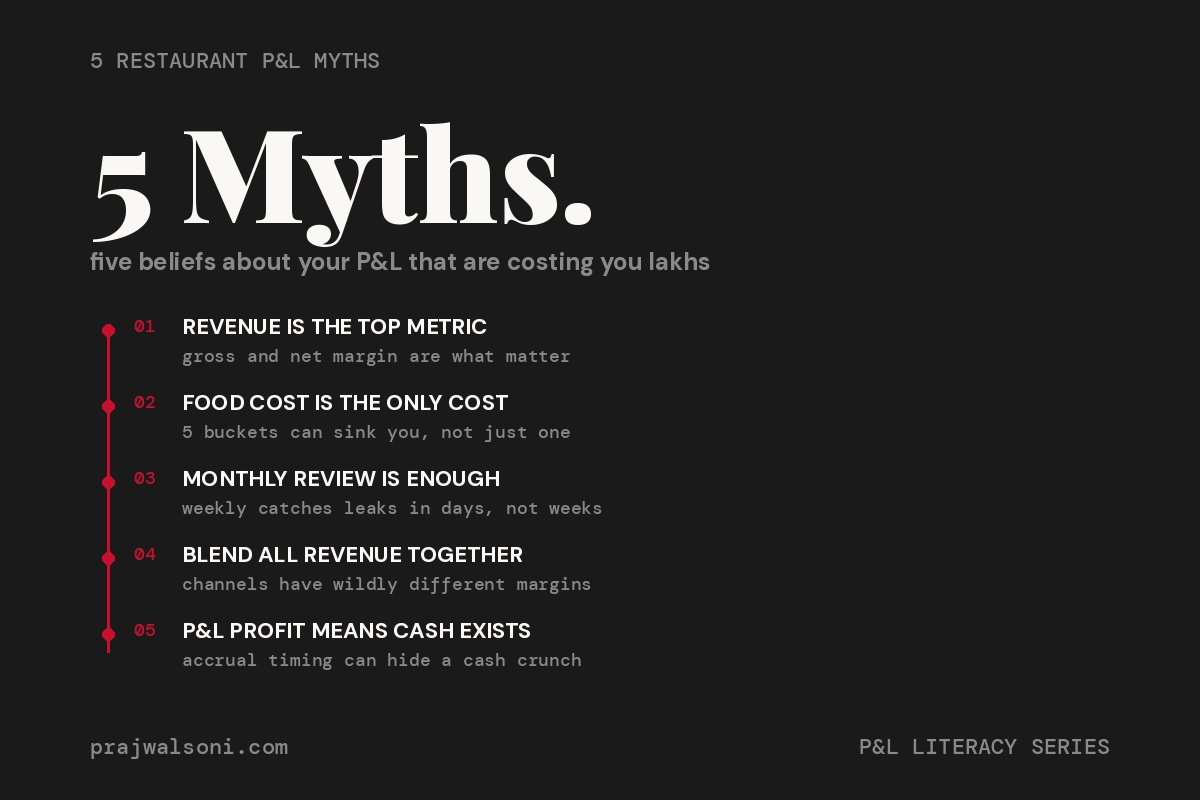
Myth 1: Revenue Is the Number That Matters Most on Your P&L
Revenue is the number that matters least in isolation. Gross profit after food cost and net profit margin are what determine whether your restaurant survives next quarter. Revenue without context is vanity.
The myth as believed: “We did Rs 18 lakh this month, so we are doing well.”
The bust: Rs 18 lakh means nothing if your food cost was 42%, rent was 14%, and aggregator commissions ate another 22%. A restaurant doing Rs 12 lakh with 30% food cost and 10% rent is healthier.
I have seen this with clients across multiple cities. Operators chase topline growth by adding delivery platforms, running discounts, and extending hours. Revenue goes up. So does food cost, packaging cost, and labor cost. Net margin stays flat or drops. Your P&L must be built so that every line item is a percentage of revenue, not just an absolute number. When your biryani does Rs 6 lakh in sales but costs Rs 2.8 lakh in ingredients alone, that is a 46% food cost on your highest-selling item. The revenue line looked great. The contribution margin was terrible.
Myth 2: Food Cost Is the Only Cost You Need to Track Closely
Food cost is important, but it is only one of five critical cost lines. Labor, rent, aggregator commissions, and packaging together often exceed food cost. Operators who obsess over ingredient prices while ignoring staff costs and platform fees are watching the wrong number.
The myth as believed: “If I keep food cost under 35%, my restaurant will be profitable.”
The bust: A 32% food cost means nothing when labor runs 28%, rent runs 15%, and Swiggy or Zomato commissions add 20-25% on delivery orders. Your P&L has at least five major cost buckets, and any one of them can sink you.
Here is a typical breakdown for a restaurant doing Rs 20 lakh monthly in a city like Pune or Ahmedabad. Food cost: 33% (Rs 6.6 lakh). Labor: 22% (Rs 4.4 lakh). Rent: 12% (Rs 2.4 lakh). Aggregator commissions on 40% delivery mix: roughly Rs 1.8 lakh. Packaging, utilities, maintenance: Rs 1.2 lakh. GST compliance costs: variable. Marketing: Rs 60,000. That leaves Rs 2.6 lakh before owner salary and loan EMI. If you only tracked food cost, you would miss where Rs 10+ lakh disappears every single month.
Your restaurant P&L must break costs into at least these categories: Cost of Goods Sold, Labor (including PF and ESI where applicable), Occupancy, Technology and Platform Fees, Marketing, and Administrative Overheads. If your P&L lumps everything into three lines, it is hiding more than it reveals.
Myth 3: A Monthly P&L Is Enough to Run the Business
A monthly P&L tells you what happened 30 days ago. It cannot help you fix problems in real time. Operators need weekly P&L reviews, and ideally, daily tracking of three numbers: revenue, food cost, and labor cost. Monthly is an autopsy. Weekly is a diagnosis.
The myth as believed: “I review my P&L at month-end. That is sufficient.”
The bust: By the time you see that food cost hit 39% at month-end, you have already lost Rs 80,000 to Rs 1.2 lakh compared to your 33% target. Four weeks of bleeding with zero course correction.
In restaurants I have consulted for, the shift from monthly to weekly P&L review typically surfaces problems within 7 days instead of 30. A dal makhani batch recipe that was over-portioning cream. A staff overtime pattern on Thursdays that nobody noticed. A packaging supplier who quietly increased rates by Rs 0.80 per container. These are small leaks. But small leaks over 30 days become large floods.
Build your P&L so it can be updated weekly. Your POS system, whether Petpooja, Posist, or UrbanPiper, already captures daily sales data. Pair it with a simple spreadsheet tracking daily purchases and staff hours. You do not need enterprise software. You need discipline and a format that makes weekly review possible.
Myth 4: Aggregator Revenue Should Be Mixed Into Total Revenue Without Separation
Aggregator revenue and dine-in revenue have completely different margin structures. Mixing them into one topline number makes your P&L lie about profitability. Every restaurant P&L should separate revenue channels because the cost to serve each channel is wildly different.
The myth as believed: “Revenue is revenue. Whether it comes from Swiggy, Zomato, or walk-ins, it all goes to the same kitchen.”
The bust: A Rs 400 biryani order from Zomato nets you Rs 280-320 after commission, GST on commission, and packaging. The same Rs 400 biryani eaten in your restaurant nets you Rs 380 after GST. That is a 15-25% difference in realization per order.
When you blend these channels, your average realization per order looks acceptable. But if your delivery mix crosses 50%, your actual margin is significantly lower than your blended P&L suggests. I have worked with cloud kitchens where the owner thought the business was profitable because the blended food cost was 34%. Once we split by channel, dine-in food cost was 30% and delivery food cost was 41%. The delivery channel was underwater. The dine-in channel was subsidizing it.
Your P&L format needs at minimum two revenue columns: Dine-in/Takeaway and Delivery. Against each, allocate the specific costs. Commission goes only against delivery. Packaging goes only against delivery. Table linen and crockery go only against dine-in. This split tells you which channel actually makes money and which one you are running at a loss for volume.
Myth 5: If the P&L Shows Profit, the Business Has Cash
Profit on the P&L and cash in the bank are two different things. A restaurant can show Rs 2 lakh profit on the P&L and still not have enough cash to pay next week’s supplier bills. This gap between accounting profit and actual cash flow kills more restaurants than losses do.
The myth as believed: “My CA says we made Rs 1.8 lakh profit this month, so we are fine.”
The bust: Swiggy and Zomato settle payments weekly with a 7-day lag. Suppliers demand payment on delivery or within 15 days. GST is due by the 20th. If your cash inflow timing does not match your cash outflow timing, a profitable P&L means nothing when there is no money in the account on the 14th.
The P&L records revenue when it is earned, not when cash arrives. It records expenses when incurred, not when paid. This accrual basis makes accounting sense but operational nonsense for a restaurant owner who needs to pay Rs 3 lakh to the vegetable vendor by Friday. A standalone P&L without a simple cash flow tracker is like a speedometer without a fuel gauge. You know how fast you are going but not how far you can go.
Build a weekly cash flow sheet alongside your P&L. Track: opening cash balance, expected inflows (by platform and channel with actual settlement dates), and committed outflows (rent, salaries, supplier payments, EMIs, GST). This takes 20 minutes per week. It prevents the crisis call to the bank that takes 20 days to resolve.
How Should You Actually Build Your Restaurant P&L?
A properly built restaurant P&L has 8 to 10 clearly defined line items, separates revenue by channel, expresses every cost as a percentage of revenue, and is reviewed weekly. Here is the format that works for most restaurants doing Rs 10-50 lakh monthly.
1. Revenue: Split into Dine-in, Delivery (Swiggy), Delivery (Zomato), Direct Orders, and Catering if applicable.
2. Cost of Goods Sold (COGS): Raw materials, packaging, and any direct procurement costs. Target: 28-35% of revenue depending on format.
3. Gross Profit: Revenue minus COGS. This is your first checkpoint. If gross profit is below 62%, your menu pricing or food cost is broken.
4. Labor Cost: Salaries, overtime, PF, ESI, contract staff. Target: 18-28% depending on whether you are QSR or fine dining.
5. Occupancy Cost: Rent, CAM charges, property tax. Target: 8-15% of revenue. If you are above 15%, your location is too expensive for your volume.
6. Platform and Technology Costs: Aggregator commissions, POS subscription, middleware fees. Track the 18% GST on aggregator commissions separately.
7. Marketing: Paid ads, Instagram promotions, influencer fees, loyalty program costs.
8. Utilities and Maintenance: Electricity, gas, water, equipment repairs, pest control, AMC costs.
9. Administrative Overheads: CA fees, legal, insurance, licenses, GST compliance, miscellaneous.
10. Net Profit Before Tax: What remains after all the above. If this number is below 10% of revenue, you have a structural problem somewhere in the lines above.
What Is the Most Common Restaurant P&L Mistake to Avoid?
The most common mistake is not tracking owner salary as a line item. Many operators in cities like Nagpur, Surat, and Hyderabad take money from the business informally throughout the month. This means the P&L shows a profit that does not actually exist because the owner already withdrew it. Add a fixed owner compensation line. If the business cannot afford to pay you Rs 50,000-Rs 1 lakh per month after all costs, it is not actually profitable. It is just funding your lifestyle through its working capital.
What Should You Do This Week?
Pull your last three months of financial data. Rebuild your P&L using the 10-line format above. Separate dine-in from delivery revenue. Express every cost as a percentage. Sit with those numbers for 30 minutes. You will find at least two line items that are higher than you assumed.
Then start weekly reviews. Every Monday morning, before you check Swiggy ratings or Instagram likes, update your P&L. That single habit separates restaurants that survive past year one from those that close wondering what went wrong.
Stop guessing. Start building. Get Design Dine Dominate, the complete restaurant business playbook from someone who has actually done it.

Leave a comment