Picture this: you are running a restaurant in Ahmedabad when a client calls for 250 plates at a wedding sangeet. You take your thali price, knock off 10% for volume, and say yes. Three weeks later, the event is done, the photos look great, and your account shows almost nothing. That gap is a catering pricing problem, and it starts the moment you quote.
Events look like easy money. One order, one date, one payment, and no aggregator taking a cut. However, catering runs on costs your dine-in P&L never shows you. Most operators still price it with dine-in logic, and that is exactly where the money leaks.
Why Do Catering Pricing Myths Cost Restaurants So Much?
Catering pricing myths cost restaurants money because operators copy dine-in prices onto events that carry extra costs. Transport, rentals, event staff, wastage buffers, and lost restaurant sales never appear on the menu card. As a result, a 300-plate order can earn less than a slow Tuesday at the outlet. That happens even when the client pays on time.
These myths did not appear out of nowhere. Most of them made sense when an outlet did two events a year for loyal regulars. NRAI’s India Food Services Report 2024 puts the industry at Rs 5.69 lakh crore, and catering sits inside that number. Once events turn into a regular revenue line, the old shortcuts start costing real money.
In restaurants I have consulted for, the owner usually prices catering on a phone call in about two minutes. Below are the five myths behind those two-minute quotes. Each one came from somewhere real, and each one is quietly expensive.
Myth 1: Your Catering Pricing Can Start From Your Menu Prices
Menu prices cannot anchor catering, because they only cover a plate served inside your own outlet. An event plate travels, needs extra hands, sits in rented equipment, and carries a wastage buffer. Your menu price was never built to absorb any of that.
Run the math on a 250-plate order. A tempo both ways, eight extra servers, chafing dishes, disposables, and gas cylinders add up fast. In my experience, these lines add roughly Rs 5 to Rs 10 per plate. Exact figures vary by city and venue distance, but the direction never changes.
Your menu price does carry rent and electricity that an off-site plate barely touches. Operators point to this and assume it balances out. It rarely does, because rent runs 8-15% of revenue while event costs on a mid-priced plate often run higher.
GST is the second leak. Many operators quote a round figure that quietly includes tax. That habit hands close to 5% of the bill straight out of your margin. Outdoor catering is generally taxed at 5% without input tax credit, though rates differ at specified premises like high-tariff hotels.
Input tax credit means offsetting the GST you paid on purchases against the GST you collect. Confirm the current rate on the CBIC GST portal or with your CA before you quote. My complete guide to GST for restaurants covers the rest.
Myth 2: Bigger Headcount Deserves a Bigger Discount
Volume discounts rarely work in catering, because your costs do not fall with headcount the way clients assume. Ingredients get slightly cheaper at scale. Staff, vehicles, and equipment, however, climb in steps as the order grows.
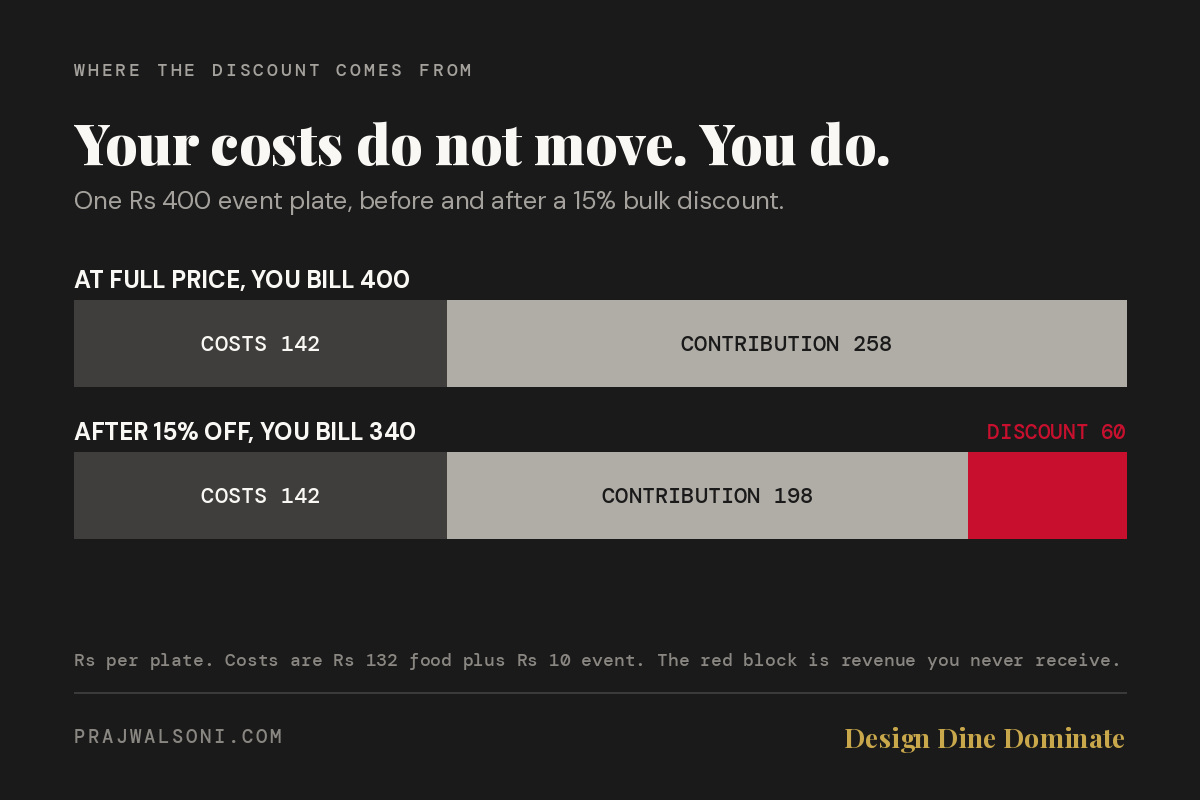
Take a Rs 400 plate. At a 33% food cost, ingredients run Rs 132. Add Rs 5-10 of event costs, and your contribution is Rs 258. Contribution means the money left after the direct costs of that plate.
Now give the client a 15% bulk discount, which is Rs 60 off. Your contribution falls to Rs 198, a drop of almost one-third. You did the same work, carried the same risk, and kept far less of it.
Operators who fight Swiggy and Zomato over every point of aggregator commission often hand a wedding client 15% without blinking. If you want to reward volume, add a live chaat counter or an extra dessert like gulab jamun. The client sees full value, while you pay only the food cost.
Volume pricing does have one honest use. A corporate client booking 20 events a year gives you predictable demand, and that predictability has value. Even then, trim the event fee or add items, and leave the per-plate food rate alone.
Myth 3: Is the Client’s Headcount the Number You Cook For?
The client’s headcount is a guess, and you pay for that guess unless your quote locks a minimum guarantee. Minimum guarantee means the client pays for an agreed plate count, even if fewer guests arrive.
Say the client confirms 300 plates. You cook for around 320, because most caterers keep a 5-10% buffer so food never runs short. Then only 250 guests turn up, and the client wants to pay for 250. That leaves 70 plates you cooked and nobody pays for.
Fix this inside the quote. Charge on the guaranteed count and bill extra plates at the same per-plate rate. Build the buffer into your per-plate cost instead of treating it as a gift. Finally, write a final-count deadline into the agreement, usually 48 to 72 hours before the event.
Myth 4: Is a Saturday Wedding Worth the Same as a Tuesday Office Lunch?
A Saturday wedding costs you more than a Tuesday office lunch, even with an identical menu. Peak-date events pull your best cooks and captains away from your busiest dine-in shift. That lost revenue belongs in the price.
Opportunity cost means the money you give up by choosing one job over another. Suppose your outlet in Surat usually does Rs 1.5 lakh on a Saturday night. Send your head cook and four servers to a venue, and the outlet runs thin. If dinner sales slip 20%, you lose Rs 30,000 before the first plate leaves.
Price peak dates higher. November to February wedding season, Navratri, and Diwali weeks should carry a clear premium. Tuesday corporate lunches can sit lower, since your outlet gives up little that day. Your dine-in profitability margins are thin enough without event days quietly eating them.
Rotating the same five people across every peak event also burns them out. That feeds the restaurant staff turnover crisis most outlets already struggle with. So charge enough to pay event staff properly, or hire event-only crew for the season.
Myth 5: How Much Advance Should You Take for a Catering Order?
Take at least 50% at booking, rather than the 20-25% many operators accept. You buy ingredients, book vehicles, and pay event staff before the balance arrives. With a small advance, you end up financing the client’s event with your own cash.
Payment terms are part of your price. A 25% advance on a Rs 1.2 lakh order is Rs 30,000. At a 33% food cost, ingredients alone run close to Rs 40,000, bought two days before the event. Then you chase the balance for weeks, because the family is busy with the next function.
A structure that holds up well is 50% at booking, 40% three days before, and 10% on the event day. Profitable restaurants still go under when cash runs dry. I break down why in my piece on restaurant cash flow management.
What Does Honest Catering Pricing Look Like?
Honest catering pricing builds the quote from the bottom up. Start with recipe-level food cost, add every event cost, account for the date, and set your margin. After that, GST and payment terms sit on top, in writing.
None of these myths came from careless operators. They came from a time when events were favours for regulars, priced on goodwill. Once catering becomes a business line, price it like one. The discipline behind pricing your menu with psychology and math applies here too.
- Cost every dish at recipe level, using this week’s ingredient prices instead of last year’s.
- Add event costs: transport, staff, rentals, disposables, fuel, and your wastage buffer. Divide the total by the guaranteed plate count.
- Add a peak-date premium for weekends, wedding season, and festival weeks.
- Set a margin that beats the 10-15% net range behind healthy restaurant profit margins.
- Quote GST separately, then attach payment terms and the final-count deadline to the quote.
The Numbers to Remember Before Your Next Quote
Five numbers should sit next to your phone the next time an event enquiry comes in. Each one protects a different part of your margin.
- Event costs like transport, staff, and rentals typically add Rs 5 to Rs 10 per plate on a 250-plate order.
- A 15% bulk discount on a Rs 400 plate cuts your contribution by almost one-third.
- Quote on a minimum guarantee, with a final-count deadline 48 to 72 hours before the event.
- Peak dates cost you dine-in sales, so price weekends and wedding season higher.
- Take at least 50% at booking, and always quote GST separately.
What Should You Do Before Your Next Event Quote?
Pull your last three catering invoices this week. Rebuild each one with the five-step method above, using real transport bills, staff payments, and the actual guest count. Then compare the rebuilt cost with what the client paid. If the gap surprises you, fix your rate card before the next enquiry comes in.
Stop guessing. Start building. Get Design Dine Dominate, the complete restaurant business playbook from someone who has actually done it.

Leave a comment