
I priced my first biryani at ₹170 because the restaurant next door charged ₹180. Seemed smart, right? Undercut the competition by ₹10.
Three months later, I was selling 100 biryanis a day and still losing money.
My food cost was ₹65. Packaging was ₹15. Swiggy’s commission was ₹39 (23%). That’s ₹119 gone before I even covered rent, salaries, or electricity. I had ₹51 left to run an entire restaurant.
That ₹10 “discount” was costing me my business.
Here’s what I learned about menu pricing after running 23 brands and fixing pricing for dozens of struggling restaurants: Your prices shouldn’t be based on what competitors charge. They should be based on what YOU need to charge to stay in business.
Let me show you how.
The Math Part (Non-Negotiable)
Forget everything else for a moment. There’s one formula that determines whether your restaurant survives or dies:
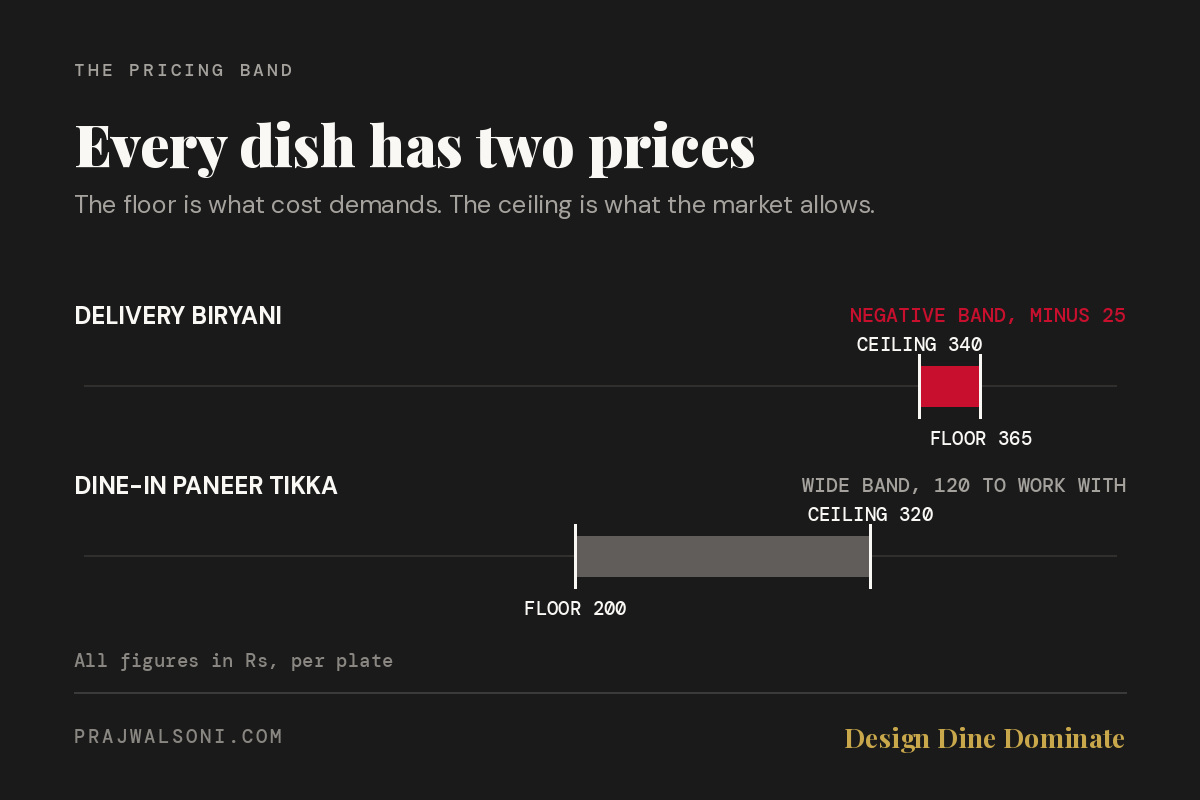
Selling Price = (Food Cost + Packaging Cost) ÷ 0.32
Why 0.32? Let me break it down.
Your selling price needs to cover:
- Food and packaging: 32%
- Aggregator commission (if applicable): 23%
- Rent, salaries, utilities, everything else: 45%
That’s 100% of your revenue accounted for. The last 45%? That includes your profit, if you’re lucky.
Let’s use real numbers:
Paneer tikka:
- Raw materials (paneer, spices, oil, etc.): ₹58
- Packaging: ₹12
- Total cost: ₹70
- Selling price: ₹70 ÷ 0.32 = ₹219
Round it to ₹220 or ₹230 based on what feels right for your market.
“But Prajwal, nobody will pay ₹230 for paneer tikka in my area!”
Then you have three options:
- Reduce your food cost (cheaper paneer, smaller portions, different recipe)
- Don’t sell paneer tikka
- Don’t open a restaurant in that area
Harsh? Maybe. True? Absolutely.
I’ve seen too many restaurant owners ignore this math, work 80-hour weeks, serve hundreds of customers, and still shut down because they priced for what they hoped customers would pay, not what they needed to charge.
The Psychology Part (Where You Make Real Money)
Once you have your baseline price from the formula, psychology takes over.
The Anchor Effect
When I relaunched one of my brands, I did something counterintuitive. I added a ₹450 “Premium Thali” to the menu.
Did anyone order it? Rarely. Maybe 2-3 orders a week.
But here’s what happened: My ₹280 regular thali suddenly felt like a deal. Sales jumped 40%.
That ₹450 item was never meant to sell. It was there to make everything else look reasonable.
How to use this: Always have 2-3 premium-priced items on your menu. They make your regular items look affordable by comparison.
The ₹299 Trap (And Why It Works)
₹300 feels expensive. ₹299 feels like ₹200-something.
This isn’t news to you. Every retailer does it. But restaurants often ignore it.
I tested this at one of our brands:
- Week 1: Butter chicken at ₹300 → 45 orders
- Week 2: Same dish at ₹295 → 62 orders
That ₹5 difference cost us nothing in margin but generated 38% more orders.
But here’s the twist: This only works for items under ₹500. Above that price point, round numbers build trust.
A ₹799 biryani feels discounted and cheap. A ₹800 biryani feels premium and confident.
The Decoy Strategy
This one’s sneaky but effective.
Let’s say you want to sell more of your profitable combo meal. Here’s what I did:
- Biryani alone: ₹180
- Biryani + Raita: ₹220 (This is what I wanted to sell)
- Biryani + Raita + Dessert + Drink: ₹280
Most people skipped the third option (too much) and the first option (incomplete meal). The middle option, my target, became the obvious choice.
Before this, the split was 70% plain biryani, 30% combos. After introducing the decoy, it flipped to 45% plain, 55% combos.
Same customers. Same food. Just smarter menu design.
What Your Menu Layout Says About Your Prices
Where you place an item on the menu affects whether people think it’s expensive or not.
I learned this the hard way. At Straina Foods, we had a dish called “Chef’s Special Curry” priced at ₹240. It wasn’t selling.
All I did was move it from the middle of the “Curries” section to the top and add a small star icon next to it. Sales tripled.
The psychology: The first item in a category becomes the reference point. Everything after is judged against it. Put your profitable items first.
Also, never put prices in a straight column on the right side of the menu. It makes people compare prices before reading what the dishes are. They’ll gravitate toward cheap items.
Instead, put prices at the end of each description line. Forces them to read about the food first, decide they want it, then see the price.
The 5 Pricing Mistakes That Kill Restaurants
Mistake #1: Matching Competitor Prices
Your competitor might own their property (no rent). Or have a different supplier network. Or be running at a loss funded by investors.
You don’t know their cost structure. Don’t copy their pricing.
I know a restaurant that copied a competitor’s prices exactly. The competitor was the landlord’s son, he paid zero rent. The copycat restaurant closed in 8 months.
Mistake #2: Pricing Everything at Cost-Plus-Fixed-Margin
Not all dishes deserve the same margin.
Your dal Tadka takes 15 minutes to cook, uses cheap ingredients, and everyone makes it the same way. It’s a commodity. Price it competitively.
Your grandmother’s secret recipe chicken curry takes 45 minutes, uses 12 spices, and tastes different from everyone else. It’s unique. Price it higher.
At Ghost Kitchens India, we had one restaurant doing 60% margins on their signature dish and 20% on their dal. The average worked out fine, and customers were happy.
Mistake #3: Round Number Syndrome
₹200, ₹300, ₹400 everywhere on the menu.
Feels clean. Looks organized. Kills psychology.
Your brain is wired to see ₹195 and ₹205 as different categories. ₹200 for both? They feel the same, so why not pick the one with more food?
Mistake #4: Ignoring Aggregator Math
“We charge ₹180 in-store, so we’ll charge ₹200 on Swiggy to cover the commission.”
Wrong.
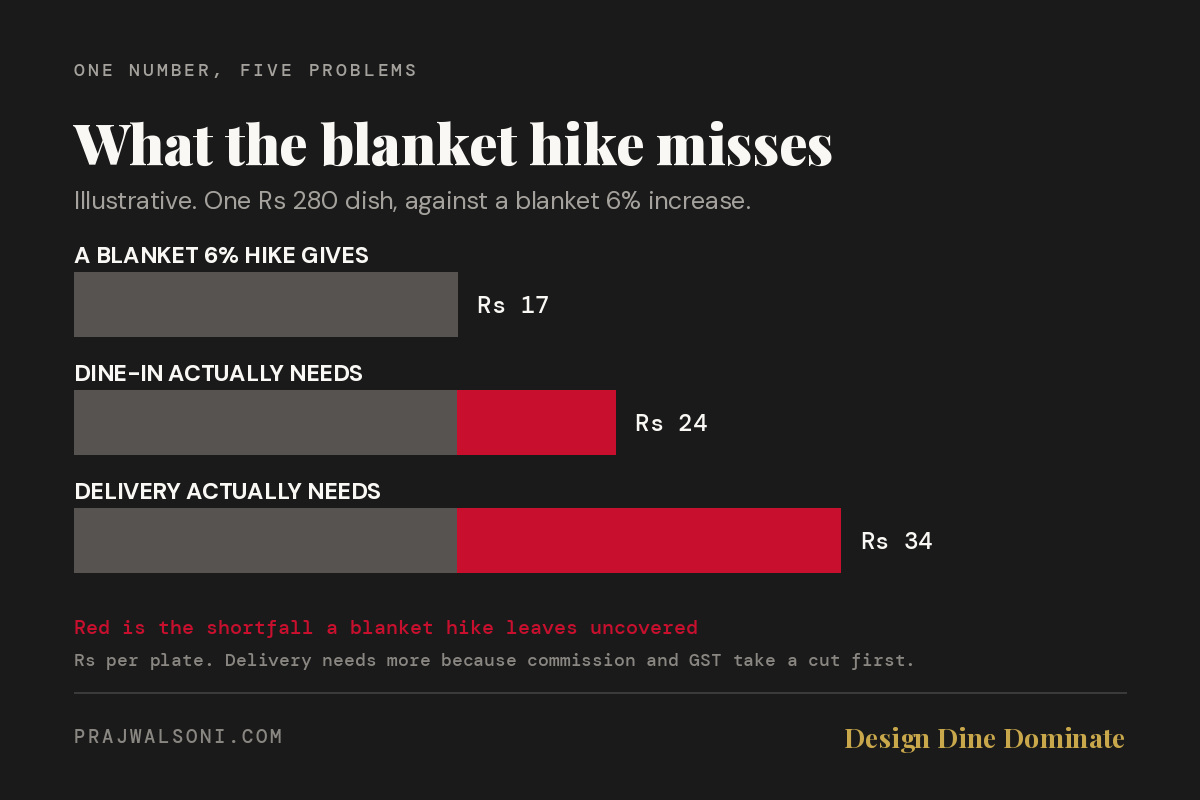
Your ₹180 in-store price has built-in dine-in costs, service staff, ambiance, crockery cleaning. None of that applies to delivery.
But delivery has packaging (₹15-25), aggregator commission (23%), and potentially higher discounts.
Price delivery separately. I’ve seen restaurants where dine-in and delivery menus have different prices, and customers understand it completely.
Mistake #5: The Race to the Bottom
Two restaurants on my street started a discount war. 20% off. Then 30%. Then BOGO.
Both closed within a year.
Here’s why: Discounts attract discount customers. When you stop discounting, they vanish. You’ve trained your market that your food isn’t worth full price.
We had a brand that ran 40% off for two months straight. When we stopped, orders dropped 70%. Took six months to recover by completely repositioning the brand.
If you’re using discounts to survive, you’re already dead. You just haven’t realized it yet.
What About Premium Pricing?
“Can I just charge more and position myself as premium?”
Maybe. But it’s harder than it sounds.
Premium pricing works when:
- Your location supports it (affluent area, low competition)
- Your branding supports it (ambiance, packaging, online presence)
- Your food justifies it (noticeably better ingredients or preparation)
At one of our brands, we tried premium positioning, charged 30% more than competitors. Failed miserably. Why? We were operating from a cloud kitchen with average packaging in a middle-class delivery area.
Same food, different location (upscale neighborhood), better packaging, worked perfectly.
Premium pricing isn’t about the food. It’s about the entire experience matching the price.
The Real-World Pricing Process
Here’s what I actually do when pricing a menu:
Step 1: Calculate minimum viable price (Food + Packaging) ÷ 0.32 = Baseline
Step 2: Check competitor range Not to copy, but to understand market tolerance. If everyone’s at ₹150-200 and your math says ₹350, something’s wrong. Either your costs are too high or you’re in the wrong market.
Step 3: Apply psychology
- Round to ₹X95 or ₹X99 for items under ₹500
- Round numbers for items above ₹500
- Place profitable items first in each category
- Create combos that make sense
Step 4: Test for 2-6 weeks Watch what sells. Watch what doesn’t. Watch what people complain about price-wise.
Step 5: Adjust If something’s not selling and you’re confident the food is good, maybe it’s priced wrong. But don’t panic and slash prices. Try repositioning, renaming, or moving it on the menu first.
The One Number You Must Track
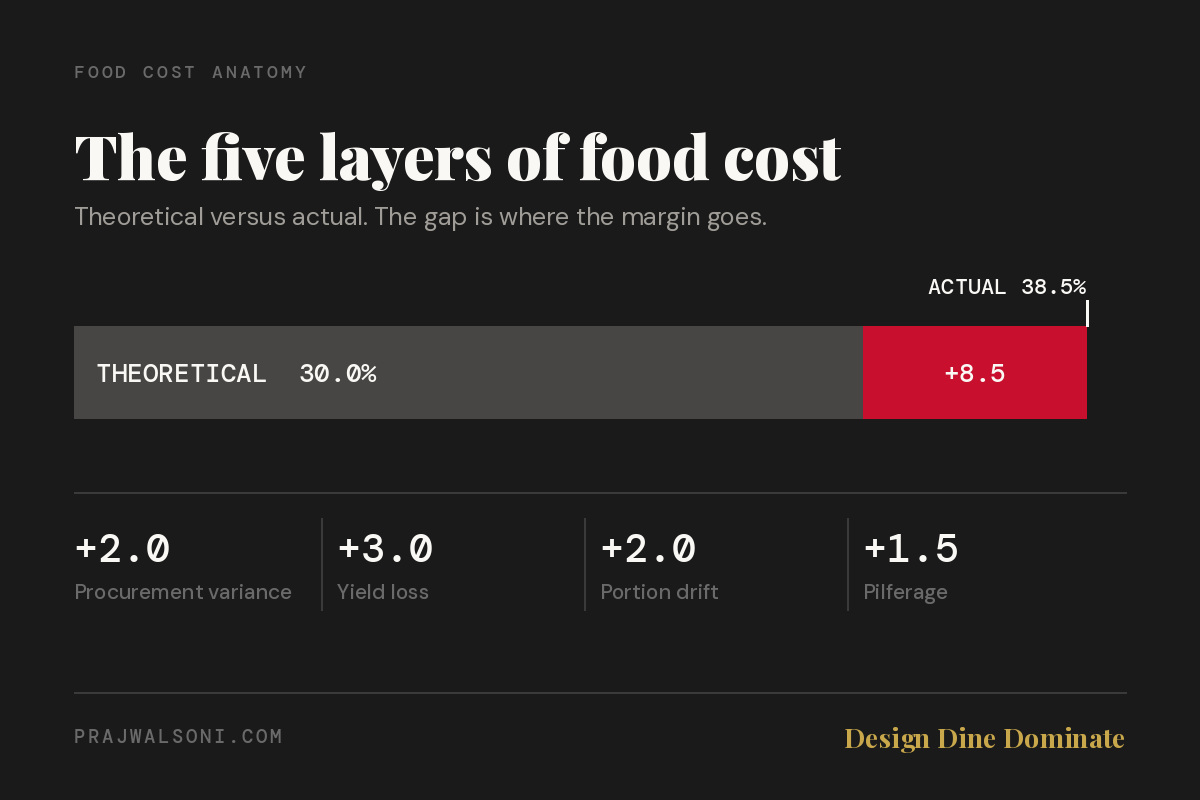
Food cost percentage.
Every week, calculate: (Total ingredient cost ÷ Total revenue) × 100
Should be 28-35%. If it’s higher, you’re either wasting food or underpricing.
At Straina Foods, I checked this number every Monday morning. When it crept above 36%, I knew something was wrong, either portion control had slipped, wastage had increased, or we’d mispriced something.
One week it jumped to 41%. Investigated and found out one of our cooks was using extra cheese in every pizza (trying to be generous to customers). One conversation fixed it. But if I’d waited a month to check, we’d have lost over ₹50,000.
When to Increase Prices
Everyone’s scared of raising prices. “Customers will leave!”
Sometimes they do. But often, they don’t.
We increased prices by 10-15% across one brand. Expected backlash. Got none. Orders stayed exactly the same.
Why? Because we were still giving value, and the price increase just brought us from “suspiciously cheap” to “reasonably priced.”
Increase prices when:
- Your food cost percentage is above 35% consistently
- Ingredient costs have increased significantly
- You’re too busy and can’t fulfill orders (demand > supply)
- Competitors have increased prices
How to increase: Do it once a year, by 10-15%, around a new year or after a menu refresh. Don’t keep increasing ₹5 every month, that’s annoying.
The Bottom Line
Menu pricing isn’t guesswork. It’s not “charge what feels right” or “match the competitor.”
It’s math that keeps you in business, wrapped in psychology that makes customers happy to pay it.
Start with the formula. Build in the psychology. Track your food cost percentage religiously.
And remember: You’re not here to be the cheapest. You’re here to be profitable.
I’ve seen restaurants with higher prices and fewer customers make more money than restaurants with lower prices and packed houses. Because at the end of the month, what matters isn’t how many customers you served, it’s how much money you kept.
Price for profit, not for popularity.
Stop guessing. Start building. Get Design Dine Dominate, the complete restaurant business playbook from someone who’s actually done it.

Leave a comment