Most afternoon discounts do not create new customers. They take your existing dinner customers, move them to 4pm, and charge them 20% less. That is the pattern behind most restaurant dynamic pricing on Swiggy and Zomato. I see it in Ahmedabad, Pune, Surat, and Hyderabad alike. The order graph goes up. Your weekly settlement goes down.
Time-based discounting means changing your price by hour of day to shift demand into slow periods. When it is built properly, it fills dead kitchen hours at a profit. Most operators build it the lazy way, though, with a flat percentage off the whole menu. That version quietly bleeds contribution while looking like growth.
What follows is a case pattern I have seen repeatedly across the 23 cloud kitchen brands I have operated. The numbers are modelled and rounded so the math stays clean. No single client’s books are on display here. Run it on your own numbers and you will know within an hour if your offer works.
Does Restaurant Dynamic Pricing Actually Fill Slow Hours?
Only when the discount reaches customers who would not have ordered otherwise. A blanket 20% off from 3pm to 6pm mostly shifts existing customers from dinner into the discount window. Revenue rises, order count rises, and contribution falls. Dynamic pricing works when the off-peak offer is a different product or targets new customers. A cheaper version of dinner fails.
Afternoon pressure is real. The National Restaurant Association of India puts the food service market at Rs 5.69 lakh crore. That figure comes from its India Food Services Report 2024. Dine-in takes roughly 59% of revenue, and delivery and takeaway share most of the rest. Every new kitchen is fighting for the same 7pm to 10pm window.
So operators look at 3pm and see an idle tandoor and a cook already on salary. Rent, gas, and salaries cost the same at 3pm as at 8pm. Any order in a dead hour feels like free money. But it is only free money if it is a new order. My breakdown of cloud kitchen profitability metrics makes the same point. Contribution per order matters more than order count.
The Case: A Biryani Kitchen That Discounted Its Way Into Losses
The kitchen in this case is a mid-sized biryani and kebab delivery brand. It does nearly all its business on Swiggy and Zomato, with an average order value of Rs 400. Average order value, or AOV, means total revenue divided by number of orders. Dinner is strong. Afternoons are dead, at roughly 15 orders between 3pm and 6pm.
To fix the afternoon, the owner launched 20% off the full menu from 3pm to 6pm. The restaurant funded the discount itself. No minimum order, no item restrictions, no customer targeting. Anyone could get Rs 80 off a Rs 400 order, provided they ordered in that window.
What did the dashboard show after six weeks?
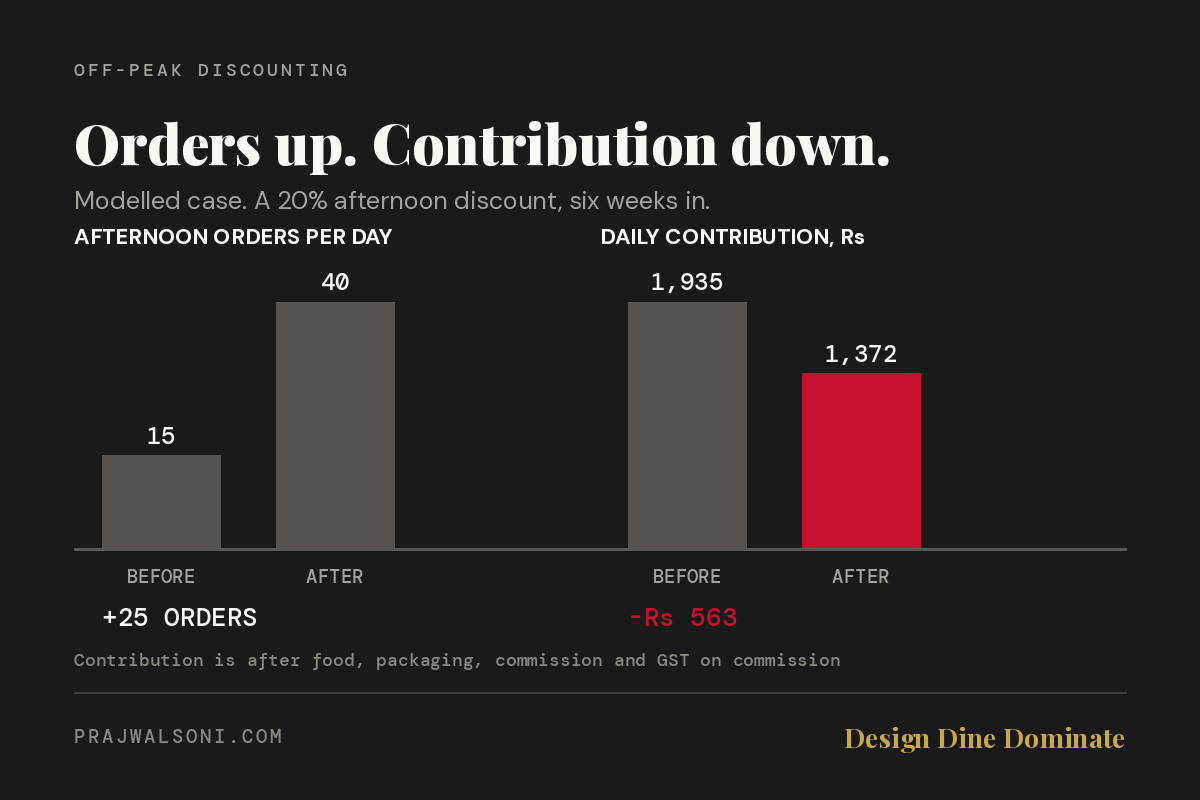
On the surface, the offer looked like a hit. Afternoon orders rose from about 15 a day to about 40. Total daily orders went up. Gross revenue went up as well. For the first time since launch, the cook was busy at 4pm.
Owners in this position usually show me the order graph like a report card. Then they ask whether they should extend the offer to lunch too. That question is where the real analysis should start. So far, nobody has checked what each of those 40 orders actually earns.
What Did the Contribution Math Reveal Underneath?
Each discounted order earned about Rs 73, against Rs 129 for a full-price order. Worse, roughly half the extra afternoon orders came from existing dinner customers. The kitchen was selling the same biryani to the same people for less money. As a result, the offer lost money every single day it ran.
The per-order math
Contribution means the money an order leaves after food, packaging, and platform deductions. It pays your rent, salaries, and profit. Here is the comparison, assuming a 32% food cost and a 25% commission.
- Full-price order at Rs 400: food Rs 128, packaging Rs 25, commission Rs 100, 18% GST on commission Rs 18. Contribution is Rs 129.
- Discounted order at Rs 320: food Rs 128, packaging Rs 25, commission Rs 80, GST on commission Rs 14.40. Contribution is about Rs 73.
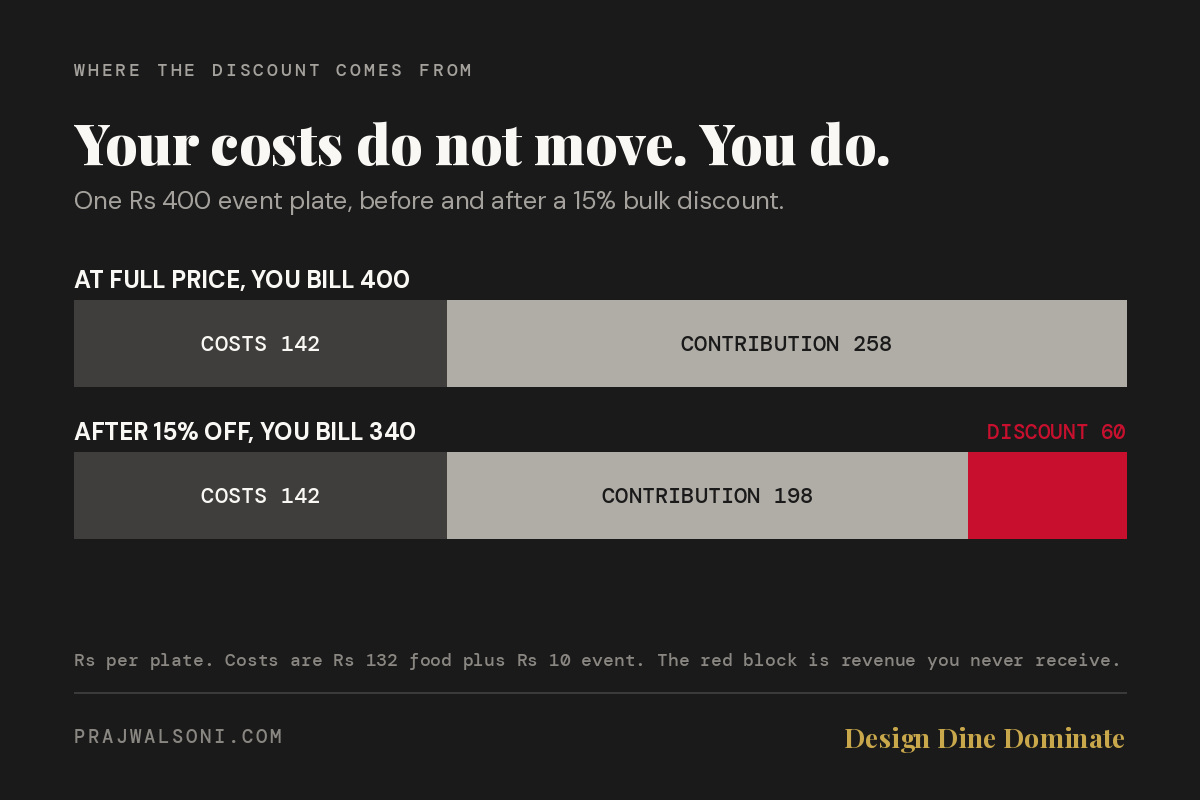
A 20% price cut removed 43% of the contribution. That happens because the biryani costs the same to make at Rs 400 or Rs 320. Only the commission shrinks with the price. To earn what one full-price order earns, the kitchen needs almost 1.8 discounted orders.
Your numbers will differ. Commission runs from 15% to 30% depending on city, volume, and plan. My piece on the aggregator commission trap breaks down how to negotiate it. Some contracts calculate commission before discount and others after, so read yours. The GST Council sets the 18% GST on platform commission. My guide to GST for restaurants shows how that hits your weekly settlement.
Where did the extra 25 orders actually come from?
Cannibalization means a promotion steals sales from your own full-price orders instead of bringing new customers. In this case, dinner orders fell by about 12 a day during the same six weeks. The repeat-customer share in the afternoon window also jumped. Regulars who used to order at 8:30pm were now ordering at 5:45pm and reheating.
Nobody switches from biryani at 8pm to biryani at 5pm for fun. They switch for Rs 80. Meanwhile, the original 15 afternoon customers started paying less for the same order. Put the daily numbers side by side and the picture changes completely.
- Before the offer: 15 afternoon orders × Rs 129 = Rs 1,935 contribution.
- During the offer: 40 afternoon orders × Rs 73 = Rs 2,920 contribution.
- Dinner orders lost: 12 × Rs 129 = Rs 1,548 contribution gone.
- Net daily change: Rs 2,920 minus Rs 1,935 minus Rs 1,548, which is a loss of Rs 563.
That is roughly Rs 16,900 a month disappearing from one outlet, while the dashboard shows growth. There was an operational cost too. Orders landing at 5:45pm collided with dinner prep. First dinner tickets went out late, and late tickets mean poor ratings in the busiest hours.
How Do You Fix Time-Based Discounting Without Killing Dinner?
Change what you sell in the slow window before you change what you charge. Build an afternoon-only product that dinner customers cannot shift into. Aim the offer at new customers, and close the window before dinner prep starts. Then measure contribution by daypart instead of revenue. Daypart means a fixed block of the trading day, like lunch, afternoon, or dinner.
The five-part fix
- Kill the blanket discount. A menu-wide percentage off gives your best customers a reason to change their order time. Remove it first, before adding anything new.
- Launch a time-locked menu. Three items run only from 3pm to 5pm. They are a mini biryani bowl with raita, a kebab roll with masala chai, and a small kebab platter. Each sells at Rs 199 with food cost around Rs 55. A single-portion bowl at 4pm does not replace a family biryani at 9pm, so dinner stays intact.
- Point offers at new customers. Both platforms offer new-user targeting on most plans, so check what your account manager can switch on. Reward existing regulars through loyalty programs that actually drive repeat orders instead.
- Close the window at 5pm. The last hour before dinner belongs to prep. Protect it, because a late first dinner ticket costs more in ratings than a 5:30pm order earns.
- Track contribution by daypart every week. Most POS platforms, including Petpooja and Posist, can schedule item availability by time slot. Confirm it on your plan. Then pull contribution per daypart every Monday alongside order counts.
Notice what is missing from that list: a bigger discount. The fix never asks customers to pay less for dinner. Instead, it gives new customers a reason to order at an hour they were not ordering at all.
What Changed in the Numbers After the Fix?
In the model, the afternoon added about Rs 1,400 a day in contribution with dinner untouched. Compared with the discount version, that is a swing of roughly Rs 1,960 a day. Over a month, that comes close to Rs 59,000 on a single outlet, without a single rupee of extra marketing spend.
Here is how the combo math works. A Rs 199 order carries Rs 55 in food, about Rs 15 in packaging, and roughly Rs 50 in commission. Add about Rs 9 of GST on that commission, and each combo leaves around Rs 70. Assume the afternoon menu brings in 20 genuinely new orders a day. That gives you the Rs 1,400.
Rs 70 looks thin next to Rs 129. However, every one of those combo orders is incremental. The 15 regular afternoon customers keep paying full price, and the 12 dinner customers stay at dinner. Some regulars will trade down to the combo, so track that line too. Trade-down is simply cannibalization at a smaller scale.
These are modelled figures, not one client’s P&L. In kitchens I have run and advised, the direction holds consistently. When operators replace a blanket discount with a time-locked product, the weekly settlement usually improves within 4 to 6 weeks. That settlement is where your restaurant cash flow actually lives.
Why Restaurant Dynamic Pricing Works Best When the Product Changes Too
A price cut on your existing menu teaches your best customers to wait for the discount. Different products at different hours create a separate purchase occasion. That separation keeps off-peak revenue incremental instead of borrowed from your peak. It also protects the price your regulars believe your food is worth.
Restaurants have used this logic for decades without calling it pricing strategy. A weekday lunch thali at Rs 249 works because it is a separate meal, at a separate hour, for a separate customer. Nobody walks in at 9pm expecting the thali price, because the dinner menu never offered it.
Blanket discounts also damage your price anchor. Price anchoring means customers judge a price against the last price they paid. Once a regular has paid Rs 320 for your biryani, Rs 400 feels like a price hike. My article on how to price your menu covers the psychology and the math behind this.
Surge pricing in the other direction is riskier still. Raising prices at 8pm on a delivery app invites screenshots and one-star reviews. Customers tolerate platform surge fees in bad weather, but those fees go to the platform and riders, never to your kitchen. Your margin has to come from smarter off-peak design. That is how operators climb from the 5% margin bracket toward 15%.
Five Rules to Pin Above Your Pricing Sheet
Time-based pricing makes money only when off-peak orders are genuinely new orders. Every rule below follows from that single test. Run each one against your current offers on the delivery apps, and against any dine-in happy hour you run. If an offer fails two of these, pull it this week.
- A 20% discount on a Rs 400 order can cut contribution by around 43%, because food and packaging costs do not shrink.
- Watch dinner orders whenever you run an afternoon offer. A dinner drop means your discount is cannibalizing.
- Off-peak offers should sell a different product, ideally at lower food cost, available only in that window.
- Use new-customer targeting on Swiggy and Zomato rather than menu-wide discounts.
- Measure contribution by daypart weekly. Revenue and order count will mislead you.
Your Restaurant Dynamic Pricing Audit for This Week
Pull 60 days of hourly order data from your partner dashboards and your POS. Compare dinner orders in the weeks before and during any time-based offer. If dinner dropped while afternoons rose, your discount is relocating customers. It is not winning new ones, and every relocated order costs you contribution.
- Export orders by hour for the last 60 days, split into afternoon and dinner.
- Calculate contribution per order at full and discounted price, using your actual commission rate plus 18% GST on it.
- Compare dinner order counts before and during the offer. A drop of more than a few orders a day needs explaining.
- Check the repeat-customer share inside the discount window on your partner dashboard.
- Draft one afternoon-only item at lower food cost, and price it before you touch the discount.
Most operators can finish this in one evening with a spreadsheet and a cup of masala chai. The harder part is trusting the numbers when they contradict the dashboard. It is the first analysis I run when an operator says offers are working but cash is not.
Stop guessing. Start building. Get Design Dine Dominate, the complete restaurant business playbook from someone who has actually done it.

Leave a comment