Why Do Restaurant Marketing Myths Survive So Long?
Restaurant marketing myths survive because operators copy what other operators do without checking if it actually works. Most of these beliefs started from one success story in one city, then spread as universal truth across Ahmedabad, Pune, Bengaluru, and everywhere else. The cost of following bad marketing advice in India is typically Rs 25,000 to Rs 50,000 a month in wasted spend. That is money going to tactics that feel productive but generate no measurable return.
I have consulted for restaurants that were spending more on influencer dinners than on their actual food cost optimization. Others were running discount campaigns so deep they were losing Rs 40 on every order. These are not edge cases. These are patterns I see across cloud kitchens and dine-in formats alike.
The restaurant marketing myths below are not harmless. Each one has a specific cost attached to it. And each one has a replacement strategy that actually moves your numbers.
Myth 1: More Instagram Followers Means More Customers
Follower count has almost zero correlation with restaurant revenue. A cafe in Surat with 47,000 followers can easily do less revenue than a thali place with 900 followers and strong Google reviews. The metric that matters is not followers. It is saves, shares, and DMs, because those indicate purchase intent.
This myth exists because social media agencies sell follower growth packages. They charge Rs 15,000 to Rs 25,000 a month and report follower count as the primary KPI. Operators see the number go up and assume business will follow. It does not.
What actually drives footfall from Instagram is hyper-local content. Reels showing your kitchen, your actual dishes being plated, your location tagged clearly. I wrote a detailed breakdown of what actually works in Instagram marketing for restaurants in 2026 with zero-budget tactics. The operators getting results post 4 to 5 reels a week with location tags, not 2 polished posts a month with generic food photography.
Stop tracking followers. Start tracking how many DMs ask “where are you located” or “what time do you close.” Those are the only Instagram metrics that convert to revenue.
Myth 2: Heavy Discounts on Aggregators Bring Loyal Customers
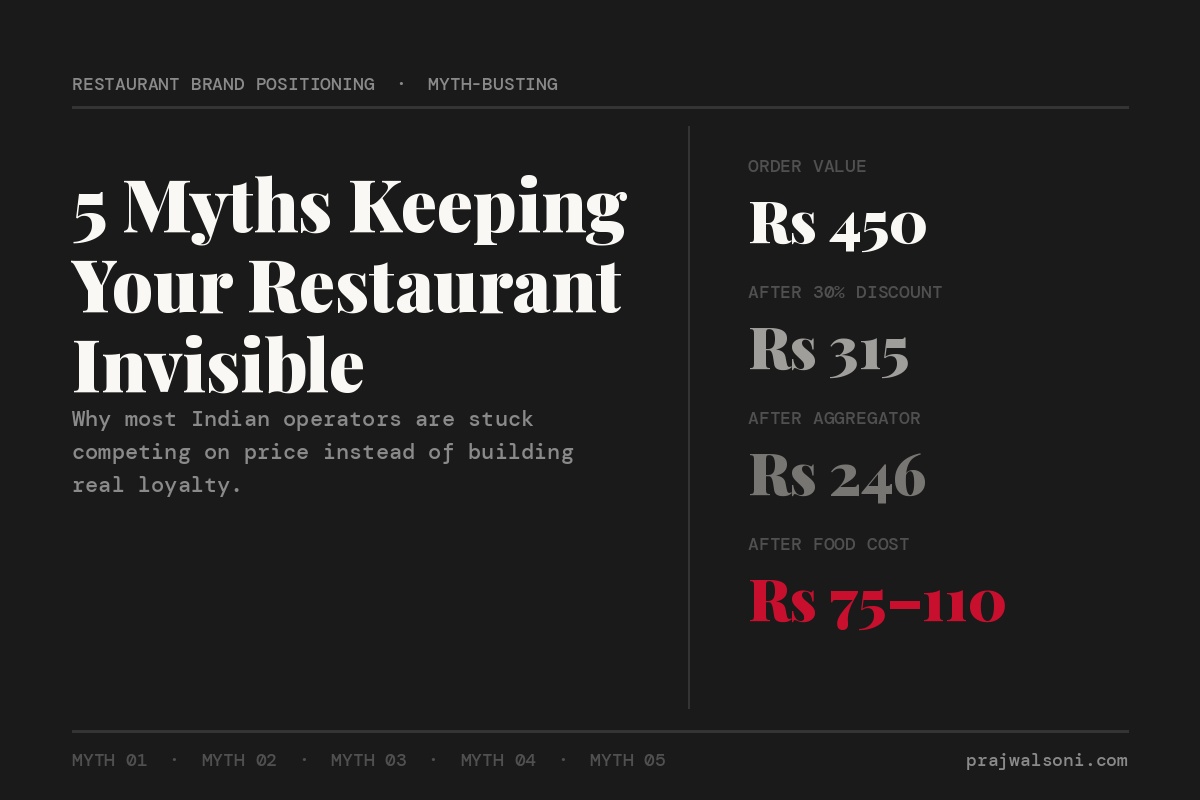
Discounts on Swiggy and Zomato bring price-sensitive one-time buyers, not loyal customers. Roughly 80% of customers acquired through deep discount campaigns never reorder at full price. You are paying aggregator commission of 15 to 30% plus funding a 40% discount. The math does not work for any restaurant operating below 20% net margins.
This myth persists because operators see a spike in order volume during a campaign. Volume feels like progress. But when you calculate the per-order economics, you are often losing Rs 30 to Rs 60 on each delivery. I have broken down how aggregator commission rates actually work in 2026 and the numbers are sobering.
The replacement strategy is simple. Instead of funding platform discounts, invest in your own repeat customer system. A WhatsApp broadcast list costs you nothing. A loyalty program where the fifth biryani is free costs you one biryani, not 40% off every order for a month. Programs like these actually build loyalty, especially with younger customers who respond to earned rewards over random discounts.
Myth 3: Food Influencers Are the Best Way to Market a Restaurant
Food influencers generate awareness, not revenue. Most restaurants that host influencers see a spike in profile visits for 48 hours and then a complete flatline. The conversion from “watched a reel” to “visited the restaurant” is extremely low, typically under 2% for influencers with over 50,000 followers.
This myth survives because influencer visits feel like marketing. Someone shows up, takes photos, posts content. It looks productive. Operators in Ahmedabad and Pune regularly spend Rs 5,000 to Rs 25,000 per influencer visit on food and sometimes cash payment. For a new restaurant doing Rs 4 lakh a month, that is a significant chunk of budget with no trackable return.
The exception is micro-influencers with under 10,000 followers in your exact locality. A food blogger in your specific neighborhood, someone whose audience actually lives within 3 km of your restaurant, can drive real walk-ins. The key is geography, not follower count.
Before you invite any influencer, ask one question. Does their audience live close enough to visit? If the answer is no, you are paying for entertainment, not marketing.
Myth 4: Good Food Markets Itself
Good food is the minimum requirement for survival, not a marketing strategy. Thousands of restaurants with excellent food close every year because nobody knows they exist. According to the NRAI India Food Services Report 2024, the industry is valued at Rs 5.69 lakh crore, and competition in every segment is fierce. Your dal makhani being the best in Nagpur means nothing if your Google listing has 11 reviews and no photos.
This is the most dangerous myth because it gives operators permission to ignore marketing entirely. I have seen restaurants with genuinely outstanding food fail within the first year because the owner believed word of mouth would do all the work.
Word of mouth works. But it works slowly. And it works much faster when you amplify it. Every happy customer should get a gentle nudge to leave a Google review. Every great dish should be photographed and posted. Every regular should be on your WhatsApp list. Good food is the foundation. Marketing is the amplifier. You need both.
Myth 5: Spending More on Ads Means More Revenue
Increasing ad spend without fixing your funnel just burns money faster. A restaurant running Rs 500 per day on Instagram ads with a poorly optimized profile, no clear location, and weak menu photos will get impressions but not customers. The ad is not the problem. Everything the ad points to is the problem.
This myth thrives because digital marketing agencies make money when you increase spend. They will show you impressions and reach as proof of performance. Neither metric pays your rent. The metrics that matter are cost per new customer acquired and the lifetime value of that customer. If you spend Rs 200 to acquire a customer who orders once for Rs 350 with a 30% food cost and 25% aggregator commission, you lost money. Simple as that.
Before increasing any ad budget, fix three things first. Your Google My Business listing needs 50+ reviews and updated photos. Your Swiggy and Zomato listings need properly priced menus with clear item descriptions. Your Instagram profile needs a working link to your menu or ordering page. Only after these fundamentals are solid does paid advertising make sense.
The most effective marketing budget allocation for a restaurant doing Rs 8 to Rs 15 lakh monthly typically looks like this:
- Rs 0 on organic Instagram content, just your time and a phone camera.
- Rs 3,000 to Rs 5,000 per month on Google Ads targeting your locality keywords.
- Rs 0 on a WhatsApp broadcast list for repeat customers.
- Rs 2,000 to Rs 5,000 per month on one or two local micro-influencer visits.
Total spend under Rs 10,000 a month. Compare that to the Rs 30,000+ most operators waste on tactics built on myths.
What Should You Actually Spend Marketing Budget On?
The highest-return marketing investments for restaurant operators are free or nearly free. Google reviews, WhatsApp lists, consistent Instagram reels, and proper Swiggy and Zomato listing optimization cost time, not money. Paid marketing only works when these organic channels are already running.
If you operate a cloud kitchen, your entire marketing game lives on aggregator listings and Google. Understanding which profitability metrics matter for cloud kitchens helps you decide where marketing spend actually moves the needle versus where it just feels busy.
For dine-in restaurants, your profitability margins in 2026 depend on repeat customers more than new ones. A repeat customer costs you nothing to acquire. Every rupee you spend building a relationship with someone who has already eaten your food returns more than any amount spent chasing strangers on Instagram.
Marketing for restaurants is not about spending more. It is about spending on the right things and measuring actual revenue impact, not vanity metrics.
Key Takeaways
- Instagram follower count does not drive restaurant revenue. Track saves, shares, and DMs instead.
- Deep aggregator discounts attract one-time buyers and destroy per-order economics for most restaurants.
- Food influencers with large followings rarely convert to walk-ins unless their audience is hyper-local to your restaurant.
- Good food is the baseline, not a marketing strategy. Without active promotion, even the best restaurant stays invisible.
- Increasing ad spend without fixing your Google listing, aggregator profiles, and Instagram basics wastes every additional rupee.
Your Action Step for This Week
Pull up your marketing spend for the last 90 days. Every rupee. Influencer meals, Swiggy discount funding, ad spend, agency fees. Now put each line item into two columns. Column one: did this generate a trackable new customer or repeat visit? Column two: did this generate likes, followers, or impressions with no revenue proof? If column two is larger than column one, you now know exactly where to cut.
Then redirect that budget into Google review generation, WhatsApp customer lists, and hyper-local Instagram reels. Give it 30 days and compare. The numbers will speak for themselves.
Stop guessing. Start building. Get Design Dine Dominate, the complete restaurant business playbook from someone who has actually done it.

Leave a comment