Why Restaurant Brand Positioning Myths Exist and What They Actually Cost You
Restaurant brand positioning means choosing exactly what your restaurant stands for in a customer’s mind, and then making every decision support that choice. Most operators skip this entirely. They open, list on Swiggy and Zomato, run discounts, and wonder why nobody comes back at full price.
These myths stick around because they feel logical. A previous generation of restaurant operators in India built businesses on footfall and location alone. Branding felt like a luxury for chains with marketing budgets. But the market has changed. With over 7.5 lakh restaurants operating across India according to the NRAI India Food Services Report 2024, a customer in Ahmedabad or Bengaluru can choose from dozens of options within a 2 km radius. If you have no clear position, you are invisible.
The cost of bad positioning is not abstract. It shows up in three places: your discount dependency on aggregator platforms, your inability to price your menu above competitors, and your repeat rate staying below 20%. I have watched operators in Surat spend Rs 40,000 a month on ads while their brand communicated nothing specific. That money bought orders, not customers.
Myth 1: A Good Logo and Instagram Feed Is Brand Positioning
A logo is not positioning. Neither is a consistent colour palette on Instagram. Positioning is the answer to one question: why should a customer pick you over the restaurant next door?
I have consulted for restaurants that spent Rs 1.5 lakh on brand identity packages. Beautiful logos, matching packaging, curated reels. Their repeat customer rate was still 12%. Because the brand said nothing specific. “Fresh food, great taste, family vibes” describes every restaurant. It positions you nowhere.
Real positioning is a decision. A biryani brand in Hyderabad that says “only dum biryani, never shortcuts, always 90 minutes” has taken a position. A café in Pune that says “no wifi, no laptops, just conversation” has taken a position. These choices exclude some customers. That is the point. Because the customers who stay become loyal.
Your Instagram content strategy should communicate your position, not replace it. Design follows positioning. Not the other way around.
Myth 2: Discounts Build Customer Loyalty
Discounts build trial, not loyalty. A customer who comes for a 40% off Zomato coupon will leave for a 50% off coupon next week. You are renting attention, not earning it.
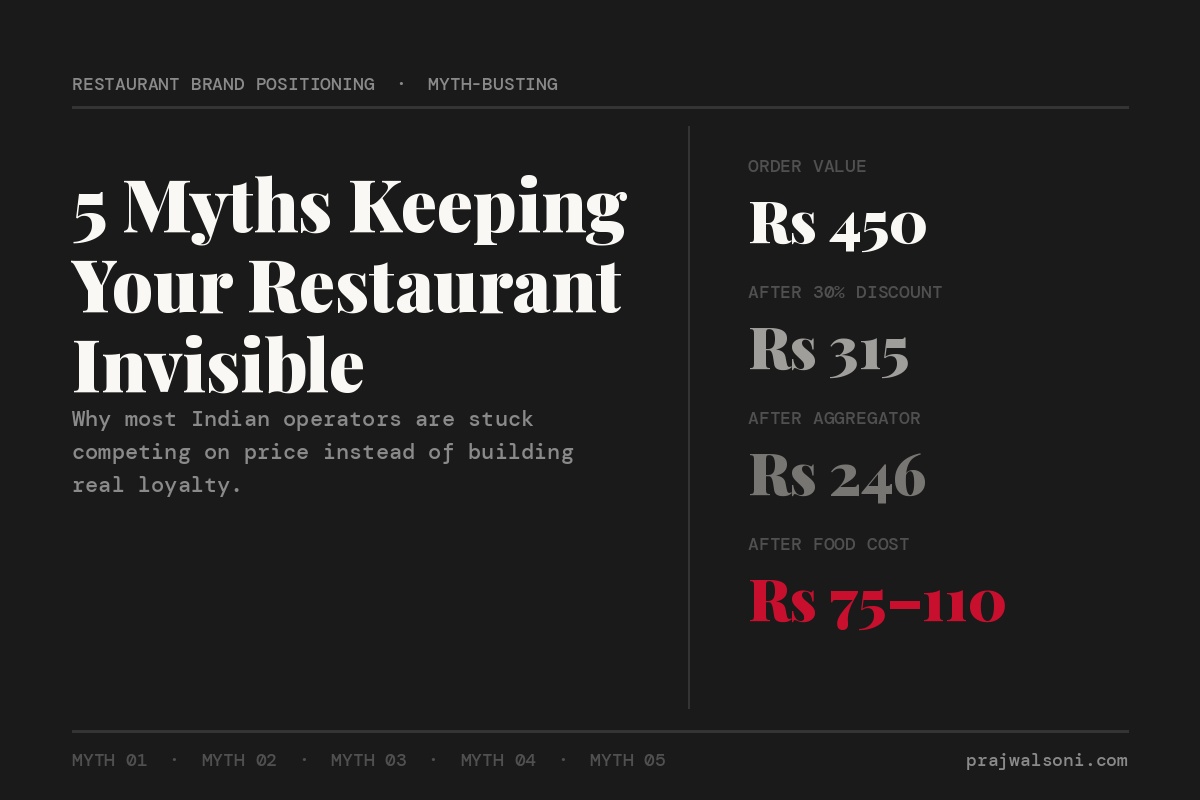
The math is brutal. If your average order value is Rs 450 and you offer 30% off, you collect Rs 315. After aggregator commission of roughly 20-25% on the discounted value, you receive Rs 235 to Rs 250. Your food cost on that order is probably Rs 140 to Rs 160. You just made Rs 75 to Rs 110 before rent, labour, packaging, and GST. For most operators, that is a loss.
Discounts have a place. Use them for new item launches or slow weekday slots. But making discounts your primary acquisition strategy means your brand stands for “cheap.” Once customers anchor you as a discount brand, raising prices becomes nearly impossible. I have seen this pattern destroy restaurant profit margins across multiple cities.
Loyalty comes from consistency and identity. A dal makhani that tastes the same every single time. A paneer tikka portion that never shrinks. A brand that stands for something specific enough to remember. Loyalty programs that actually work reward behaviour, not just transactions.
Myth 3: You Need a Big Marketing Budget to Build a Brand
You do not need Rs 2 lakh a month for marketing. You need clarity about who you serve and what you promise them. Budget follows clarity, not the other way around.
Some of the strongest restaurant brands I have worked with in Gujarat spend under Rs 15,000 a month on marketing. What they do spend is time. Time responding to every Google review within 24 hours. Time training staff to explain why their gulab jamun is made fresh twice daily. Time writing Swiggy listing descriptions that actually say something instead of generic “best food in town” copy.
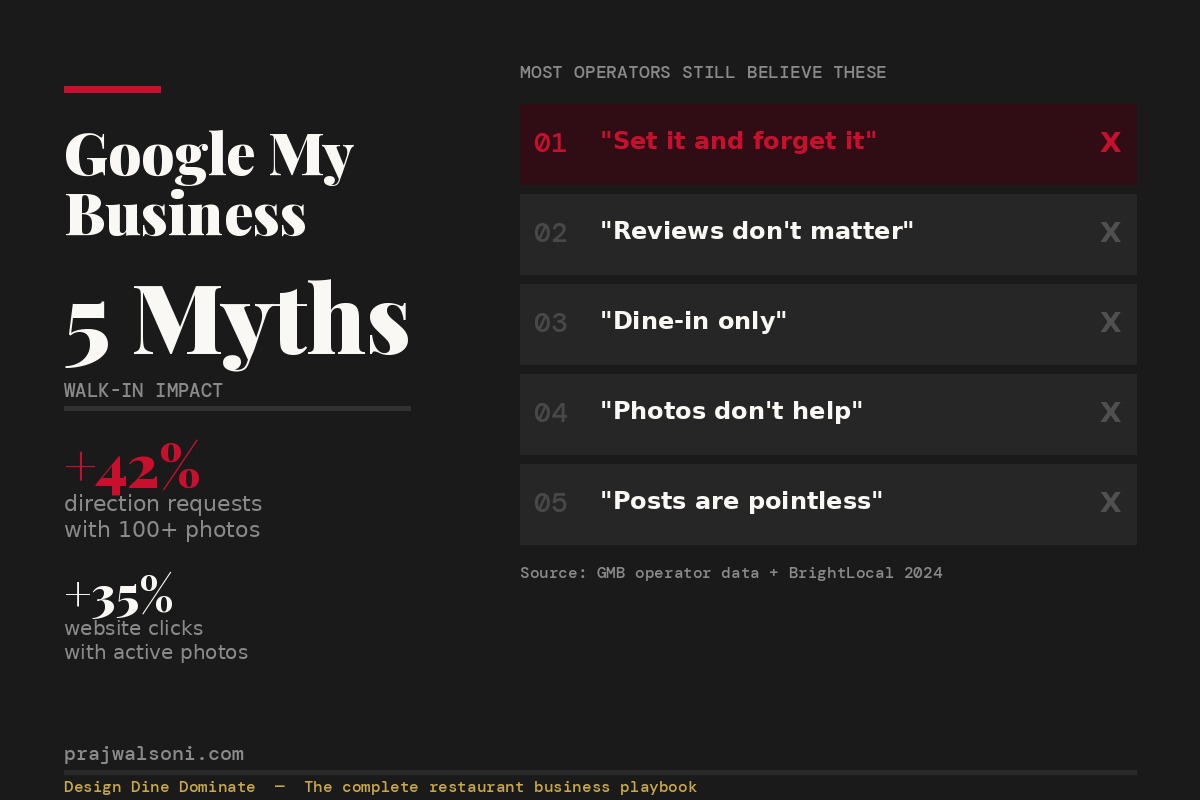
According to Google Business Profile data, restaurants that respond to reviews get roughly 35% more direction requests than those that do not. That costs zero rupees. Your Swiggy and Zomato listing photos, description, and menu structure are free to update. Most operators treat these like one-time setup tasks. They are ongoing brand communication channels.
A restaurant in Nagpur selling thali meals does not need influencer campaigns. It needs 50 Google reviews from real customers who mention the specific thing that makes the thali worth coming back for. That specificity is positioning. And it is free.
Does Copying a Successful Brand’s Strategy Work for Restaurants?
Copying another brand’s menu, aesthetic, or pricing strategy almost never works. Their positioning is built on their context, their location, their customer base, and their operations. You have none of those.
This is Myth 4, and it is everywhere. A cloud kitchen in Bengaluru sees a competitor doing well with loaded fries and butter chicken bowls. Within two months, five more brands launch identical menus on the same aggregator platforms. Now none of them have positioning. They are all competing on price and ad spend.
I have operated 23 cloud kitchen brands. The ones that survived had one thing the copycats did not: a specific promise that could not be replicated by changing a menu template. Maybe it was a regional recipe done authentically. Maybe it was a portion size guarantee. Maybe it was a 20-minute delivery window enforced by kitchen layout.
When you copy, you also copy someone else’s cost structure assumptions. A brand in Mumbai pricing dal makhani at Rs 349 has a different rent reality than you in Surat. Copying their price without their economics is how you end up with a cloud kitchen that looks busy but bleeds money.
Myth 5: Brand Positioning Is Only for Big Restaurant Chains
Single-outlet restaurants need positioning more than chains do. A chain has budget to buy awareness. You do not. Your position is your only competitive advantage against operators with deeper pockets.
Think about the restaurants you personally go back to. Not chains. The specific local place. You go back because it stands for something. The best masala chai in your area. The only place that does Kutchi dabeli properly. The café where the owner knows your order. That is positioning. It does not require a brand team.
Small operators actually have an advantage here. You can make a positioning decision today and execute it by tomorrow morning. A chain needs six months of approvals. If you run a single restaurant in a Tier 2 city, your positioning can be hyper-local. “The only place in Rajkot that serves authentic Kathiyawadi thali with 12 items for under Rs 250.” That is specific. That is memorable. That gives a customer a reason to tell someone else about you.
Without positioning, you are forced into the aggregator commission trap because discounts become your only differentiator. With positioning, you build a brand that customers search for by name. That changes everything about your unit economics.
How Do You Actually Build Restaurant Brand Positioning This Week?
Start with three questions. Answer them on paper, not in your head.
First, what is the one dish or experience your best customers talk about most? Not what you think is best. What they actually mention in reviews and conversations. Pull your last 30 Google reviews and your Swiggy/Zomato feedback. Look for patterns.
Second, who are you not for? If your answer is “everyone,” you have no position. A family restaurant is not for solo diners looking for quick bites. A fast casual brand is not for date night couples. Decide who you exclude.
Third, can you say what makes you different in eight words or fewer? “Authentic Lucknowi biryani, no shortcuts, guaranteed.” “Best filter coffee south of MG Road.” If you cannot say it simply, your customers cannot repeat it. And if they cannot repeat it, your brand does not spread.
Once you have these answers, update three things immediately. Your Swiggy and Zomato listing descriptions. Your Google Business Profile “from the business” section. Your staff’s answer to “what is special about this place.” All three should say the same thing. That alignment is positioning in action.
If you want to scale your restaurant without losing what makes it work, positioning is the foundation. Everything else, from your menu engineering to your cash flow management, becomes easier when you know exactly who you are.
What Matters Most
- Brand positioning is a strategic decision about what your restaurant stands for, not a logo or colour scheme.
- Discounts create trial but destroy margin. Loyalty comes from consistency and a clear identity.
- You do not need a big budget. You need clarity, then communicate it through every free channel you already have.
- Copying competitors copies their context, which does not transfer to your cost structure or location.
- Single-outlet operators need positioning more than chains. It is your only real advantage against bigger budgets.
Pull your last 30 customer reviews this week. Highlight every specific compliment. That pattern is the seed of your brand position. Write it down in eight words. Then update your Swiggy listing, your Google profile, and your staff script to say exactly that.
Stop guessing. Start building. Get Design Dine Dominate, the complete restaurant business playbook from someone who has actually done it.

Leave a comment