Why Do These Google My Business Myths Exist?
Google My Business for restaurants is the single most underused free marketing tool in the industry. A properly optimized listing directly influences walk-in traffic, phone orders, and direction requests. Yet most operators in Ahmedabad, Pune, Surat, and Bengaluru either set it up once during launch or never touch it again.
These myths persist because operators spend all their energy on Swiggy and Zomato. Aggregator dashboards give you real-time data. Google feels passive by comparison. So operators assume it does not matter much.
That assumption is expensive. According to Google’s own data, searches for “restaurants near me” have grown consistently year over year. When someone types that query on a Saturday evening in Hyderabad, your listing either shows up and earns a walk-in or it does not. The myths below explain why most listings fail to show up.
Each myth here is something real operators actually believe. Each one costs real money. And each one has a fix you can apply this week without spending a single rupee.
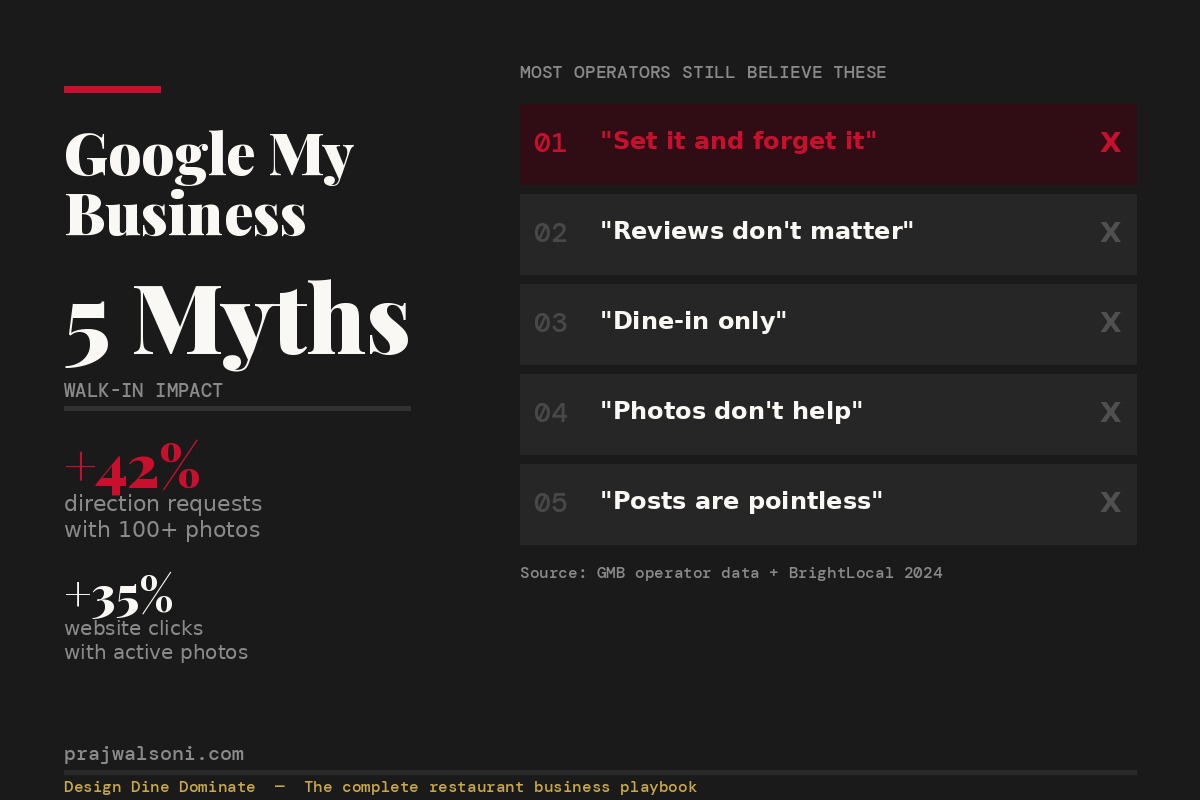
Myth 1: “I Listed My Restaurant on Google. My Job Is Done.”
Creating a listing is step one of roughly twenty. Google treats your GMB profile like a living document. Listings that get regular updates, fresh photos, and new reviews rank higher in local search results. A stale listing from 2022 sits at the bottom.
The bust: Google’s local ranking algorithm weighs three factors heavily: relevance, distance, and prominence. Prominence includes review count, review velocity, and how often you update your listing. A restaurant that posts weekly updates and gets five new reviews a month will outrank a competitor 500 meters closer that has not touched its listing in six months.
I have seen restaurants in Surat jump from page two to the top three local results within 8 weeks. The only change was posting two photos per week and responding to every review. No ad spend. No SEO agency. Just consistency.
If you are spending Rs 15,000 a month on Instagram marketing for your restaurant, but your Google listing still shows your pre-launch menu photos, your priorities are backwards.
Myth 2: “Reviews Don’t Really Affect My Business. People Just Come for the Food.”
Reviews are the first thing a potential customer reads before deciding where to eat. A restaurant with 4.2 stars and 300 reviews will pull more walk-ins than a restaurant with better food but 3.8 stars and 40 reviews. This is not opinion. This is how consumer behavior works on Google Maps.
The bust: According to BrightLocal’s 2024 consumer review survey, roughly 87% of consumers read online reviews for local businesses. For restaurants specifically, that number is even higher because food is personal. Nobody wants to risk a bad meal.
Here is what actually matters about reviews. It is not just the star rating. Review velocity, meaning how many new reviews you get per week, signals to Google that your business is active and relevant. A restaurant that got 200 reviews in 2023 but only 5 in the last three months looks like it is declining.
How Should You Handle Negative Reviews?
Respond to every single one. Within 24 hours if possible. A thoughtful response to a 2-star review actually builds trust with potential customers who read it. They see a restaurant that cares. Ignoring it or responding defensively does the opposite.
Many operators I work with ask their billing staff to request a Google review from every dine-in customer. A simple “Would you mind leaving us a quick review on Google?” after handing the bill works. No QR code gimmick needed. Just ask. Most happy customers will do it if someone asks politely.
If you want to understand how reviews tie into repeat customer behavior, this piece on loyalty programs that actually work connects the dots.
Myth 3: “Google My Business Is Only for Dine-In Restaurants.”
Cloud kitchens, delivery-only brands, and QSR outlets all benefit from a GMB listing. Google does not restrict visibility to dine-in formats. If you serve food and have a fixed address, you qualify.
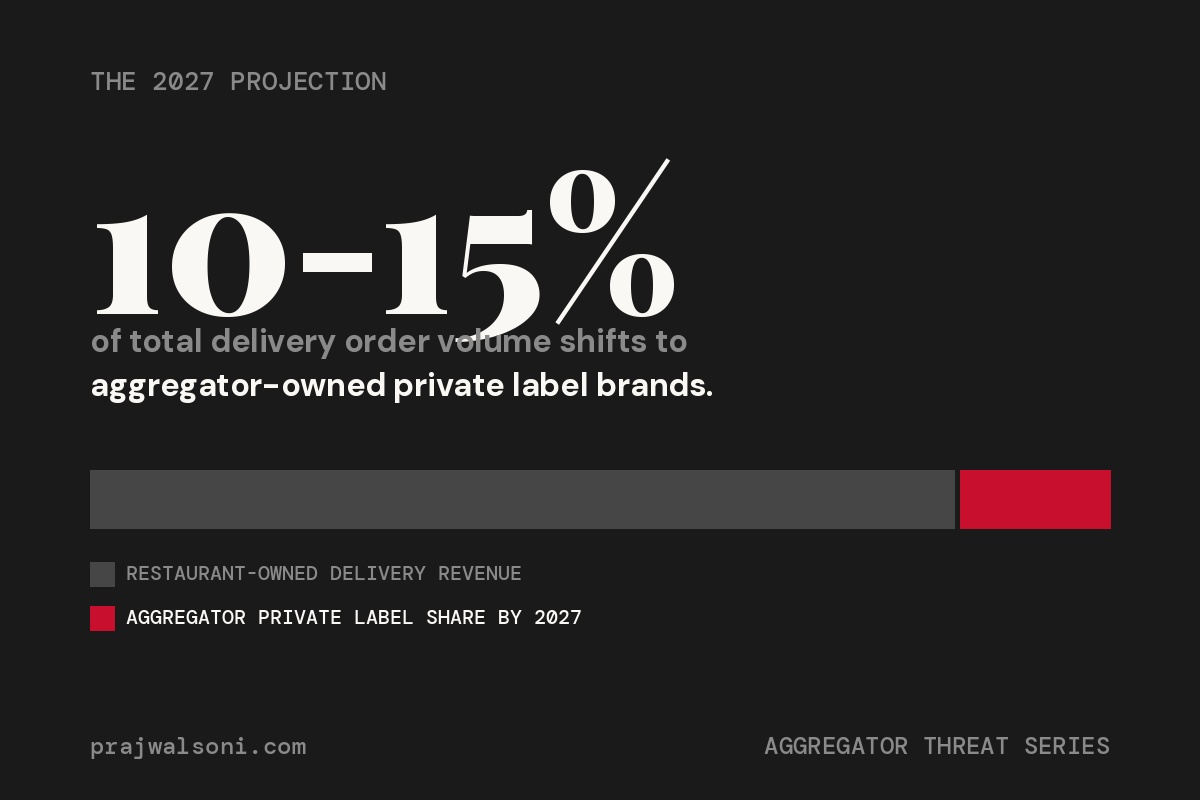
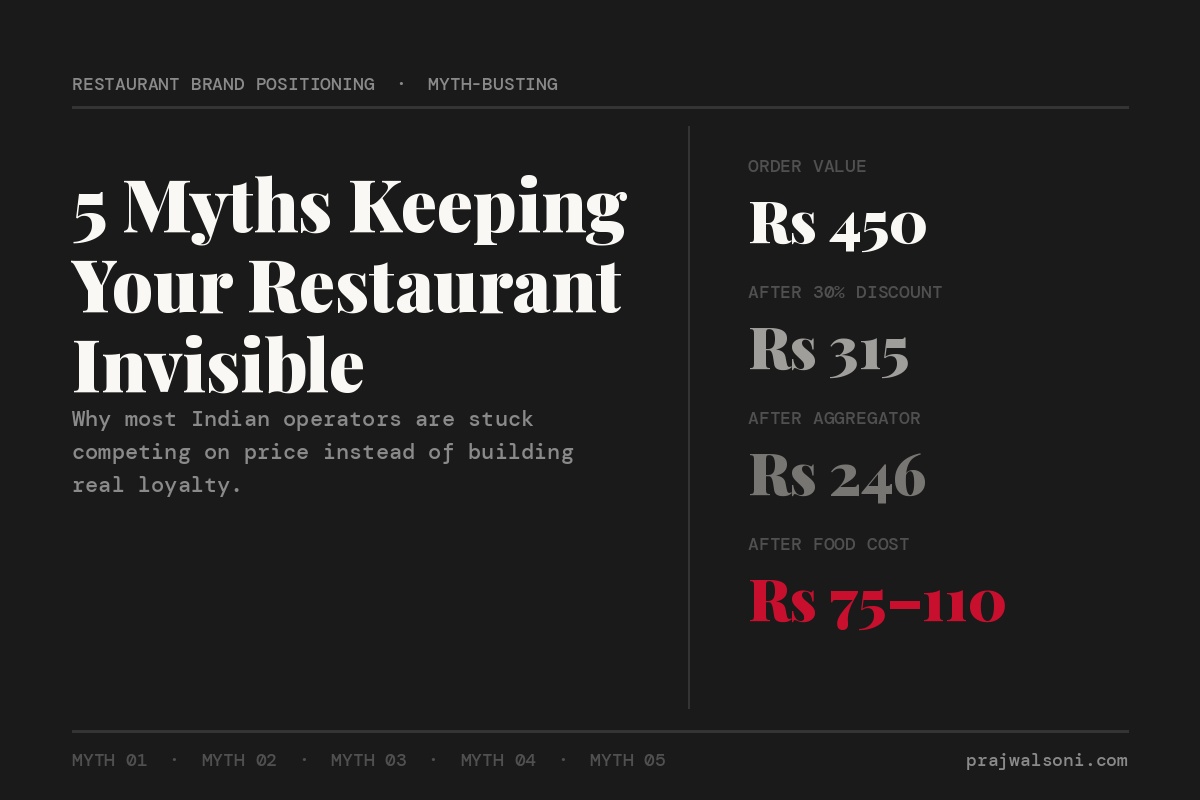
The bust: A cloud kitchen in 2026 that relies entirely on Swiggy and Zomato for discovery is paying 15-30% commission on every order. A GMB listing lets customers find your direct ordering link, your phone number, or your WhatsApp order line. Even if only 10% of your orders shift to direct because of Google discovery, that saves real commission money every month.
Google now allows food businesses to list their menu, mark delivery availability, and even integrate with ordering platforms. Cloud kitchen operators in Bengaluru and Pune who activate these features see direct order inquiries that bypass aggregator commissions entirely. I have written about the real cost of aggregator commissions and why reducing dependency matters for margins.
If you run a delivery brand, your GMB listing is not optional. It is your cheapest customer acquisition channel.
Myth 4: “Photos Don’t Matter. My Food Speaks for Itself.”
Your food cannot speak if nobody walks through the door. Photos are the first impression on Google Maps. Listings with more than 100 photos get significantly more direction requests and website clicks than listings with fewer than 10.
The bust: Google’s own help documentation confirms that businesses with photos receive 42% more direction requests and 35% more website clicks. For a restaurant, that translates directly to walk-in customers and online orders.
But here is where operators go wrong. They upload 50 photos during launch week and never add another one. Or they upload blurry phone shots of dal makhani under yellow kitchen lighting. Both hurt more than they help.
What Kind of Photos Actually Work?
Three categories matter most:
- Hero dish shots: Your top 5 bestsellers photographed in natural light. Clean background. No clutter. These are the photos that make someone say “I want that” while scrolling Google Maps at 7pm.
- Ambiance shots: Your seating area, entrance, and any distinctive design elements. These help dine-in customers picture themselves in your space before they arrive.
- Fresh weekly uploads: Even a well-lit photo of today’s thali special or a new gulab jamun plating tells Google your listing is active. Upload at least two photos per week.
You do not need a professional photographer. A modern smartphone with natural window light produces photos good enough for Google. Spend 10 minutes every Monday uploading fresh shots. That consistency alone puts you ahead of 80% of restaurants in your area.
For Swiggy and Zomato listing photos, the rules are similar but the stakes are even higher. Your menu pricing strategy means nothing if the thumbnail photo makes your biryani look grey.
Myth 5: “GMB Posts Are Pointless. Nobody Reads Them.”
GMB posts show up directly in your knowledge panel when someone searches your restaurant name. They appear right below your reviews and above your menu. Calling them pointless is like saying your restaurant’s front window display does not matter.
The bust: Posts serve two functions. First, they signal freshness to Google’s algorithm, which improves your local ranking. Second, they give you a free billboard to promote offers, new dishes, or events to anyone who searches for you by name.
A restaurant in Ahmedabad I consulted for started posting a weekly “Weekend Special” with a photo and a one-line description. Within a month, they noticed a measurable increase in weekend walk-ins. Customers specifically mentioned seeing the special on Google. The total time investment was 15 minutes per week.
Post types that work best for restaurants:
- Offers: “Flat 20% off on family platters this Sunday” with a photo of the platter.
- What’s New: “New masala chai kulfi just launched” with a photo.
- Events: “Live music every Friday 8pm onwards” if applicable.
Posts expire after seven days. So you need to post at least once a week to keep your panel fresh. Set a phone reminder for Monday morning. Upload a post before your chai gets cold.
This kind of zero-budget consistency is exactly what separates restaurants that grow from restaurants that fail in the first year.
The Positive Reframe: Google My Business Is Your Free Storefront
Think of your GMB listing as the storefront you never have to pay rent on. Dine-in still accounts for roughly 59% of India’s Rs 5.69 lakh crore foodservice industry, according to the NRAI IFSR 2024 report. A large chunk of those dine-in customers decide where to eat by searching Google Maps.
Every week you ignore your listing, you lose walk-in customers to the competitor down the street who updates theirs. The competitor does not have better food. They just have a better listing.
For operators already focused on dine-in profitability, GMB optimization is the lowest-cost way to increase covers without increasing ad spend. Your profit margin on a walk-in customer who found you on Google is always better than a delivery order through an aggregator.
What You Should Do This Week
Here are the five things to fix in the next seven days:
- Log into your Google Business Profile and verify that your phone number, hours, and address are 100% accurate.
- Upload 5 fresh photos of your top-selling dishes. Use natural light. No filters.
- Respond to every unanswered review, positive and negative, from the last 90 days.
- Create your first GMB post with a weekend offer or a new dish announcement.
- Ask your billing staff to request a Google review from every dine-in customer starting today.
None of this costs money. All of it costs attention. And attention is the one resource most operators waste on the wrong platforms.
Stop guessing. Start building. Get Design Dine Dominate, the complete restaurant business playbook from someone who has actually done it.

Leave a comment