Rs 22 Lakh in Equipment, Rs 6 Lakh Actually Earning Its Keep
Restaurant equipment procurement decisions should be driven by production volume, not by chef wishlists or supplier catalogues. The right equipment mix matches your peak-hour output needs, your menu complexity, and your service format. Most operators buy for an imagined future instead of their actual present, and the idle capacity eats their cash flow alive.
I walked into a QSR kitchen in Nagpur last October. The owner had opened four months earlier. He had spent Rs 22 lakh on kitchen equipment before serving his first order. A commercial combi oven worth Rs 4.8 lakh. A walk-in cold room sized for a 200-cover banquet operation. Two heavy-duty fryers when the menu had exactly three fried items.
His daily revenue was averaging Rs 18,000. On a good day, Rs 24,000. The kitchen ran two shifts but the combi oven fired up only during the lunch rush for about 90 minutes. The walk-in cold room was at 30% capacity because his actual inventory needs were a fraction of what the unit could hold. One of the two fryers had not been turned on in six weeks.
The equipment was brand new. Perfectly maintained. And almost entirely idle.
What Did the Equipment Audit Actually Reveal?
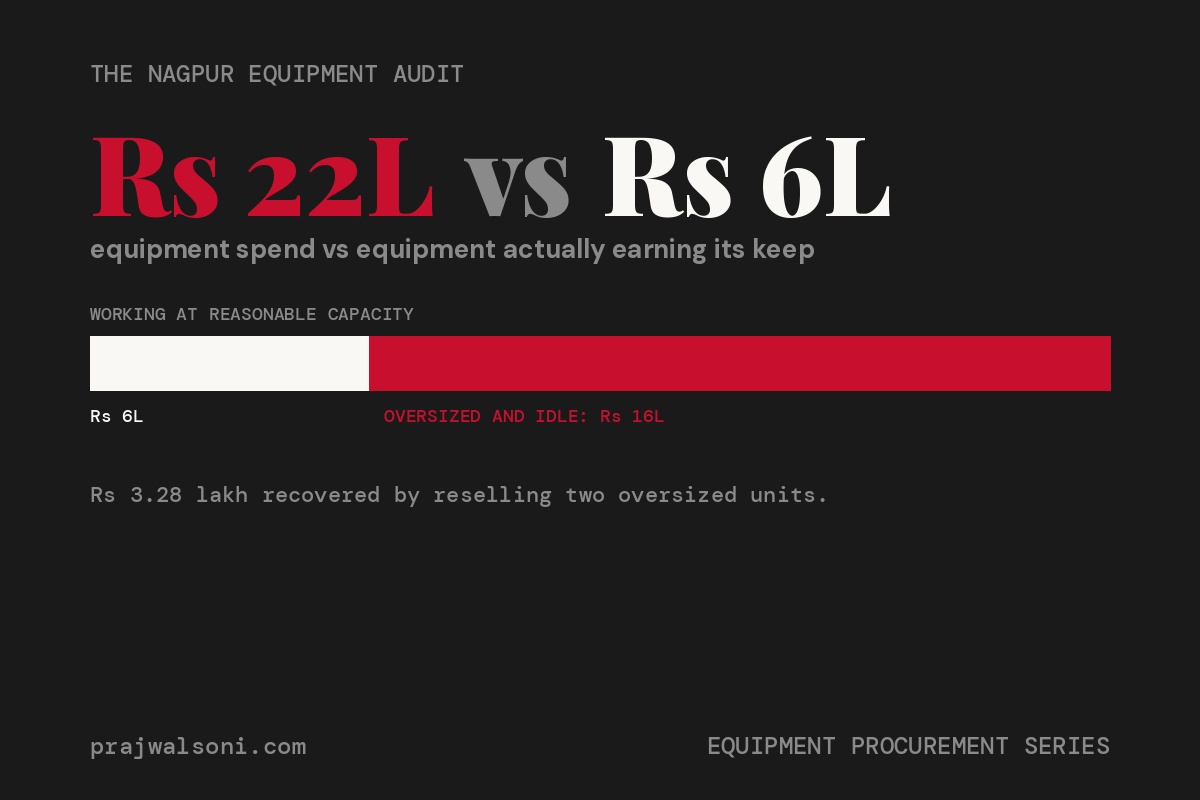
The audit revealed that Rs 16 lakh of the Rs 22 lakh equipment spend was oversized for the restaurant’s actual output. Only Rs 6 lakh worth of equipment was working at reasonable capacity during service hours. The rest was depreciating capital sitting on the kitchen floor, consuming electricity on standby, and occupying space that could have been used for prep stations.
Here is how the numbers broke down. The combi oven was being used as a glorified reheating unit. The owner had bought it because his chef said it would “future-proof” the kitchen. But the menu was wraps, rice bowls, and grilled sandwiches. A mid-range convection oven at Rs 1.2 lakh would have handled the same output comfortably.
The walk-in cold room cost Rs 3.5 lakh. His daily ingredient consumption was roughly Rs 6,500, meaning he was storing two to three days of inventory at most. A standard two-door commercial refrigerator at Rs 80,000 would have been sufficient. The walk-in was burning an extra Rs 4,200 per month in electricity alone compared to a right-sized unit.
The second fryer sat cold because the three fried items on the menu never generated enough simultaneous orders to need parallel frying capacity. Even during peak, one fryer handled the load with time to spare.
When I mapped equipment utilization against actual production data for a full week, the picture was brutal. The combi oven ran at meaningful capacity for 1.5 hours out of a 13-hour operating day. The walk-in ran 24/7 to keep 30% of its shelf space cold. This is what bad restaurant profit margins look like before you even get to food cost.
Why Do Restaurant Operators Overbuy Equipment?
Operators overbuy equipment because they confuse capacity with capability. They plan for the restaurant they hope to become in year three, then finance equipment for that fantasy with year-one cash flow. Three patterns cause this consistently.
First, the chef-driven procurement trap. Chefs specify equipment based on what they have used before, not on what your specific menu and volume require. A chef who worked at a 300-cover hotel banquet kitchen will spec a combi oven because that is what he knows. He is not thinking about your 80 orders per day.
Second, the supplier upsell. Equipment suppliers in Ahmedabad, Pune, and Bengaluru earn higher margins on larger units. When an operator walks in saying “I am opening a QSR,” the supplier does not ask about projected daily covers. He shows the premium range. I have seen this in every city I have consulted in.
Third, the fear of under-capacity. Operators worry about a day when orders spike and the kitchen cannot handle demand. So they buy for a spike that may never come, or that comes once a month. You do not buy a truck because you move furniture twice a year. But restaurant operators do the equivalent with kitchen equipment regularly.
This is the same pattern I see when operators scale without discipline. The instinct is always to buy bigger, faster, more. Rarely is the instinct to buy precisely what is needed today with a clear upgrade path for tomorrow.
What Was the Specific Intervention in the Nagpur Kitchen?
We did not rip out the equipment. That would have been a second waste of capital. Instead, we restructured the operation in three steps that recovered cash and reduced monthly operating costs immediately.
Step one: we listed the second fryer and the combi oven on a commercial kitchen equipment resale group. Within three weeks, the combi oven sold for Rs 2.9 lakh, roughly 60% of the purchase price. The fryer sold for Rs 38,000. That put Rs 3.28 lakh back into the business as working capital. We replaced the combi oven with a Rs 1.1 lakh convection oven that handled the menu perfectly.
Step two: we could not easily resell the walk-in cold room because it was a built-in unit. Instead, we repurposed half of it as a dry storage zone with proper shelving, which freed up 40 square feet elsewhere in the kitchen. That space became a dedicated packing station for delivery orders. Before this change, the team was packing Swiggy and Zomato orders on the same counter used for plating dine-in trays. The separation alone cut average order packing time from 4.5 minutes to 2.8 minutes.
Step three: we created a production capacity document. This is a one-page sheet that maps every piece of equipment to its maximum output per hour, its actual utilization percentage, and the break-even daily volume needed to justify the equipment’s depreciation cost. This document became the reference point for any future equipment decision.
The approach mirrors what I recommend for cloud kitchen profitability. Every square foot and every piece of steel in your kitchen needs to justify its presence with production data, not assumptions.
What Were the Actual Financial Results?
The results showed up in three areas within 60 days of implementation.
Monthly electricity cost dropped by Rs 8,400. The combi oven’s standby draw and the walk-in running at 30% capacity were the biggest drains. Removing the oven and reducing the cold room’s active cooling load made an immediate difference.
The Rs 3.28 lakh recovered from equipment resale covered almost two months of rent. For a restaurant doing Rs 18,000 per day in revenue, that cash injection was the difference between survival and shutdown. The owner had been considering a personal loan to bridge a cash gap. He did not need it after the resale.
The faster packing station increased delivery throughput during peak hours. Before the change, the kitchen was losing roughly 3-4 delivery orders per lunch rush because packing bottlenecked the line. After the dedicated station went live, those orders started getting fulfilled. At an average order value of Rs 280, that recovered roughly Rs 25,000-30,000 in monthly revenue that was previously being lost to cancelled or delayed orders.
Total monthly impact: approximately Rs 38,000 to Rs 42,000 in recovered revenue and reduced costs. On a base of Rs 5.4 lakh monthly revenue, that is a 7-8% margin improvement from one intervention. No menu change. No marketing spend. No aggregator commission negotiation. Just right-sizing equipment to match actual production reality.
Should You Buy or Lease Restaurant Kitchen Equipment?
The buy-versus-lease decision depends on three variables: your format certainty, your cash position, and the equipment’s expected utilization rate. There is no universal answer, but there is a clear decision framework.
Buy when you are operating an established format with proven demand. If you have run the same menu for 12 months and you know your tandoor runs at 80% capacity during service, buying a second one makes sense. You have the data. The risk is low.
Lease when you are launching a new concept, testing a new location, or running a cloud kitchen brand that might pivot its menu within six months. Equipment leasing in the Indian market typically runs Rs 3,000 to Rs 15,000 per month per major unit depending on the category. That feels expensive until you compare it to buying Rs 4 lakh of equipment that you resell for Rs 2.4 lakh eight months later because the concept did not work.
Leasing also makes sense for seasonal demand equipment. If you run a biryani brand and your dum cooking vessels are only at full capacity during weekends and festivals, leasing additional capacity for those periods costs less than owning units that sit idle five days a week.
One caution on leasing: read the maintenance clauses carefully. Some leasing companies in Surat and Ahmedabad charge repair costs separately, which can add 15-20% to the effective monthly cost. Get the all-inclusive maintenance terms in writing before signing.
This connects directly to cash flow management discipline. Whether you buy or lease, the question is the same: does this equipment decision protect or drain your operating cash?
How to Build a Production Capacity Document Before Buying Anything
A production capacity document matches each piece of equipment to your actual daily output needs. Build one before you sign a single purchase order. It takes about two hours and can save you lakhs.
Here is the process in four steps.
1. List every menu item and its required cooking equipment. A paneer tikka wrap needs a grill or tandoor. A dal makhani needs a pressure cooker and a finishing pan. Map every item to the specific equipment it requires.
2. Estimate your peak-hour order volume per item. If you project 60 orders per hour at peak and 40% of those include a grilled item, your grill needs to handle 24 grilled portions per hour. Most commercial grills handle 30-40 portions per hour. One grill is enough. You do not need two.
3. Calculate the utilization rate. If your grill can produce 35 portions per hour but you need 24, your utilization is roughly 69%. Anything between 60-85% utilization is the sweet spot. Below 50% means the equipment is oversized. Above 90% means you will bottleneck during rushes.
4. Calculate the daily depreciation cost per unit. If a Rs 1.5 lakh grill has a 5-year useful life, it depreciates at roughly Rs 82 per day. Your daily revenue from grilled items needs to comfortably exceed that depreciation plus the operating cost. If it does not, reconsider the purchase.
This is the same analytical rigour that separates restaurants doing healthy dine-in margins from those bleeding money while looking busy. The equipment is either earning or it is costing. There is no neutral.
The Generalising Principle: Buy for Today, Build an Upgrade Path for Tomorrow
The Nagpur case is not unusual. In my experience across restaurant setups in Ahmedabad, Pune, Surat, and Hyderabad, roughly 7 out of 10 new restaurants overspend on equipment by 30-50%. The NRAI’s India Food Services Report 2024 estimates the industry at Rs 5.69 lakh crore, but a significant portion of new entrants never survive long enough to contribute meaningfully because their capital is locked in steel they do not need.
The principle is simple. Buy for your current volume with a 20% buffer for growth. Not 50%. Not 100%. Twenty percent. When you consistently hit 80% utilization on a piece of equipment for four consecutive weeks, that is your signal to upgrade or add capacity. Not before.
Track utilization weekly on your POS system. Platforms like Petpooja and Posist can generate item-wise sales reports that map directly to equipment load. If your tandoor items account for only 15% of orders, that Rs 2.5 lakh tandoor is not a core asset. It is a liability.
Before you spend your next rupee on equipment, do this: pull your last 30 days of item-wise sales from your POS. Map every item to the equipment it requires. Calculate the utilization rate of each piece of equipment you already own. If anything is below 50%, you either need to build menu items that use it or sell it and recover the capital.
Also review how you price your menu because equipment costs are part of your overhead, and your pricing needs to account for depreciation and utilization, not just food cost. Similarly, understand your GST obligations on equipment purchases because input tax credit rules affect whether buying or leasing is more tax-efficient for your specific situation.
Stop guessing. Start building. Get Design Dine Dominate, the complete restaurant business playbook from someone who has actually done it.

Leave a comment