A restaurant in Ahmedabad uploaded 74 items to Zomato last year. Forty-one of those items had no image. Twelve had descriptions that said things like “our special” or “chef’s choice” with no actual detail. By Q3 2025, the platform’s algorithm had buried most of those items below the scroll line. Orders dropped 23% in four months, and the operator blamed “Zomato suppressing us.” The platform did not suppress anything. It rewarded restaurants with cleaner, more complete menus. This is menu standardisation aggregators are already pushing, and most operators have not noticed.
What Is Menu Standardisation and Why Are Aggregators Pushing It?
Menu standardisation means platforms enforce consistent structure for item names, descriptions, images, pricing formats, and category tags across every restaurant on their marketplace. Swiggy and Zomato are moving toward this because it improves search accuracy, enables AI-driven recommendations, and increases average order values across the platform.
Think about it from the platform’s side. When a customer in Pune searches for “paneer tikka,” the algorithm needs to match that query to a specific item in your catalog. If your menu lists it as “Pnr Tikka Special” with no description and a blurry photo, the platform cannot confidently serve that result. So it shows the restaurant next door that has a clean listing, a proper image, and a 40-word description.
Both platforms have already started this process quietly. Zomato introduced catalog hygiene scores in late 2024. Swiggy started rejecting low-resolution menu images in select cities. Neither platform has announced a hard mandate yet. But the pattern is clear to anyone paying attention.
This is not a cosmetic change. It is an infrastructure shift that will determine which restaurants the algorithm promotes and which ones it buries. If you care about your restaurant profit margins, you need to care about this.
What Signals Are Already Visible Right Now?
Three concrete signals confirm this direction. First, Zomato’s menu audit notifications started reaching restaurants in Bengaluru and Hyderabad in early 2025, flagging incomplete descriptions and missing allergen tags. Second, Swiggy’s restaurant partner dashboard now shows a “menu completeness score” that directly correlates with search placement. Third, both platforms are building item-level data layers for AI search and voice ordering.
Voice ordering is the force multiplier here. When a customer says “order butter chicken near me” to a voice assistant, the system needs exact item-level data to fulfil that request. Vague menu entries cannot be parsed by voice AI. Platforms know voice and conversational ordering will grow significantly over the next 24 months, so they are preparing the data layer now.
Also consider how quick commerce is reshaping delivery expectations. Platforms like Blinkit and Zepto have already standardised product listings to the SKU level. Swiggy and Zomato are watching that playbook closely. Food is messier than packaged goods, but the direction is the same.
Where Do Most Operators Stand Today?
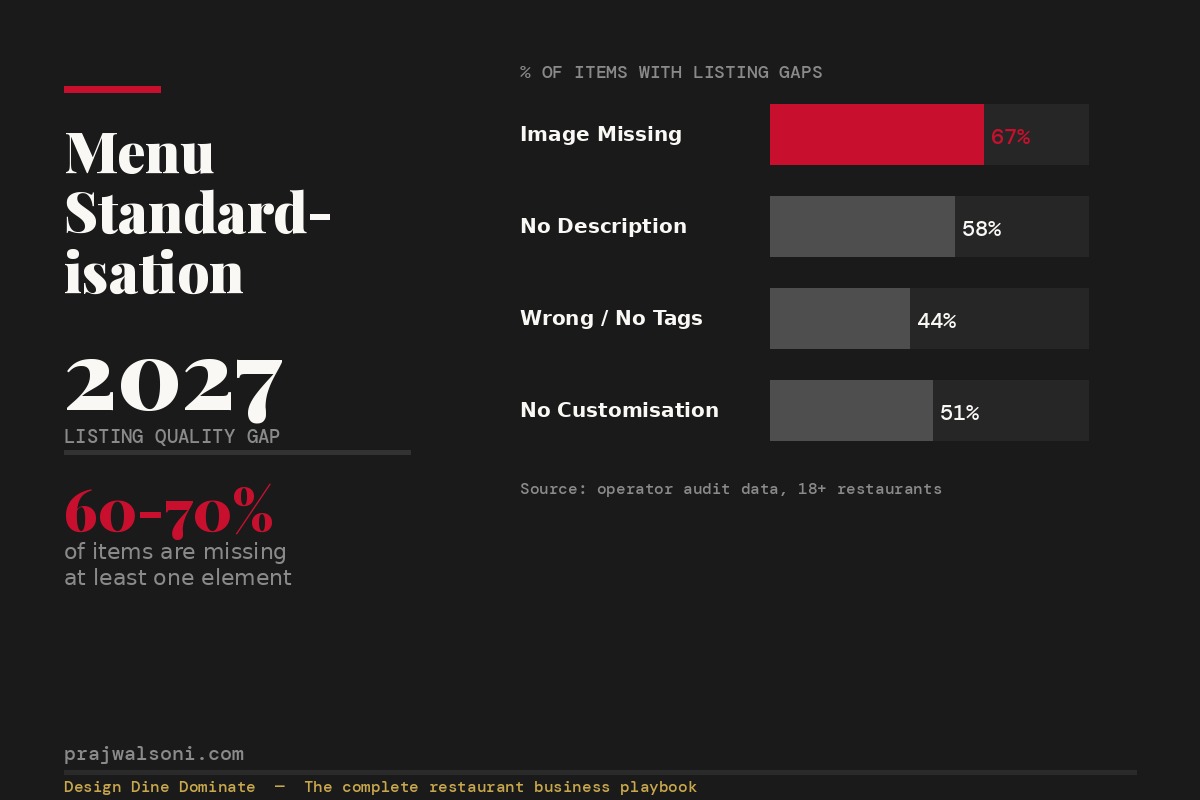
Most operators treat their aggregator menu as a one-time upload they never revisit. In restaurants I have consulted for, roughly 60-70% of menu items on Swiggy or Zomato are missing at least one of these: a proper image, a description over 20 words, correct dietary tags, or accurate customisation options.
The typical operator in Surat or Nagpur copies the dine-in menu into the aggregator dashboard, uploads whatever photos they have, and moves on. Then they wonder why their dal makhani sells well in the restaurant but gets zero orders online. The answer is almost always a listing problem, not a food problem.
Here is what a poorly standardised menu looks like on most dashboards:
- Item names use internal kitchen shorthand instead of customer-facing language
- Descriptions are either missing or say “served with rice” and nothing else
- Images are taken on a phone with bad lighting and no consistency in plating or angle
- Categories are bloated with 15+ items per section, making scroll depth unbearable
- Customisation options like “extra cheese” or “less spicy” are not configured
Every one of those issues reduces your conversion rate per item. Platforms already reward restaurants that fix them. By 2027, they will likely penalise restaurants that do not.
How Will Menu Standardisation Affect Restaurant Revenue by 2027?
Restaurants with fully standardised menus will capture a disproportionate share of platform search traffic. Those without will see gradual visibility loss, lower conversion rates, and shrinking order volumes even if their food quality stays the same.
This is not speculation. It follows the exact pattern every marketplace has followed. Amazon penalises incomplete product listings. Google penalises unstructured web content. Swiggy and Zomato will do the same to unstructured menus because it serves their business model.
The NRAI India Food Services Report 2024 values the food services industry at Rs 5.69 lakh crore, with the organised segment growing at 13.2% CAGR. That growth is increasingly captured through digital channels. If your digital menu is a mess, you are losing share of that growth every single week.
For cloud kitchen operators running multiple brands, the impact is even sharper. I have written about cloud kitchen profitability metrics in detail. A cloud kitchen lives and dies on its platform listing. There is no walk-in traffic to compensate for a bad digital presence. When standardisation becomes a ranking factor, cloud kitchens with messy menus will simply stop appearing in results.
The aggregator commission structure already takes 15-30% of your order value depending on your plan and city. If you are paying that commission but your menu is not optimised to convert, you are essentially renting shelf space in a supermarket and leaving your products unlabelled.
What Should Operators Do in the Next 90 Days?
Start treating your aggregator menu like a revenue asset, not an admin task. Here are five specific actions you can take before the next quarter ends.
- Audit every item listing. Open your Swiggy and Zomato dashboards this week. Flag every item missing an image, a description over 25 words, or correct veg/non-veg/egg tags. Fix the top 20 selling items first.
- Shoot consistent food photography. You do not need a professional photographer. Use natural daylight, a clean white or dark background, and the same angle for every dish. Consistency matters more than perfection. Budget Rs 3,000-5,000 for a basic setup.
- Rewrite descriptions for search. Include the dish name, key ingredients, preparation style, and serving size. “Paneer Tikka” becomes “Paneer Tikka — charcoal-grilled cottage cheese marinated in yoghurt and spices, served with mint chutney, 6 pieces.” This helps both human customers and platform search algorithms.
- Trim your menu. If you have 80+ items, you almost certainly have 30 that get fewer than 5 orders per month. Remove them. A focused menu converts better and is easier to standardise. I covered the math behind menu pricing and structure here.
- Configure customisation options. Add spice level, portion size, and add-on options for your top sellers. Platforms weight listings with more customisation options because they increase average order value.
If you use a POS system like Petpooja or Posist, check whether it syncs menu changes to aggregator platforms through middleware like UrbanPiper. Manual updates across multiple platforms create inconsistencies that will hurt you when standardisation scoring gets stricter.
Will This Hurt Small Restaurants More Than Chains?
Yes, initially. Chains already have brand teams that manage digital menus with consistent photography, structured descriptions, and regular updates. A single-outlet operator in Ahmedabad or Pune typically does this work themselves, often badly, because they are also managing the kitchen, staff, and suppliers.
But here is the opportunity. Most chains have bloated menus with hundreds of items. A small operator with 25 well-photographed, well-described items can outperform a chain with 120 poorly listed items on platform search. The algorithm does not care about brand size. It cares about listing quality and conversion data.
Small operators who move now, before standardisation becomes mandatory, will build a visibility advantage that compounds over time. Platform algorithms reward consistency. If your menu is clean for six months straight, your baseline ranking improves. Waiting until the mandate drops means starting from zero while competitors are already ranked.
This is the same pattern I see with operators who try to scale without discipline. The ones who build systems early always outperform the ones who scramble to catch up later.
The Bigger Picture: Platforms Are Becoming the Menu
The long-term implication is uncomfortable but operators need to hear it. For delivery-heavy restaurants, the aggregator listing IS your menu. Most customers never see your physical menu card. They decide what to order based entirely on what the platform shows them.
That means platform rules about naming conventions, image standards, and description formats will effectively dictate how you present your food to the majority of your customers. You can resist that reality or you can work within it and win.
Operators focused on dine-in profitability have a buffer because their in-house menu remains under their control. But even dine-in restaurants are seeing 20-35% of revenue from delivery in most Indian cities. Ignoring platform menu standards means ignoring a third of your revenue.
Also, consider this from an AI and direct ordering perspective. If you eventually build your own ordering channel, the discipline of structured menus transfers directly. Clean item data, proper images, and complete descriptions work everywhere. Building that muscle now pays off regardless of which channel grows.
Key Takeaway
- Swiggy and Zomato are already scoring menu quality and using it to determine search placement
- By 2027, menu standardisation will likely shift from a ranking boost to a hard requirement
- Roughly 60-70% of restaurant menu items on aggregator platforms are missing images, descriptions, or correct tags
- Small operators who standardise now can outrank chains with larger but messier catalogs
- The five-step audit above costs under Rs 5,000 and can be completed in a single week
Pull up your Swiggy and Zomato dashboards today. Check your menu completeness score. Identify your top 20 items by order volume and fix every single listing gap this week. Do not wait for a platform email telling you to comply. By then, your competitors will already be ranked above you.
Stop guessing. Start building. Get Design Dine Dominate, the complete restaurant business playbook from someone who has actually done it.

Leave a comment