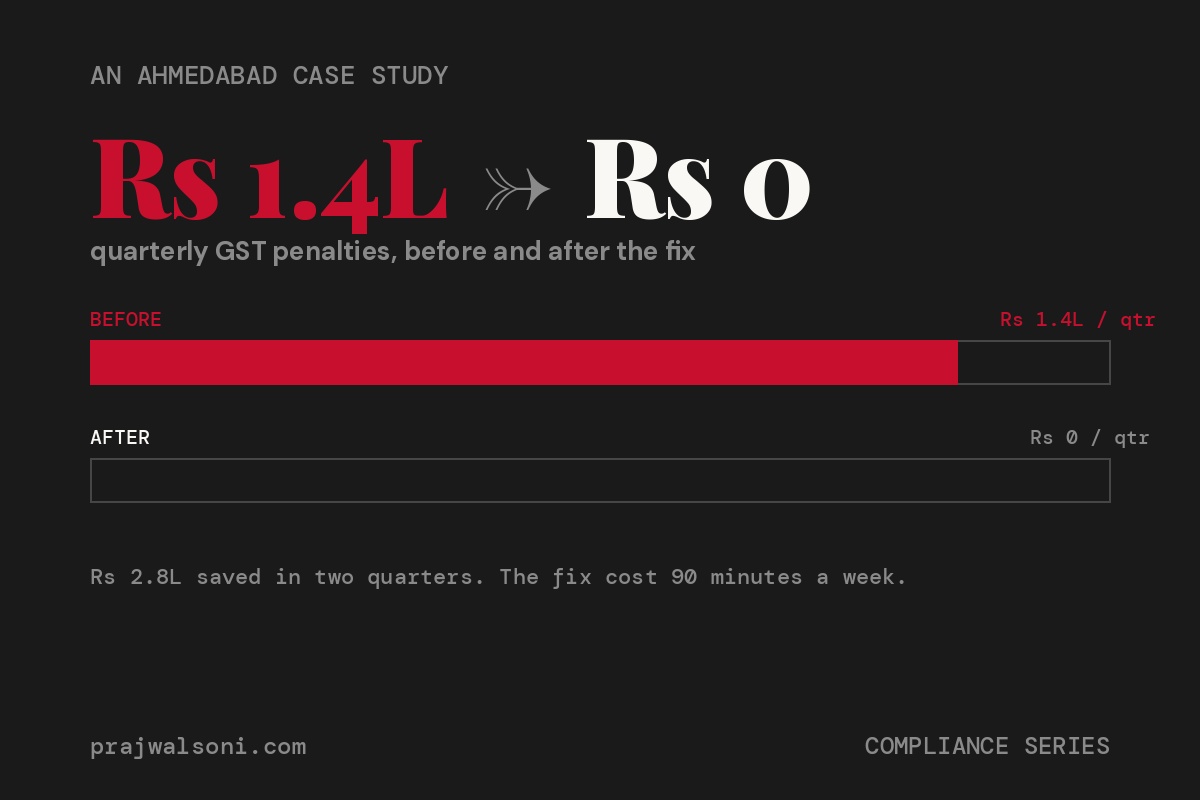
The Situation: Rs 4,200 Per Day in Thali Sales, Rs 1.4 Lakh Per Quarter in GST Penalties
GST compliance for restaurants means filing accurate returns on time, applying the correct tax rate to every invoice, and reconciling input credits monthly. When this breaks down, the penalties compound fast. Most restaurant operators in India lose between Rs 30,000 and Rs 2 lakh per quarter to avoidable GST errors.
I walked into this Ahmedabad thali restaurant in early 2025. The format was simple. Unlimited thali, two locations, average ticket size of Rs 280. Daily covers across both outlets were roughly 1,500. Revenue was healthy. The owner was convinced his only problem was food cost.
He was wrong. His actual bleeding point was sitting in a drawer full of GST notices. Over the previous four quarters, he had paid Rs 5.6 lakh in penalties and interest. That is Rs 1.4 lakh per quarter, gone. Not to rent. Not to ingredients. To the government, for mistakes his CA could have prevented.
The owner’s response when I flagged it was the same thing I hear from operators in Surat, Pune, and Nagpur: “My CA handles all of that.” That sentence has cost more restaurants more money than bad food ever has.
What Were the Actual GST Compliance Errors?
Three distinct errors were draining this restaurant. Each one is common across the industry, and each one was completely fixable. The problem was nobody looked until the penalty notices arrived.
Error 1: Wrong GST rate on delivery orders. The restaurant was charging 5% GST on all orders, including delivery orders placed through Swiggy and Zomato. Since January 2022, GST on restaurant services supplied through e-commerce operators is collected at 5% without input tax credit, but the restaurant was also claiming ITC on purchases related to delivery. That mismatch triggered notices. The penalty for incorrect ITC claims under Section 73 of the CGST Act runs 10% of the tax amount, plus 18% annual interest on the shortfall.
Error 2: Late GSTR-3B filings for three consecutive months. The CA was filing returns 15 to 40 days late. Late filing fees under GST are Rs 50 per day for CGST and Rs 50 per day for SGST. That is Rs 100 per day for a regular taxpayer. For three months of delays averaging 25 days each, the late fees alone were Rs 7,500. But the real cost was interest at 18% per annum on the unpaid tax amount for each delayed period.
Error 3: Mismatched GSTR-2A and GSTR-3B. The restaurant’s purchase invoices did not match the supplier filings. Roughly Rs 3.8 lakh worth of purchases per quarter had no matching entry in the supplier’s GSTR-1. Because the restaurant operated under the 5% scheme without ITC, this should not have mattered. But the CA had been filing under the regular scheme for the dine-in entity, claiming ITC that could not be verified. The department flagged it.
Why Do Restaurant Operators Ignore GST Compliance Until Penalties Hit?
Operators ignore GST compliance because the consequences are invisible until they are expensive. Unlike food cost or rent, you do not feel the penalty in your daily cash register. It shows up as a notice three months later, and by then the damage is compounded.
In my experience across restaurant consulting, three patterns drive this neglect. First, operators delegate tax filing to a CA and never verify the output. Second, restaurant-specific GST rules are genuinely confusing. The 5% without ITC versus 18% with ITC distinction trips up even experienced accountants who do not specialize in food service. Third, most restaurant profit margins in India sit between 8% and 15%. A Rs 1.4 lakh quarterly penalty on a business doing Rs 35-40 lakh in quarterly revenue wipes out roughly 3.5% of revenue. That is the difference between a 12% margin and an 8.5% margin.
This is not a tax problem. It is a profit margin problem wearing a tax costume.
What Was the Specific Fix for This Ahmedabad Restaurant?
The fix involved four interventions, implemented over six weeks. None of them required new software. All of them required the owner to spend 90 minutes per week on something he had been outsourcing blindly.
1. Separate GST registration clarity for dine-in and delivery. The restaurant confirmed its scheme: 5% without ITC for restaurant services. All ITC claims were reversed for the current period. Going forward, purchase invoices were categorized but not claimed as input credits. This alone eliminated the mismatch risk.
2. Weekly invoice reconciliation, not monthly. Every Friday, the manager pulled the week’s purchase invoices and cross-checked them against supplier GSTIN numbers using the GST portal’s invoice matching tool. This took roughly 45 minutes per week. Previously, nobody did this until the CA asked for documents at quarter-end. The cash flow management discipline extended to tax documentation.
3. Filing deadline ownership moved to the owner. The CA still prepared the returns. But the owner set a personal calendar reminder for the 15th of every month. If the CA had not shared a draft GSTR-3B by the 12th, the owner followed up. This simple accountability step eliminated late filings entirely.
4. Aggregator commission reconciliation against GST. Swiggy and Zomato charge commission plus 18% GST on that commission. For a restaurant paying 22% commission on a Rs 500 order, the commission is Rs 110. GST on that commission is Rs 19.80. The total deduction is Rs 129.80, not Rs 110. The owner was recording only the commission amount, not the GST component, which created a Rs 15,000 to Rs 20,000 monthly gap in his books. Understanding how aggregator commissions actually work is essential for accurate GST accounting.
What Were the Results After Two Quarters?
After implementing these four changes, the restaurant paid zero penalties in the next two quarters. That is Rs 2.8 lakh saved over six months. The total cost of implementing the fixes was essentially zero in terms of technology or new hires. The only investment was the owner’s time: 90 minutes per week.
The indirect benefit was larger. Because the books were now clean, the owner could finally see his actual net profit margin without distortion from penalty charges. His real operating margin was 13.2%, not the 9.8% his previous P&L showed. The penalties had been masking a fundamentally healthy business.
I have seen this pattern repeat across cloud kitchens and dine-in formats. When operators clean up their GST compliance, they often discover their actual margins are better than they thought. The problem was never the business model. The problem was financial noise created by avoidable errors. Operators focused on cloud kitchen profitability often miss this because they assume smaller formats have simpler tax obligations. They do not.
How Should Restaurant Operators Structure Weekly GST Compliance?
GST compliance for restaurants should follow a weekly rhythm, not a monthly or quarterly one. The weekly cadence catches errors when they are small and fixable, not after they have compounded into penalty notices.
Here is the weekly routine that works, based on what I have implemented across multiple restaurant brands:
Every Monday: Download the previous week’s sales summary from your POS. Petpooja, Posist, and most Indian POS platforms generate GST-ready sales reports. Verify that the tax rate applied matches your registered scheme. If you are on 5% without ITC, every invoice should reflect 2.5% CGST and 2.5% SGST.
Every Wednesday: Collect and file all purchase invoices received that week. Check that every supplier invoice has a valid GSTIN. If a supplier does not have a GSTIN, you cannot claim ITC on that purchase, and the invoice should be flagged separately. For restaurants on the 5% scheme, this matters less for ITC but still matters for accurate expense recording and potential audits.
Every Friday: Reconcile aggregator payouts. Swiggy and Zomato settle weekly. Compare the payout amount against your order records. Check that the commission percentage matches your agreement. Verify the GST charged on commission. Record the net amount correctly. This step alone prevents the Rs 15,000 to Rs 20,000 monthly gap I described earlier.
This entire weekly process takes about 90 minutes total. For a business doing Rs 10-15 lakh per month, 90 minutes per week to prevent Rs 1 lakh or more in quarterly penalties is the highest-ROI activity you can do. It beats spending that same 90 minutes on Instagram content.
The Generalizing Principle: Your CA Is Not Your Compliance System
The deeper lesson from this Ahmedabad case is not about GST rates or filing deadlines. It is about ownership. Your CA is a service provider. Your CA files what you give them. If what you give them is incomplete, late, or categorized incorrectly, the filing will be wrong. The penalty comes to you, not to them.
Restaurant operators who treat compliance as someone else’s job will keep paying for that delegation in penalties and interest. Operators who spend 90 minutes a week on it will not. The math is that simple.
According to the NRAI India Food Services Report 2024, the organized restaurant segment is growing at 13.2% CAGR. As the industry formalizes, GST scrutiny on restaurants will only increase. The department is already using data analytics to flag mismatches between aggregator-reported sales and restaurant GST filings. If your Swiggy dashboard shows Rs 8 lakh in monthly orders and your GSTR-1 shows Rs 6.5 lakh, that gap will generate a notice.
I have worked with operators running 23 cloud kitchen brands and managed restaurants across Gujarat. The pattern is always the same. Operators who build financial discipline into their weekly operations, from menu pricing to tax compliance, are the ones hitting 15% net margins. Those who treat finance as a quarterly surprise stay stuck at 5-8%.
The Central Board of Indirect Taxes and Customs (CBIC) portal has all the rate clarifications and circulars specific to restaurant services. Bookmark it. Your CA should be referencing it. If they are not, you need a different CA.
Three Facts to Remember
1. GST compliance for restaurants is a weekly discipline, not a quarterly filing task. Ninety minutes per week prevents lakhs in annual penalties.
2. The 5% without ITC scheme means you cannot claim input tax credits on purchases. If your CA is filing ITC claims under this scheme, you will get a notice. It is not a question of if.
3. Aggregator commission GST (18% on the commission amount) must be recorded separately. The gap between recorded and actual deductions compounds silently every month.
Your Move This Week
Pull your last four quarters of GST filings. Compare them against your POS sales reports and your Swiggy and Zomato payout statements. If the numbers do not match within 2%, you have a problem that is costing you money right now. Call your CA and ask them to explain every line item. If they cannot, find one who can.
Stop guessing. Start building. Get Design Dine Dominate, the complete restaurant business playbook from someone who has actually done it.

Leave a comment