Swiggy’s private label brand The Bowl Company operated out of over 100 kitchens across India at its peak. Zomato acquired Blinkit and has been testing ready-to-eat meals through quick commerce. These are not side experiments. They are a signal that aggregator private labels will directly compete with restaurant operators for delivery revenue within the next 18 months.
What Are Aggregator Private Labels and Why Should You Care?
Aggregator private labels are food brands owned and operated by platforms like Swiggy and Zomato themselves. They use cloud kitchen infrastructure to sell meals directly to customers on their own apps, competing with the very restaurants that pay them commissions. For operators in Ahmedabad, Bengaluru, or Pune, this means the platform you depend on for 40-60% of your orders is also becoming your competitor.
This is not speculation. Swiggy ran The Bowl Company, Homely, and other house brands. Zomato tested similar concepts before pivoting deeper into quick commerce with Blinkit. The playbook is borrowed from Amazon and Flipkart, where private labels now account for a meaningful chunk of GMV in categories like electronics and apparel. Food is next.
The reason this matters to you specifically is data. Aggregators know exactly which dishes sell most in your pin code. They know the price points that convert. They know peak order windows. When they launch a private label biryani brand in your area, they are not guessing. They are using your sales data to build a product designed to take your customer.
Where Are Aggregator Private Labels Headed by 2027?
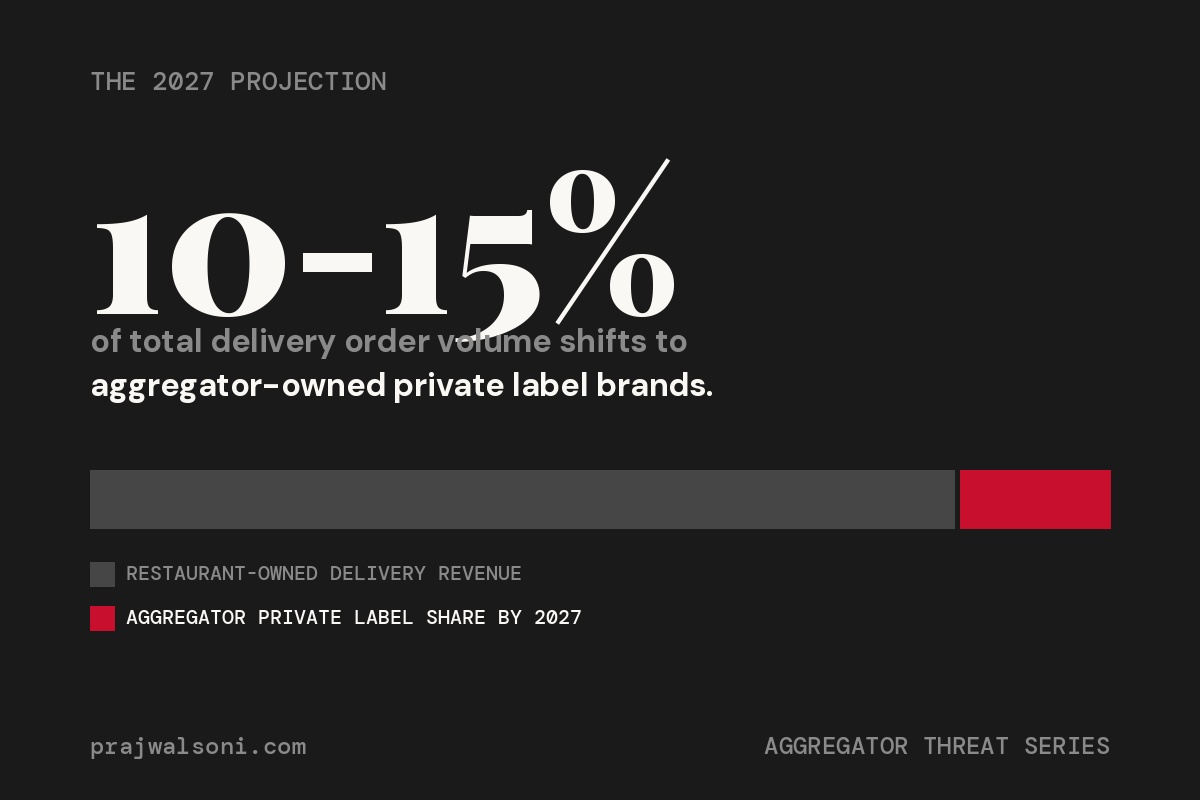
Private label food brands from aggregators will likely capture 10-15% of total delivery order volume on their platforms by 2027. This projection is based on two observable trends. First, quick commerce platforms like Blinkit and Zepto are already normalizing branded ready-to-eat meals. Second, aggregators are investing heavily in kitchen infrastructure that does not depend on restaurant partners.
The NRAI India Food Services Report 2024 values the industry at Rs 5.69 lakh crore. Online delivery is the fastest-growing segment. When the platform controls both the demand side and the supply side, restaurant operators lose pricing power. You cannot negotiate commissions from a position of strength when the platform can replace you with its own brand.
The pattern is clear if you watch adjacent industries. Flipkart’s SmartBuy and Amazon Basics started small. Within five years, they dominated high-margin categories. Aggregators will do the same with high-volume, low-complexity food categories first. Think: dal makhani bowls, paneer tikka wraps, and fried rice combos priced 15-20% below your menu.
Which Restaurant Segments Are Most Vulnerable?
Operators running undifferentiated delivery menus in the Rs 150-300 price range face the highest risk. If your top-selling items are generic north Indian combos or basic Chinese, an aggregator private label can replicate that with lower food costs and zero commission overhead. Cloud kitchen operators in Surat, Nagpur, and tier-2 cities are especially exposed because delivery volumes are more concentrated on fewer platforms.
I have seen this in consulting engagements. Brands that rely on volume over identity get squeezed hardest when a cheaper alternative appears on the same platform. If your customer cannot tell the difference between your fried rice and the platform’s fried rice, they will pick the one that is Rs 30 cheaper. Every time.
Restaurants with strong dine-in brands, regional specialties, or cult followings are less vulnerable. A private label cannot replicate the Hyderabadi dum biryani from a 40-year-old family recipe. But it can absolutely replicate the “chicken biryani” listing that looks identical to 200 other listings on the same search page. Your menu pricing strategy and brand positioning decide which side of this line you fall on.
How Does This Change Your Relationship with Aggregators?
Your relationship with Swiggy and Zomato shifts from partner to competitor-dependent. You pay them 15-30% commission while they use the data from your transactions to build competing products. This is not a conspiracy theory. It is a business model that has played out in every marketplace platform globally.
The practical implication is that your profit margins on delivery will get tighter. Aggregators can undercut you because they do not pay commissions to themselves. Their food cost might be similar, but their effective margin on every order is 15-30% better than yours before they even optimize anything else.
Operators who build direct ordering channels now will be better positioned. A WhatsApp ordering system, your own website, or a loyalty program that captures customer data outside the aggregator ecosystem gives you a buffer. The tools to reduce aggregator dependence already exist. Most operators just have not prioritized them because delivery orders still feel easy.
What Should Operators Do in the Next 12 Months?
Preparation starts with three specific moves you can execute before this trend hits your P&L directly.
1. Audit your delivery menu for replaceability. Look at your top 10 delivery items. Ask honestly: could a cloud kitchen with no brand identity sell the same dish at a lower price? If yes, those items need differentiation. Signature sauces, unique combinations, or regional authenticity that a private label cannot copy. Generic menus are the first casualty.
2. Build a direct ordering channel and actually use it. This does not mean just having a website. It means actively driving customers to order directly. Offer Rs 50 off on the first direct order. Include a QR code in every delivery bag. Track what percentage of your repeat customers order directly versus through aggregators. If that number is below 20%, you are too dependent.
3. Strengthen your dine-in and takeaway revenue. The margins on dine-in are structurally better than delivery. Aggregator private labels cannot touch your dine-in experience. Restaurants that maintain a healthy mix across channels, rather than going all-in on delivery, will survive this shift with margins intact.
Also, track your cash flow weekly, not monthly. When aggregator private labels start pulling volume from your delivery business, the impact shows up in cash flow before it shows up in your monthly P&L. Weekly tracking gives you a 3-4 week head start on course correction.
The Bigger Picture for Restaurant Operators in India
Aggregator private labels are one part of a larger shift. Quick commerce is already changing how customers think about convenience food. Blinkit delivers ready-to-eat meals in 10 minutes in cities like Delhi and Mumbai. Zepto is expanding the same model. The customer who used to order from your restaurant at 9 PM now has three more options that did not exist 18 months ago.
The operators who will thrive are the ones who stop treating aggregators as their primary growth engine. Delivery is a channel, not a strategy. If your entire business depends on ranking well on Swiggy or Zomato, you are building on rented land. The landlord just announced they are opening their own shop next door.
This is not a reason to panic. It is a reason to build. Build your brand outside the aggregator. Build loyalty programs that keep customers coming back to you, not to the platform. Build a menu that a private label cannot photocopy.
Pull up your aggregator dashboard this week. Look at your top 5 delivery items. For each one, write down what makes it impossible for a private label to replicate. If you cannot write anything, that is the item you need to fix first.
Stop guessing. Start building. Get Design Dine Dominate, the complete restaurant business playbook from someone who has actually done it.

Leave a comment