A restaurant operator in Surat told me he was ready to open his second location. Monthly revenue at the first unit was Rs 14 lakh. Sounded healthy. Then I asked him three questions about his restaurant unit economics, and by the end of the conversation, he decided to wait six more months. That wait saved him roughly Rs 22 lakh in avoidable losses. The problem was not ambition. The problem was that his first location was not generating the kind of surplus that could absorb the cost of building, staffing, and stabilizing a second one.
This is the most common expansion mistake in India right now. Revenue looks good. The kitchen runs. Customers keep coming. So the operator signs a second lease. But revenue is not the same as unit economics, and confusing the two is how profitable single-unit restaurants become bleeding multi-unit operations.
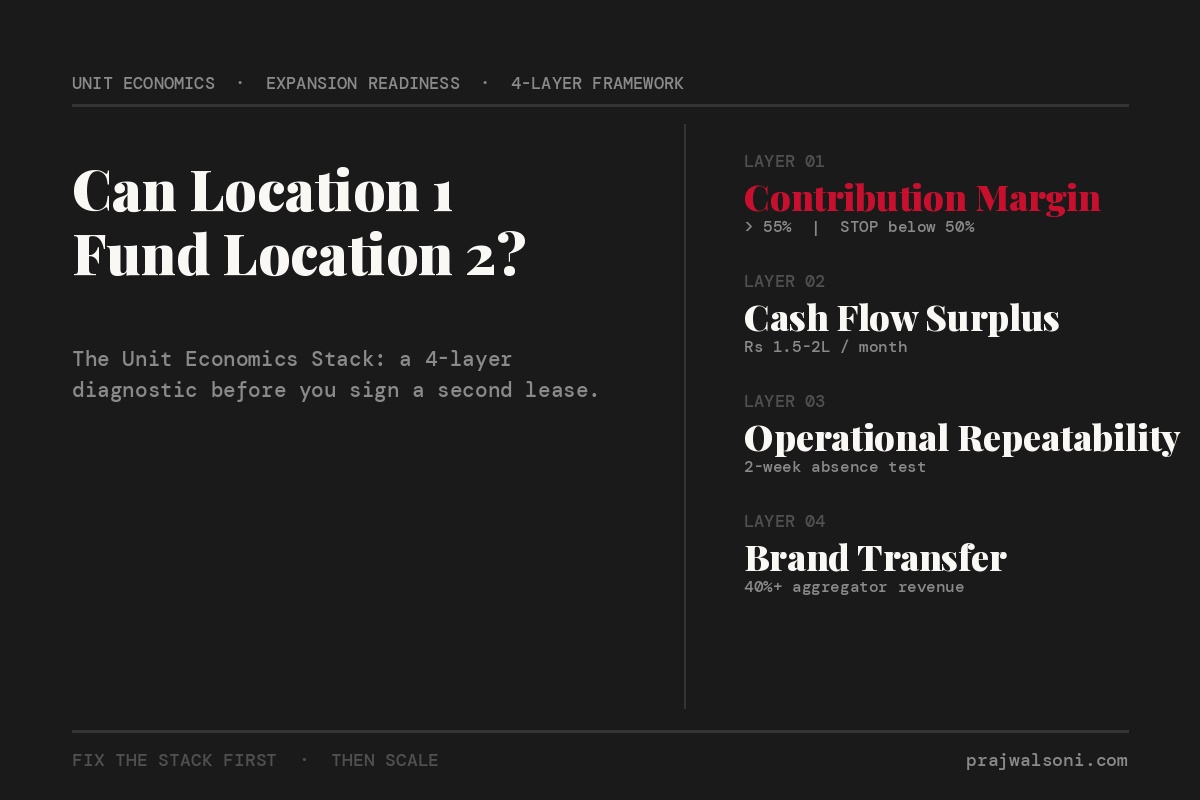
I built the Unit Economics Stack to solve this. It is a four-layer diagnostic framework that tells you whether your first location is genuinely ready to fund a second. Not based on how you feel about the brand. Based on numbers you can pull from your POS and accounting system this afternoon.
What Problem Does the Unit Economics Stack Solve?
The Unit Economics Stack solves the problem of premature expansion. It prevents operators from opening a second location before their first unit generates enough free cash flow, margin stability, and operational consistency to absorb the financial shock of replication. Most restaurants that fail at scaling do not fail because of the second location. They fail because the first one was not strong enough to carry both.
According to the NRAI India Food Services Report 2024, the organized restaurant segment is growing at 13.2% CAGR. Operators see this growth and assume expansion is the logical next step. But growth in the industry does not mean growth in your P&L. I have consulted for restaurants across Ahmedabad, Pune, and Nagpur where the owner was already scouting locations for unit two while unit one was operating at 6% net margin. That is a margin so thin that one bad month at the new location could wipe out six months of profit at the old one.
The real question is not whether you want to scale. Every operator does. The question is whether your current unit’s economics give you the right to. I covered the broader mindset traps of scaling in this piece on restaurant scaling with discipline. The Unit Economics Stack is the specific tool you use to answer that question with data.
What Are the Four Layers of the Unit Economics Stack?
The Unit Economics Stack has four layers, evaluated in order from bottom to top. Each layer must be solid before you look at the one above it. If any layer fails, you stop. You fix it before you expand. The layers are: Contribution Margin Floor, Cash Flow Surplus, Operational Repeatability, and Brand Transfer Readiness.
Layer 1: Contribution Margin Floor
Your contribution margin is revenue minus your variable costs. Variable costs include food cost, packaging, aggregator commissions, and delivery logistics. For a restaurant in India, a healthy contribution margin sits above 55%. Below 50%, you do not have enough gross profit per order to cover fixed costs and still generate surplus.
Pull this number from your last 90 days, not your best month. Food cost typically runs 28-38% of revenue in Indian restaurants. Aggregator commissions on Swiggy and Zomato range from 15-30% depending on your plan, city, and whether you use their riders. Add packaging costs. If your blended contribution margin across all channels falls below 50%, opening a second location just doubles the problem.
A biryani brand doing Rs 10 lakh monthly revenue with a 48% contribution margin generates Rs 4.8 lakh in gross profit. After rent of Rs 1.2 lakh, labor of Rs 2.2 lakh, and overheads of Rs 80,000, the net is Rs 60,000. That is a 6% net margin. You cannot fund expansion from Rs 60,000 a month. The contribution margin floor was too low to begin with.
Layer 2: Cash Flow Surplus
Profit on paper and cash in the bank are different things. Your second layer checks whether your first location generates actual free cash after all obligations. This means after GST payments, after loan EMIs, after owner salary, and after a reserve buffer for at least two months of fixed costs.
I have seen operators with 12% net margins on paper who had negative cash flow because their cash cycle was broken. Swiggy settles payments weekly. Suppliers demand payment in 7-15 days. Rent is due on the first. GST is quarterly. If your inflows and outflows are misaligned, your P&L says profit but your bank account says otherwise.
For this layer, calculate your average monthly free cash flow over the last six months. Free cash flow means net profit minus loan repayments minus any one-time expenses minus owner draws. If this number is not consistently above Rs 1.5-2 lakh per month for a restaurant doing Rs 10-15 lakh revenue, you do not have a surplus. You have survival.
Layer 3: Operational Repeatability
Can your kitchen produce the same food, at the same quality, at the same speed, without you standing in it? If you cannot answer yes with confidence, you are not ready. Your second location needs you to be absent from the first one for weeks at a time during setup and launch. If the first unit breaks when you leave, you do not have a system. You have a dependency.
Operational repeatability means documented SOPs for every station. It means a kitchen manager who can run service without calling you. It means your Petpooja or Posist reports look the same whether you are present or not. Most restaurants I work with discover they have no written SOPs at all when they start this audit. The failure rate in restaurants is already high for single units. Without operational repeatability, a second unit nearly guarantees both locations suffer.
Test this with a two-week absence. Do not visit the restaurant for 14 days. Monitor only through POS data and daily photos from the kitchen team. If revenue drops more than 8%, if food cost spikes, or if customer complaints increase, the operation is not repeatable yet.
Layer 4: Brand Transfer Readiness
Your restaurant works in its current neighborhood because of a specific combination of foot traffic, customer demographics, pricing tolerance, and local competition. A second location in a different part of Ahmedabad, or a different city entirely, changes all of those variables.
Brand transfer readiness asks whether your brand can generate demand in a new catchment area without your personal presence and local reputation doing the heavy lifting. If your restaurant’s success depends on your regular walk-in crowd knowing you by name, that is a personal relationship, not a brand. Brands travel. Relationships do not.
Check this by looking at your delivery mix. If Swiggy and Zomato already drive 40%+ of your revenue, your brand has some transfer potential because aggregator customers do not care where the kitchen is located. They care about ratings, photos, and pricing. Also check whether your Instagram and social presence generates awareness beyond your immediate 2 km radius. If nobody outside your neighborhood has heard of you, your brand is local. Local brands can still expand, but the marketing budget for the second location will be significantly higher.
How Do You Apply the Unit Economics Stack to a Real Expansion Decision?
You apply the stack from the bottom up. Start with Layer 1 and do not move to the next until each layer passes. A single failing layer is a stop signal, not a yellow light. Here is what the evaluation looks like for a typical cloud kitchen or QSR format in a city like Pune or Bengaluru.
First, pull your last 90 days of data from your POS system. Calculate contribution margin by channel. Dine-in, Swiggy, Zomato, and direct orders each have different margins because of varying commission structures and packaging costs. Your blended contribution margin must clear 55%. If your cloud kitchen profitability metrics show a contribution margin below 50%, fix your pricing or negotiate better supplier rates before anything else.
Second, calculate free cash flow for each of the last six months. Not net profit. Free cash flow after every obligation. If three or more months show negative free cash, you have a cash flow problem that expansion will make worse, not better.
Third, run the two-week absence test. This is uncomfortable for most operators, but it is the fastest way to find out if your operation can survive without you. Track revenue, food cost percentage, and customer complaints daily during those 14 days.
Fourth, audit your brand’s reach. Check your delivery radius data on Swiggy and Zomato. Look at where your orders come from geographically. If 90% of orders originate within 3 km of your kitchen, your brand has limited transfer potential. You need to build awareness in the target area months before you open there.
What Decision Does the Unit Economics Stack Enable?
The framework gives you one of three clear outputs. Expand now, because all four layers are solid. Fix first, because one or two layers need work before expansion is safe. Or wait, because the economics are too fragile to absorb the cost and distraction of a second unit.
Most operators I work with land in the “fix first” category. That is not failure. That is intelligence. Fixing a contribution margin problem at one location costs far less than discovering that problem after you have signed a second lease, hired a second team, and committed Rs 15-25 lakh in setup costs.
The operators who build strong multi-unit businesses in India almost always spent 12-18 months optimizing their first unit’s economics before expanding. They worked on menu pricing, supplier negotiations, staff training systems, and margin improvement until the first location was generating reliable, repeatable cash surplus. Then they expanded from strength, not from hope.
Can You Answer This Diagnostic Question Right Now?
Here is the question that determines whether you should even start running the full Unit Economics Stack audit. What was your average monthly free cash flow, after every single obligation, over the last six months?
If you cannot answer that question within 30 seconds, you are not tracking the most important number in your business. You need to fix your financial reporting before you fix anything else. Pull your bank statements tonight. Add up every month’s ending balance minus the starting balance, adjusted for any capital injections. That raw number tells you whether your restaurant creates cash or consumes it.
If you can answer the question and the number is below Rs 1.5 lakh per month on a Rs 10-15 lakh revenue base, your first location is not expansion-ready. Focus on the contribution margin floor and cash flow management before you start looking at second locations.
If the number is consistently above Rs 2 lakh, move to Layer 3. Run the absence test. See if your operation holds without you. That is where most operators get their reality check.
Your ambition is not the bottleneck. Your unit economics are. Fix the stack first. Then scale.
Stop guessing. Start building. Get Design Dine Dominate, the complete restaurant business playbook from someone who has actually done it.

Leave a comment