Rs 47. That is the average hidden cost per delivery order that most restaurant operators in India never account for, on top of the commission they already track. Across Ahmedabad, Pune, Surat, and Bengaluru, I have seen operators fixate on the 20-25% Swiggy or Zomato commission line and completely miss four or five other charges stacked on every single order. When you add those up, your actual platform cost per order is not 22%. It is closer to 35-40% of order value on a Rs 350 average order.
Where Does the Rs 47 Actually Come From?
The Rs 47 comes from charges that sit outside the commission line on your settlement report. These are real deductions that hit your bank account every week but never show up in the number you mentally track as “platform cost.” Here is what stacks up on a typical Rs 350 order where commission is already 22%.
First, GST on commission. Aggregators charge 18% GST on the commission amount itself. On a Rs 350 order at 22% commission, that is Rs 77 in commission plus Rs 13.86 in GST on that commission. Most operators know this exists but never add it to their per-order cost calculation.
Second, payment gateway and convenience fees. These range from Rs 3-7 per order depending on the platform and payment method. Small number. But multiply it by 1,500 orders a month. That is Rs 4,500 to Rs 10,500 you did not budget for.
Third, platform-funded discounts where the restaurant share is not zero. Operators sign up for “platform-funded” promotions thinking the aggregator absorbs the full cost. Read the fine print. On many discount structures, the restaurant co-funds 25-50% of the discount value. On a Rs 75 discount, you might be absorbing Rs 25-37 per discounted order. And discounted orders are often 40-60% of your total volume during campaign periods.
Fourth, photo shoot deductions and listing upgrade fees. Zomato and Swiggy both offer menu photo shoots and premium listing placements. These get deducted from settlements in installments. I have seen operators in Surat not realize they were paying Rs 2,000-4,000 per month in listing fees until they actually read their settlement breakdown line by line.
Add it all up. On that Rs 350 order, you are looking at roughly Rs 77 commission plus Rs 14 GST on commission plus Rs 5 payment fees plus Rs 20-25 in co-funded discount absorption plus Rs 3-5 in amortized listing charges. That is Rs 119-126 gone. On a Rs 350 order, that is 34-36% of order value. The Rs 47 is the gap between what you thought you were paying (commission only) and what you are actually paying.
Why This Number Matters More Than Commission Rate
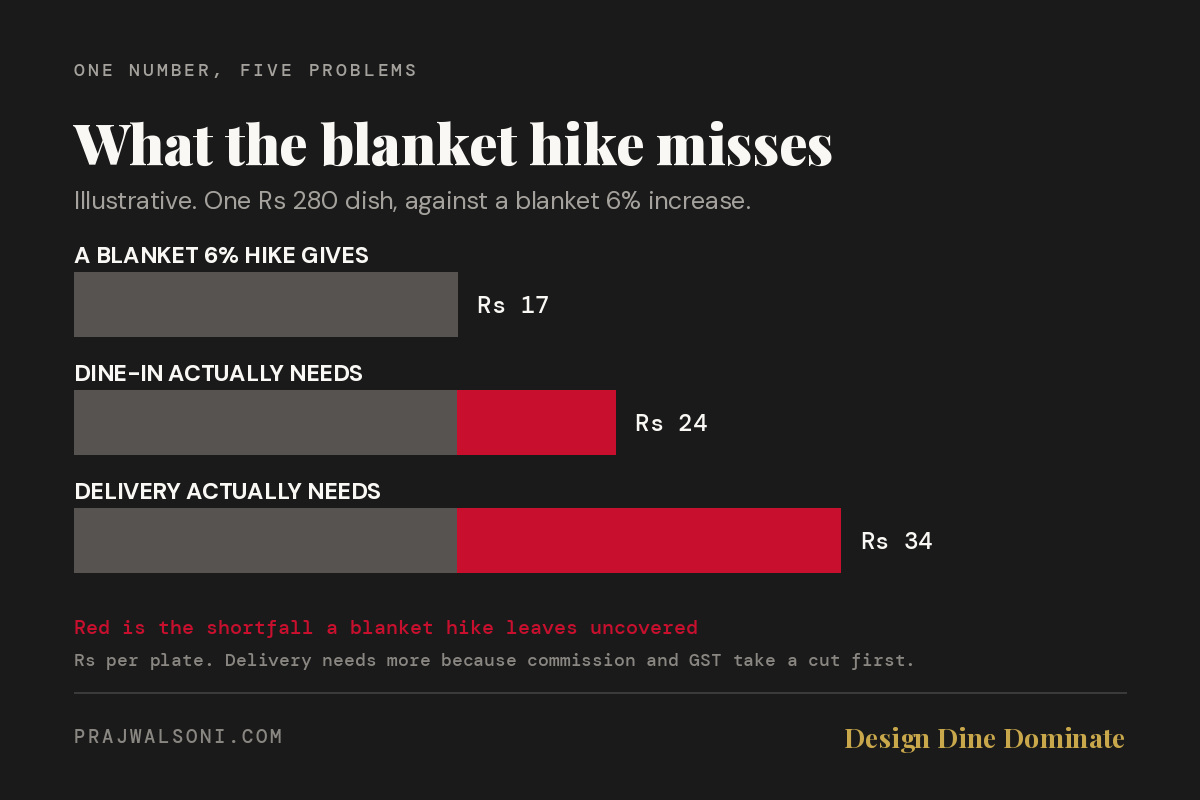
Your menu pricing is probably built on the wrong cost base. When operators price their delivery menu, they typically factor in food cost plus commission percentage. They set prices to maintain a 60-65% margin after food cost and commission. But if your actual platform cost is 12-15 percentage points higher than the commission you are using in your pricing math, your real margin on delivery is half of what you think.
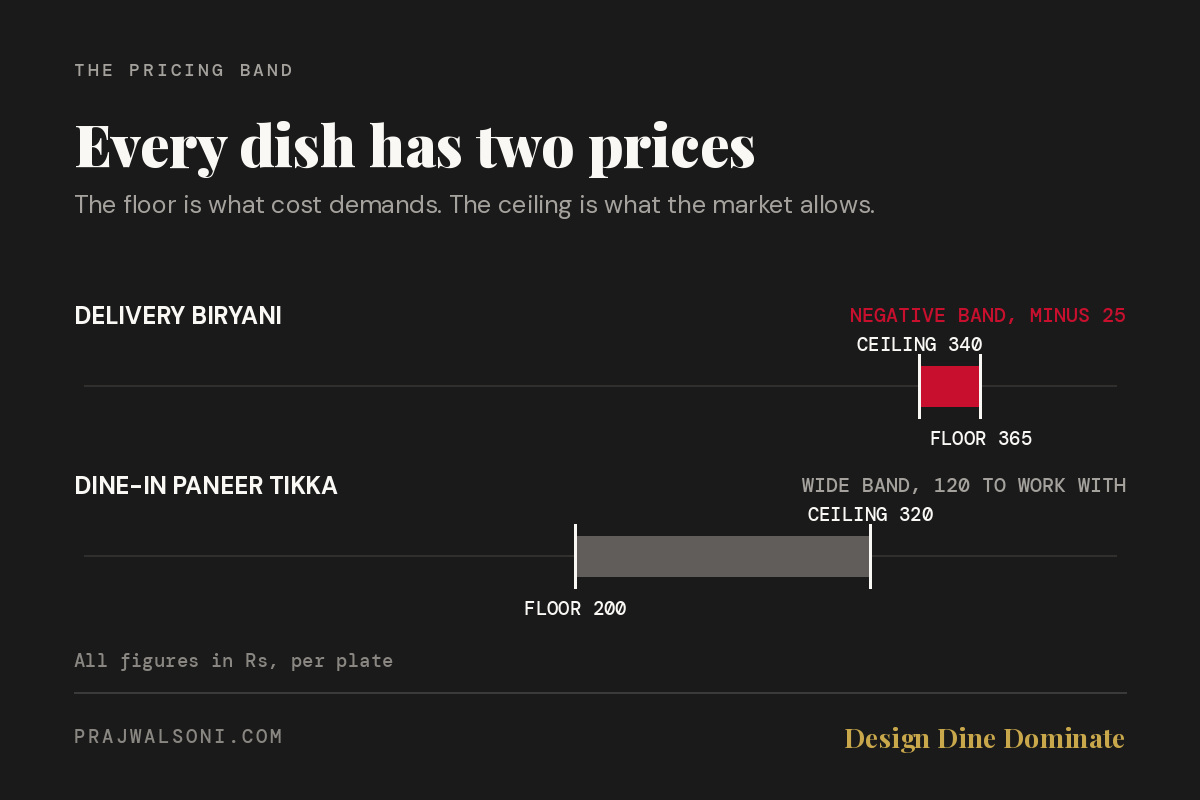
I have consulted for restaurants running 1,200-1,800 delivery orders a month in cities like Ahmedabad and Nagpur. When we sat down and calculated the true all-in platform cost per order, the number shocked every single owner. They were making Rs 15-20 net profit on orders they thought were earning Rs 55-70. On some items, they were losing money on every order and did not know it.
This is the real reason so many delivery-heavy restaurants in India look busy but stay stuck at 5-8% net margins. Volume feels good. The kitchen is moving. Orders are pinging. But the money leaks out in six different line items that nobody is adding together.
The Platform Fee Problem Gets Worse at Lower AOVs
Restaurants with an average order value below Rs 300 get hit hardest by hidden platform fees because several of these charges are fixed-amount, not percentage-based.
This is why cloud kitchens targeting budget meals under Rs 200 face a brutal math problem. Your commission is still 20-25%. Your GST on commission is still 18%. Your payment fees are still Rs 3-7. But your revenue per order is 40% lower. The hidden Rs 47 becomes a bigger percentage of your total. On a Rs 200 order, those same stacked charges can take your true platform cost above 45% of order value.
Operators running budget meal brands in Tier 2 cities face this pressure more than anyone. The Tier 2 market opportunity is real, but only if you price correctly against the full cost structure, not just the commission headline number.
How to Calculate Your Real Per-Order Platform Cost
Pull your last four weekly settlement reports from Swiggy and Zomato. Not the dashboard summary. The detailed settlement breakdown PDF or Excel file. Every single deduction line item is in there. Most operators have never opened this file.
Create a simple spreadsheet with these columns: total orders, total order value, commission deducted, GST on commission, payment/convenience fees, discount co-funding deductions, listing or subscription fees, any other deductions. Sum the total deductions column. Divide by total orders. That is your true per-order platform cost in rupees.
Now divide total deductions by total order value. That is your true platform cost as a percentage of revenue. If you have been using just the commission percentage in your menu pricing calculations, the gap between that number and your true platform cost percentage is exactly how much margin you have been miscalculating.
A good cash flow management system tracks this weekly, not monthly. Monthly averages hide the weeks where discount campaigns spike your co-funding costs. Weekly tracking shows you exactly which promotion windows are destroying your margin.
What Changes When You Know the Real Number
Three things change immediately when you know your true per-order platform cost. First, your delivery menu pricing gets corrected. You stop underpricing items by 10-15% because you were building prices on incomplete cost data. Second, you can make smarter decisions about which aggregator promotions to participate in and which ones to refuse. If a campaign requires 50% discount co-funding on orders that already cost you 35% in platform fees, the math tells you to say no. Third, you can set a minimum order value for profitability on each platform and engineer your menu combos to push orders above that threshold.
Restaurants I have worked with that start tracking true per-order platform cost typically find room to recover Rs 15,000-40,000 per month through pricing adjustments and selective promotion participation. The money was always leaking. They just could not see where because they were looking at one number instead of six.
Some operators use this analysis to build a case for shifting a portion of their delivery volume to direct ordering channels, which I covered when writing about reducing aggregator dependency. The economics only become clear once you know the true cost, not the advertised one.
One Action for This Week
Download your last four settlement reports from both Swiggy and Zomato. Open the detailed breakdowns. Add up every deduction line item, not just commission. Divide by total orders. Write that number on a sticky note and put it next to your POS screen. That is the number you should be using when you price your delivery menu, decide on promotions, or evaluate whether delivery volume is actually making you money.
If the true per-order platform cost is above 35% of your AOV, you have a pricing problem or a promotion problem or both. Fix it before next month’s settlement hits your account.
Stop guessing. Start building. Get Design Dine Dominate, the complete restaurant business playbook from someone who has actually done it.

Leave a comment