The Closing Checklist Belief That Costs You Money Every Morning
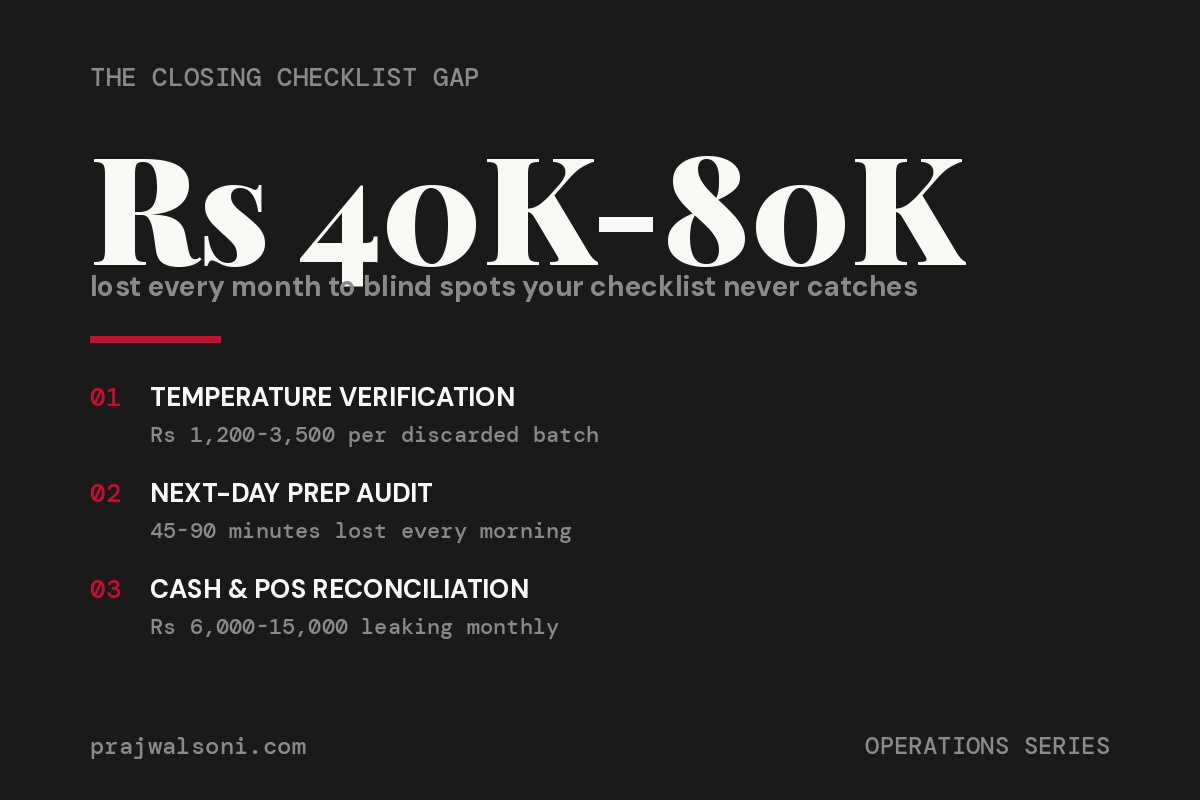
A restaurant closing checklist does not prevent morning problems. It only records that someone said they finished tasks before leaving. The gap between “checked off” and “actually done right” is where most operators lose Rs 40,000 to Rs 80,000 a month in waste, rework, and missed prep.
Every restaurant operator in Ahmedabad, Pune, or Bengaluru has a closing checklist. Most have had one since day one. It lives on a clipboard near the back door or inside a Petpooja dashboard. Staff tick boxes. The manager signs off. And the next morning, the opening crew walks into a kitchen that is not actually ready.
Because the reason most restaurants fail is not the absence of systems. It is systems that look complete but measure the wrong things.
Why Does a Completed Restaurant Closing Checklist Still Fail?
A completed checklist fails because most checklists measure activity, not outcome. “Clean the grill” is an activity. “Grill surface has zero carbon residue and oil trap is emptied” is an outcome. When your closing crew ticks “clean the grill,” they did something. Whether that something actually matters for tomorrow’s first order is anyone’s guess.
I have reviewed closing checklists in over 18 restaurant operations. Roughly 80% of them share the same three blind spots.
Blind Spot 1: No Temperature Verification at Close
Most checklists say “store prep in walk-in cooler.” Almost none say “record walk-in temperature at closing and photograph the thermometer.” Your cash flow takes a hit every time a morning crew discovers that dal makhani base or paneer prep sat at 8°C instead of 4°C overnight. That is a full batch discarded. Rs 1,200 to Rs 3,500 gone before the first customer walks in.
The FSSAI’s Food Safety and Standards (Licensing and Registration of Food Businesses) Regulations require cold storage below 5°C for perishable items. Your checklist should record the actual number, not just confirm the cooler door was closed.
Blind Spot 2: No Prep Readiness Audit
Closing is not just about shutting things down. It is about setting up the next day. A good closing shift should leave the kitchen 30-40% prepped for the morning. Marinations started. Dough portioned. Base gravies cooled and stored with labels and dates.
Most checklists skip this entirely. They focus on cleaning and locking. So the morning shift starts from zero every single day. That adds 45 to 90 minutes of prep time before the kitchen can take its first order. For a cloud kitchen running on Swiggy and Zomato, that is missed lunch traffic during the 11:30 AM to 12:30 PM surge window.
Blind Spot 3: No Cash and POS Reconciliation at Close
The third blind spot is financial. Most checklists say “close the register.” They do not say “reconcile POS total with actual cash in drawer, record variance, and photograph the Z-report.” Small variances of Rs 200 to Rs 500 per night compound into Rs 6,000 to Rs 15,000 per month. That is money leaking out while the checklist shows everything as complete.
If you are running GST compliance properly, your closing reconciliation is also your first line of defense against input mismatches that trigger notices during filing.
Why Do Operators Keep Using Broken Closing Checklists?
Operators keep using broken checklists because the checklist itself feels like proof of discipline. When someone asks “do you have SOPs?” you point to the clipboard and say yes. The checklist becomes a psychological comfort blanket rather than an operational tool.
Also, most checklists get written once during the restaurant launch and never updated. The menu changes. The prep volume changes. The kitchen layout changes. But the checklist from 2022 still sits there, asking the team to “wipe down the tandoor” even though you replaced it with a combi oven eight months ago.
The staff turnover problem makes this worse. New hires inherit the checklist without understanding why each item exists. They tick boxes mechanically. Nobody trains them on what “done right” actually looks like for each task.
What Should a Restaurant Closing Checklist Actually Measure?
A closing checklist should measure three categories of outcomes: food safety readiness, prep completion for the next shift, and financial reconciliation. Every item on the list should answer one question: will this prevent a specific problem tomorrow morning?
Here is how to restructure yours this week.
1. Replace Activity Items With Outcome Items
Change “clean fryer” to “fryer oil filtered, TDS below 24%, oil level at fill line, exterior wiped.” Change “store ingredients” to “all open containers labeled with item name, date, and staff initials, stored at or below 4°C.” Each item should be verifiable by someone who was not there during closing.
2. Add a Next-Day Prep Section
Include five to seven prep tasks that the closing shift must complete. Biryani masala ground. Chicken marinated for tomorrow’s tandoori orders. Roti dough portioned into 50g balls. This section turns your closing shift from a shutdown crew into a setup crew. The margin difference between 5% and 15% net profit often comes down to how much prep waste and rework happens every morning.
3. Add a Photo Verification Step
This is the single most effective change. Require the closing manager to send three photos to a WhatsApp group before leaving. Walk-in thermometer reading. The kitchen line in final state. The POS Z-report. Photos create accountability that tick marks never will. In restaurants I have consulted for, adding photo verification reduced morning complaints from opening staff by a measurable amount within the first two weeks.
4. Build in a 90-Second Manager Walkthrough
Before signing off, the closing manager physically walks the kitchen in a fixed route. Pass, then grill station, then fryer, then prep area, then walk-in, then dry store, then back door. Fixed route every night. Takes 90 seconds. Catches the things the checklist cannot: a container left uncovered, a floor drain still clogged, a gas knob left slightly open.
This walkthrough is not on the checklist. It is the check on the checklist. If you are scaling to multiple locations, this walkthrough habit is what separates units that run clean from units that slowly drift.
What Happens When You Fix the Restaurant Closing Checklist?
When you fix the closing checklist, morning shifts start faster, waste drops, and cash variances surface immediately instead of compounding silently. The opening crew stops blaming the closing crew. The closing crew takes ownership because their work is now visible through photos and outcome-based items.
For a restaurant doing Rs 8 to Rs 12 lakh in monthly revenue, tightening the closing process typically recovers Rs 30,000 to Rs 60,000 per month. That comes from reduced morning prep rework, fewer discarded batches due to temperature failures, and caught cash variances.
For cloud kitchen operators in Surat or Nagpur running three to four brands from one kitchen, the impact multiplies. Each brand has its own prep list, and a failed closing shift cascades across all of them the next morning.
Key Takeaway
- Most closing checklists measure activity, not outcome. “Cleaned” is not the same as “ready for tomorrow.”
- The three blind spots are temperature verification, next-day prep completion, and cash reconciliation. Fix these first.
- Photo verification on WhatsApp creates more accountability than any signature on a clipboard.
- A 90-second fixed-route walkthrough by the closing manager catches what checklists miss.
- For a restaurant doing Rs 8 to Rs 12 lakh monthly, fixing the close typically recovers Rs 30,000 to Rs 60,000 per month in waste and rework savings.
Your Action Step This Week
Pull your current closing checklist. Circle every item that is an activity (“clean X”) and rewrite it as an outcome (“X is in Y condition, verified by Z”). Add temperature logging, next-day prep tasks, and photo verification. Test it for five nights. Compare your Monday morning opening experience after one week.
Stop guessing. Start building. Get Design Dine Dominate, the complete restaurant business playbook from someone who has actually done it.

Leave a comment