Every dish on your menu has two prices hiding inside it. Your floor is the lowest price at which the plate still makes money. The ceiling is the highest price a guest pays before scrolling to the next biryani on Swiggy. A sound menu pricing method finds both numbers first, then prices inside that band.
Most operators I meet in Ahmedabad, Pune, and Surat pick one end and ignore the other. Cost-plus people multiply plate cost by three and stop there. Value-based people copy the restaurant down the road and hope the math works. As a result, both groups leave money on the table or lose it on every delivery order.
I call the fix the Floor-Ceiling Pricing Model. It is how I have priced menus across 23 cloud kitchen brands and 18 restaurants in Gujarat. Once you see the band for each dish, the cost-plus versus value-based debate simply ends.
Cost-Plus or Value-Based: Which Menu Pricing Method Actually Works?
Neither works alone. Cost-plus pricing tells you the minimum you can charge without losing money. Value-based pricing tells you the maximum a guest will pay without hesitating. You need both numbers for every dish, because the profitable price sits between them. Sometimes the gap even tells you to cut the dish.
Cost-plus pricing means you take the plate cost and apply a fixed markup, usually targeting 28-35% food cost. It is simple, and your chef can do it on a calculator. However, it ignores the guest completely. A dal makhani costing Rs 60 gets priced at Rs 180, even if competitors nearby charge Rs 260.
Value-based pricing means you set the price by what the guest believes the dish is worth. It captures more money on signature dishes. But operators who use it alone rarely check whether that price survives an aggregator commission. I have seen kitchens price by gut feel for months, then discover their bestseller loses money on every delivery.
What Is the Floor-Ceiling Pricing Model?
The Floor-Ceiling Pricing Model means calculating a cost floor and a value ceiling for every dish. You then position the price inside that band based on the dish’s job on your menu. Cost-plus builds the floor. Market research builds the ceiling. The model has three components, and each one answers a single question.
Component 1: The Cost Floor
The cost floor is the lowest price at which a dish hits your target food cost after every channel deduction. Most operators calculate the first half and forget the second. Plate cost means everything that leaves the kitchen with the order: ingredients, garnish, packaging, and a small wastage buffer.
Dine-in still holds roughly 59% of foodservice revenue, according to the National Restaurant Association of India’s India Food Services Report 2024. So most restaurants need two floors, one per channel. Here is the calculation.
- Add ingredients, packaging, and a small wastage buffer to get your true plate cost.
- Divide plate cost by your target food cost, usually 30-35%. That is your dine-in floor.
- Work out your channel cost. Swiggy and Zomato charge 15-30% commission depending on city, volume, and plan, with 18% GST on that commission.
- Divide your dine-in floor by 1 minus the effective channel cost. That is your delivery floor.
Step 4 is where most delivery menus break. At 25% commission, GST pushes the effective deduction to about 29.5%. Your delivery floor then lands more than 40% above your dine-in floor. If you have never pushed back on that commission, start with how to negotiate aggregator commission rates. Tax rules shift, so confirm current rates on the CBIC GST portal and in my complete guide to GST for restaurants.
Component 2: The Value Ceiling
The value ceiling is the highest price a guest pays for a dish without hesitating. You find it by looking outward at the market, because your kitchen costs mean nothing to the guest. Three inputs set it.
- Competitor anchors. Open the delivery apps and note prices from 8-10 comparable outlets within 3-4 km. Compare half plate with half plate.
- Perceived portion and presentation. Biryani served in a handi reads as more valuable than the same quantity in a plastic box.
- Occasion. A Saturday family dinner in Hyderabad carries a higher ceiling than a Tuesday office lunch order.
Your working ceiling is the price where the upper end of comparable outlets sits. For the anchoring and menu design side of this, read the psychology and math behind menu pricing.
Component 3: The Band Position
Band position means where inside the floor-ceiling gap you set the final price. The dish’s job on your menu decides it.
- Traffic drivers, like your entry biryani or a value combo, sit near the floor. They win the listing and bring in the first order.
- Core dishes sit mid-band. They carry steady volume at steady margin.
- Signatures, the dishes nobody nearby makes the same way, sit near the ceiling. This is where most of your menu margin lives.
How Does the Floor-Ceiling Model Work on a Real Menu?
Run the model on two dishes and the difference shows up fast. The numbers below are illustrative, built from typical cost ranges I see, so plug in your own. One dish has a band that is negative. The other has a band so wide that cost-plus pricing leaves Rs 90 or more per plate on the table.
Delivery Chicken Biryani in Pune
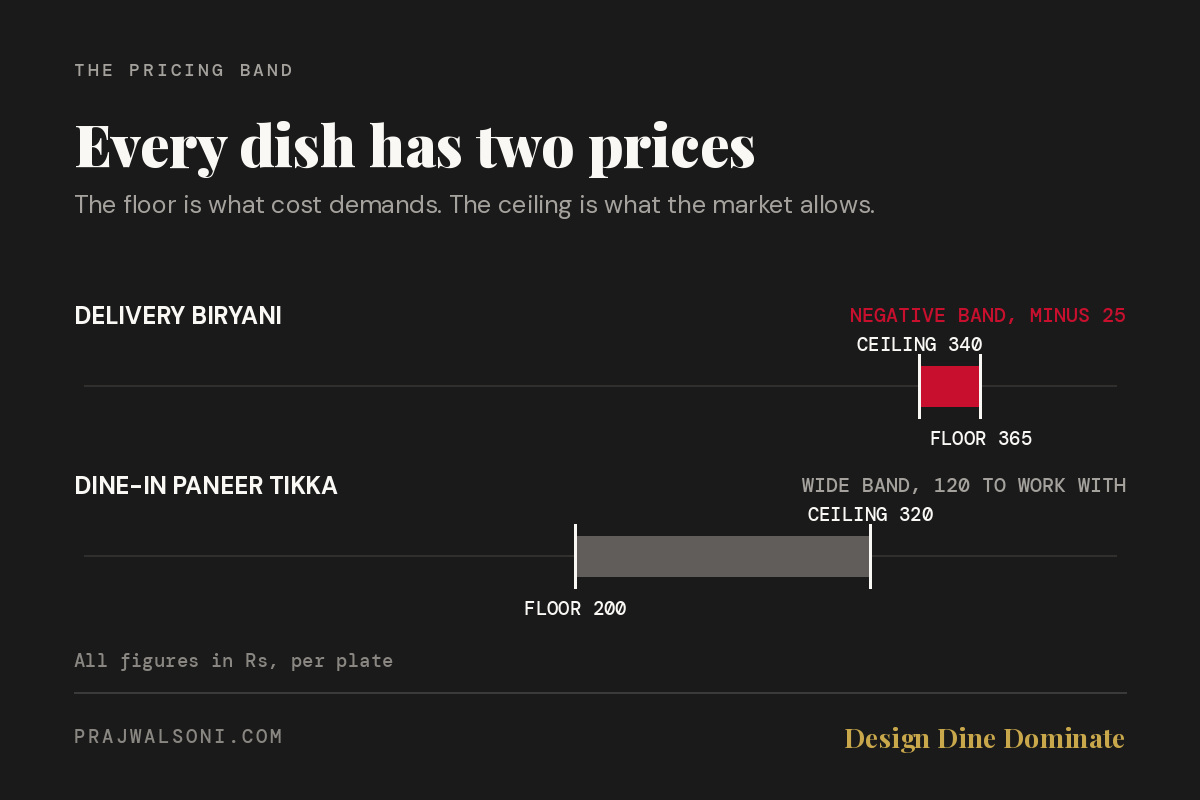
Say your plate cost is Rs 90, with Rs 75 in ingredients and Rs 15 in packaging. At a 35% food cost target, the dine-in floor is about Rs 257. On delivery, at 25% commission plus GST, the floor climbs to about Rs 365.
Now check the ceiling. Suppose comparable biryani listings within 3 km sit between Rs 280 and Rs 340. Your ceiling is Rs 340 against a floor of Rs 365. The band is negative by Rs 25.
Cost-plus alone would price this at Rs 257 and bleed margin on every delivery. Value-based alone would price it at Rs 340 and feel fine. Meanwhile, food cost after commission quietly runs near 38%.
Dine-In Paneer Tikka in Ahmedabad
Say your plate cost is Rs 70. At 35% food cost, the floor is Rs 200. Suppose casual dining outlets nearby charge Rs 280 to Rs 320 for a comparable portion. Your ceiling is Rs 320.
Paneer tikka is your signature here, so it belongs near the ceiling. At Rs 300, food cost drops to about 23%. A pure cost-plus operator charges Rs 210 and gives away Rs 90 on every plate.
Across 40 plates a day, that Rs 90 becomes roughly Rs 1 lakh a month from one dish. Gaps like this decide which dine-in formats stay profitable in 2026.
What Decisions Does This Menu Pricing Method Force?
Band width drives every decision. A negative band means the dish cannot make money on that channel as currently built. Narrow bands mean you compete on cost. Wide bands usually mean you are underpricing unless you already sit near the ceiling. So check the band before you touch the price.
- Negative band: re-engineer or remove. Trim the portion, switch packaging, or keep the dish dine-in only. If none of that closes the gap, delist it from delivery. Direct orders also shrink the floor, since commission drops out. See how AI helps restaurants escape aggregator commission.
- Narrow band: price near the ceiling and fight on cost. Renegotiate with suppliers and check your yields. Your lever here is cost, because the market has already capped the price.
- Wide band: climb toward the ceiling in steps. Move Rs 10-20 at a time. Then watch order volume for two to three weeks before the next step.
Moving signatures up the band is one of the fastest margin levers you have. For context on where you stand, see the real gap between 5% and 15% restaurant profit margins. Cloud kitchens should run every dish on delivery floors alone, because no dine-in channel absorbs the gap. More on that in cloud kitchen profitability metrics for 2026.
Can You Diagnose Your Menu Right Now?
Yes, with one question. Take your top five sellers and ask whether each delivery price sits above its delivery floor. If you cannot answer with a number for every dish, you are pricing blind. Most operators I work with find at least one bestseller below its floor.
Here is what to do this week.
- Pull your top 10 dishes by quantity from Petpooja or Posist for the last 30 days.
- Cost each plate, including packaging and a wastage buffer.
- Calculate dine-in and delivery floors using the actual commission from your last weekly settlement.
- Check 8-10 competitor listings per dish and write down a working ceiling.
- Mark every band as negative, narrow, or wide, then fix the negatives first.
This takes one afternoon with a spreadsheet. Pricing blind is one of the quiet reasons behind why so many restaurants fail in their first year.
What the Floor-Ceiling Model Comes Down To
The Floor-Ceiling Pricing Model replaces the cost-plus versus value-based argument with one calculation per dish. Your costs set the minimum. The market sets the maximum. Its role on your menu sets the final price, and these four facts hold across every channel.
- Cost-plus pricing sets the floor. Value-based pricing sets the ceiling. Neither sets the price alone.
- At 25% commission plus 18% GST on it, your delivery floor runs more than 40% above dine-in.
- A negative band means re-engineer or delist the dish, never discount it.
- Signature dishes belong near the ceiling, where most of your menu margin sits.
Stop guessing. Start building. Get Design Dine Dominate, the complete restaurant business playbook from someone who has actually done it.

Leave a comment