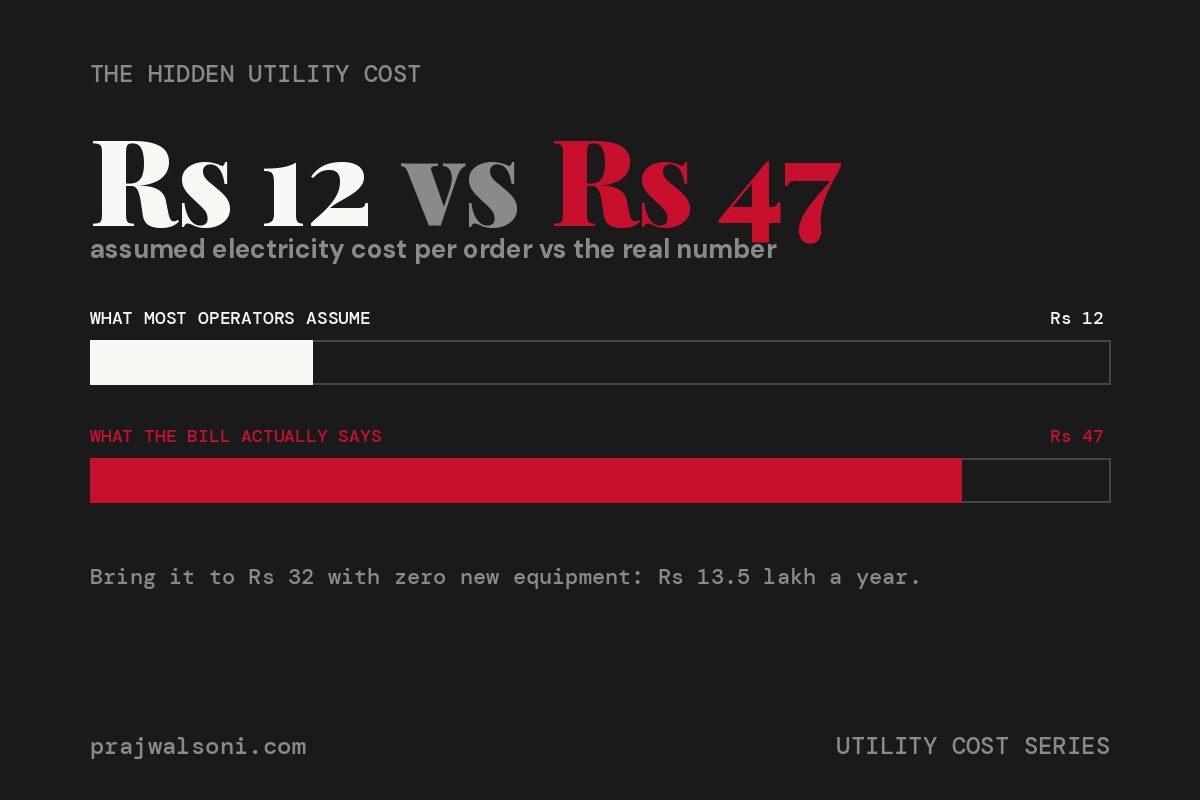
Rs 47. That is the average electricity cost per order in a mid-size restaurant kitchen running two tandoors, a walk-in cooler, three deep fryers, and six exhaust hoods across a 14-hour service day in Ahmedabad. Most restaurant operators in India estimate their restaurant electricity cost per order at Rs 10 to Rs 15. They are off by a factor of three. And that gap is eating their margins quietly every single month.
How Do You Calculate the Real Electricity Cost Per Order?
Divide your total monthly electricity bill by the total number of orders served that month. This gives you the true per-order electricity burden. Most operators in Surat, Pune, or Bengaluru who do this calculation for the first time discover a number between Rs 35 and Rs 55, not the Rs 12 they assumed.
The reason the estimate is always wrong is simple. Operators think about electricity as a fixed monthly cost. They see Rs 85,000 on the bill and file it under “overhead.” They never connect it to output. But electricity is a variable cost disguised as a fixed one. A kitchen running 200 orders a day pays Rs 42 per order. The same kitchen running 300 orders pays Rs 28 per order. Your electricity cost per order drops when volume rises, which means slow days are not just bad for revenue. They are punishing on utility cost per plate.
If your net margin sits between 5% and 15%, a Rs 47 electricity cost on a Rs 350 average order value means utilities alone consume over 13% of revenue. That is not overhead. That is a second rent payment.
Why Is the Number So High in Indian Restaurant Kitchens?
Three equipment categories account for roughly 70% of a typical kitchen electricity bill: refrigeration, exhaust systems, and deep fryers. Most Indian kitchens run all three at full capacity for hours beyond actual service time, because nobody tracks when equipment gets switched on or off.
Walk-in coolers run 24 hours. That is expected. But the compressor cycles more aggressively when the door gets opened 40 times during a chaotic prep shift versus 10 times during a disciplined one. I have seen kitchens in Hyderabad where the walk-in door stays propped open with a crate during lunch prep because the cook does not want to keep pulling the handle. That single habit can increase compressor runtime by 30% and add Rs 4,000 to Rs 6,000 to your monthly bill.
Exhaust hoods are another problem. In most kitchens I have consulted for, hoods run from 9 AM to midnight regardless of whether all burners are active. A hood pulling 2 HP for 15 hours costs roughly Rs 500 per day in electricity. If your kitchen only needs full exhaust for 8 hours of active cooking, you are burning Rs 200 daily for no reason. That is Rs 6,000 a month from one piece of equipment.
Deep fryers get preheated an hour before service “just in case” and stay on 45 minutes after the last order. Across two fryers, this idle time costs Rs 3,000 to Rs 4,000 monthly. These are not guesses. Pull your kitchen schedule, check when each piece of equipment actually gets switched on, and compare it to when the first and last order hits.
What Does Rs 47 Per Order Actually Cost You Over a Year?
A restaurant doing 250 orders per day at Rs 47 per order spends Rs 11,750 daily on electricity. That is Rs 3.5 lakh per month. Over 12 months, Rs 42 lakh goes to the electricity board. If you could bring that per-order cost down to Rs 32, which is achievable without buying a single new piece of equipment, you save Rs 3,750 per day. That is Rs 1.12 lakh per month. Over a year, Rs 13.5 lakh stays in your pocket.
Rs 13.5 lakh. For most operators, that is the difference between a 5% net margin and a 12% net margin. No menu redesign needed. No marketing spend. No negotiation with Swiggy or Zomato on commission rates. Just operational discipline in the back of house.
Where Do Most Restaurant Operators Lose Money on Utilities?
The biggest utility losses happen in three zones: idle equipment runtime, poor maintenance schedules, and incorrect tariff slabs. Each one is fixable within a week.
Idle Equipment Runtime
Assign one kitchen staff member per shift to manage power-on and power-off times for every major appliance. Create a simple checklist on a whiteboard next to the breaker panel. Tandoor on at 11:15, off at 3:30 and on again at 6:45. Fryer on at 11:00, off at 10:30 PM. This is not sophisticated. It is a basic accountability system that most kitchens skip because nobody owns the task.
Poor Maintenance
A refrigerator compressor with dirty condenser coils uses 15% to 25% more electricity. Exhaust hood filters clogged with grease force the motor to work harder, increasing power draw. In restaurants I have worked with, a quarterly deep-clean of all condenser coils and monthly filter cleaning reduced the electricity bill by 8% to 12% without any other changes. The cost of cleaning supplies and a technician visit is under Rs 5,000. The monthly saving is Rs 8,000 to Rs 12,000.
Wrong Tariff Slab
Commercial electricity tariffs vary by state, connection type, and sanctioned load. In Gujarat, a restaurant on an LT-2 commercial tariff pays roughly Rs 7.5 to Rs 8.5 per unit. But some operators still run on a higher tariff because they never applied for reclassification after their initial connection. Check your electricity bill. Verify your tariff category. If your sanctioned load does not match your actual usage, apply for revision. This is a one-time administrative fix that can save Rs 15,000 to Rs 25,000 annually.
Does This Apply to Cloud Kitchens Too?
Cloud kitchens face an even sharper version of this problem. A cloud kitchen running multiple brands from one kitchen uses more equipment across a longer service window, but order volume per brand may be lower. This means the per-order electricity cost can climb to Rs 55 or Rs 60 if brands are underperforming.
I have operated 23 cloud kitchen brands, and the ones that stayed profitable tracked utility cost per order as a core metric, not just food cost and commission. When a brand’s per-order electricity burden crosses Rs 50, it signals that the brand is not generating enough volume to justify its share of the kitchen’s energy draw. At that point, you either fix the volume problem or you kill the brand before it drags down the entire kitchen’s unit economics.
Cash flow management in cloud kitchens depends on understanding these per-unit costs. Operators who only look at the monthly total miss the brand-level picture entirely.
One Action You Can Take This Week
Pull your last three months of electricity bills. Divide each month’s total by the number of orders served that month. You now have your per-order electricity cost for Q4 and Q1. Write that number on a sticky note and put it on your kitchen door.
If it is above Rs 40, start with the idle equipment checklist. Assign power-on and power-off responsibility to one person per shift. Track it for two weeks. You will see the number drop.
If it is above Rs 50, you also have a maintenance problem or a volume problem. Get your condenser coils cleaned this week. Then look at whether your menu pricing accounts for this utility cost or whether you have been absorbing it unknowingly.
Electricity is not a fixed cost you cannot control. It is an operational cost you have been choosing not to measure. The number is Rs 47. Now you know. Fix it.
Stop guessing. Start building. Get Design Dine Dominate, the complete restaurant business playbook from someone who has actually done it.

Leave a comment