What Does Restaurant Manager Development Actually Mean?
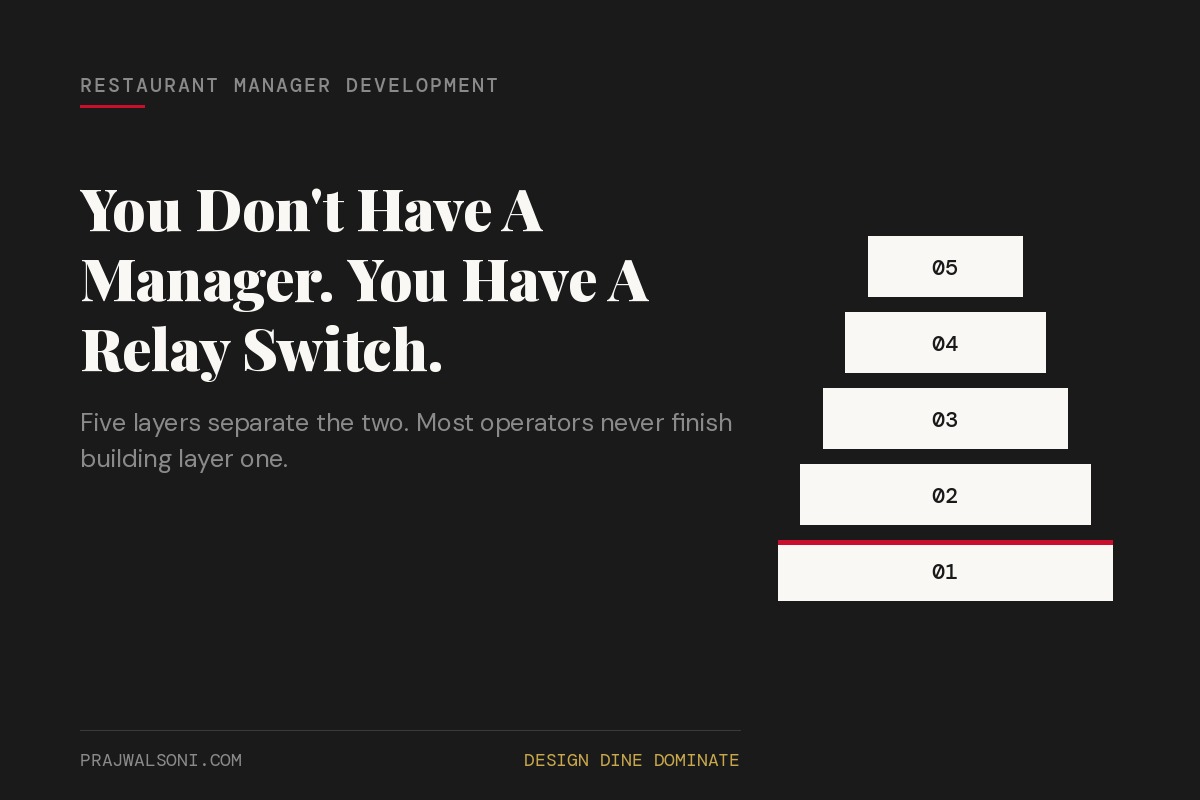
Restaurant manager development is the deliberate process of building someone who can run your floor, manage your staff, protect your margins, and handle service without calling you. It is not a promotion. It is a five-layer construction project that most operators in Ahmedabad, Pune, and Bengaluru skip entirely, then wonder why they cannot take a single day off.
Most operators think they have a manager. What they actually have is a senior staff member with a title. The difference costs you Rs 2-4 lakh a month in waste, missed upsells, and turnover you could have prevented.
I have worked with 18 restaurants across Gujarat. In nearly every case, the owner was the real manager. The person called “manager” was just a relay switch between the kitchen and the owner’s phone. So let me break down what a real floor manager looks like, layer by layer.
Layer 1: Operational Literacy, Not Just Experience
Operational literacy means a manager can read the numbers that run the restaurant, not just follow instructions. This is the foundation layer, and most operators never install it because they promote based on tenure instead of capability.
A server who has worked three years at your biryani joint knows the menu. That does not mean he understands why your food cost sits at 34% instead of 30%. Knowing the menu and knowing the business are completely different skills.
Operational literacy includes reading a POS day-end report on Petpooja or Posist and spotting problems. It includes understanding what a 72% table occupancy rate means for staffing. It includes knowing that when Swiggy orders spike between 7-9 PM, the kitchen needs a different prep sequence than a walk-in rush.
Test for this layer before you promote anyone. Print last week’s sales report. Ask them three questions about it. If they cannot tell you which day had the lowest average order value, they are not ready. Train them on the numbers first, because everything else depends on this.
Why Do Most Restaurant Managers Fail at Staff Accountability?
Most managers fail at staff accountability because they were never given a system for it. They were handed authority without structure. Authority without a framework creates either a tyrant or a pushover. Both destroy your team.
Layer 2: People Management With a Framework
This is the layer where operators lose the most money without realizing it. The staff turnover crisis in Indian restaurants runs deep. Replacing a single trained kitchen staff member costs roughly Rs 25,000-40,000 when you factor in recruitment, training, and the mistakes a new hire makes in the first 30 days.
A manager with real people management skills does three things consistently. First, they run a daily 10-minute pre-shift briefing. Not a motivational speech. A briefing: today’s specials, yesterday’s complaints, one thing to improve. Second, they give feedback within 15 minutes of the incident, not at the end of the week. Third, they document performance simply, even if it is just a notebook with dates and notes.
In restaurants I have consulted for, the ones where managers had a written feedback system saw staff retention improve measurably within 60-90 days. The ones without a system? Their managers either avoided conflict entirely or screamed at staff during rush hours. Both approaches push good people out the door.
Build this layer by giving your manager a simple performance tracker. Name, date, what happened, what was said. Review it together once a week. This one habit changes everything about how your floor runs.
How Does Decision-Making Autonomy Change a Manager’s Impact?
Decision-making autonomy is the layer that separates a relay switch from a real manager. Without it, every customer complaint, every vendor issue, every staff conflict routes back to your phone. You become the bottleneck for your own business.
Layer 3: Decision Authority With Clear Boundaries
The mistake operators make is binary thinking. Either the manager has no authority, or they get full authority. Both are wrong. What works is a decision matrix. Simple. One page.
Here is what a practical decision matrix looks like for a restaurant doing Rs 20-40 lakh monthly in Surat or Nagpur:
1. Customer complaints up to Rs 500 in value: manager resolves on the spot without calling the owner. A free dessert, a discount, a replacement dish.
2. Staff no-shows: manager adjusts the shift plan from a pre-approved backup roster.
3. Vendor short delivery: manager documents it, uses the backup vendor from an approved list, and reports by end of day.
4. Equipment breakdown: manager calls the approved service contact and informs the owner. No waiting for permission to act.
5. Anything involving cash above Rs 2,000 or staff termination: owner decision.
When a manager knows exactly what they can decide, they stop calling you 14 times during dinner service. When they do not know, they either freeze or overreach. Both cost you. I have written about why operators fail at scaling, and this layer is one of the biggest reasons. You cannot open a second location if your first location cannot survive a weekend without your presence.
What Makes a Restaurant Manager Protect Margins Instead of Just Running Service?
A manager protects margins when they understand that every operational decision has a financial consequence. This awareness does not come from experience alone. It comes from being trained to think in rupees, not just in plates.
Layer 4: Financial Ownership of the Shift
This layer is where most restaurant manager development programs, if they exist at all, completely fall apart. Operators keep financial information close to their chest. The manager never sees food cost percentages, never understands menu pricing logic, and never connects wastage to profit.
Then the operator wonders why the manager approved an extra 5 kg of paneer “just in case” on a Tuesday night. Because nobody taught him what 5 kg of unused paneer actually costs when your food cost is already at 36%.
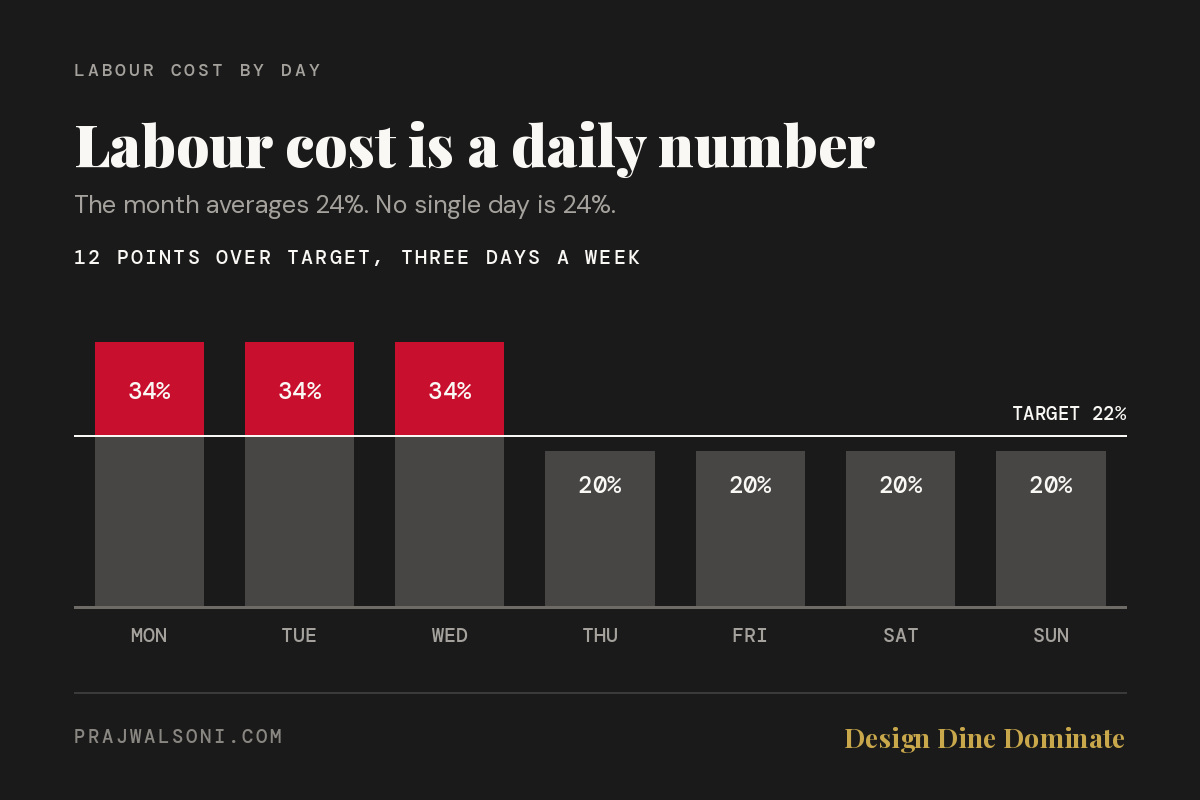
Financial ownership means the manager knows three numbers every single day. Revenue from the previous day. Wastage in rupees. Labor cost for the shift based on hours worked. You do not need to share your P&L or your bank balance. Share these three numbers and tie them to a weekly goal.
For example, if your dal makhani has a food cost of Rs 65 and sells for Rs 249, your manager should know that. When a customer sends it back and the kitchen makes a fresh one, the manager should understand that the replacement just cost Rs 65 in raw material plus the labor time. That awareness changes behavior. It changes how carefully they check plates before they leave the pass counter.
Restaurants where managers track daily wastage in a simple register typically see a 15-20% reduction in waste within the first month. Not because of a magic system, but because measurement creates attention, and attention reduces carelessness. This directly impacts your cash flow in ways that compound over weeks and months.
Why Is Hiring and Onboarding the Final Layer, Not the First?
Hiring and onboarding is the final layer because a manager who cannot handle the first four layers will destroy your hiring process. They will hire friends instead of competent staff. They will skip onboarding because they never received proper onboarding themselves.
Layer 5: Building the Team Below Them
A fully developed manager is someone who can bring a new hire from day one to confident floor performance in 14 days without the owner’s involvement. This is the test. If your manager cannot do this, you have not finished building them yet.
Building this layer requires a written onboarding checklist. Not a 40-page manual. A single sheet with what the new hire learns each day for two weeks. Day 1: floor layout, POS basics, uniform standards. Day 3: menu knowledge, common customer questions. Day 7: handling a complaint, upselling techniques for gulab jamun and masala chai with the main course. Day 14: a practical assessment where the manager observes a full shift and scores performance.
When your manager owns this process, two things happen. Your staff turnover drops because new hires feel supported instead of thrown into chaos. And your service quality stabilizes because every new team member learns the same standards, not whatever the senior server decides to teach that day.
The NRAI India Food Services Report 2024 (NRAI IFSR 2024) values the industry at Rs 5.69 lakh crore. In an industry this large and growing at 8.1% CAGR, the operators who build managers who can build teams will scale. The operators who remain the only person who can run their floor will stay stuck at one or two locations forever.
How Do These Five Layers Work Together?
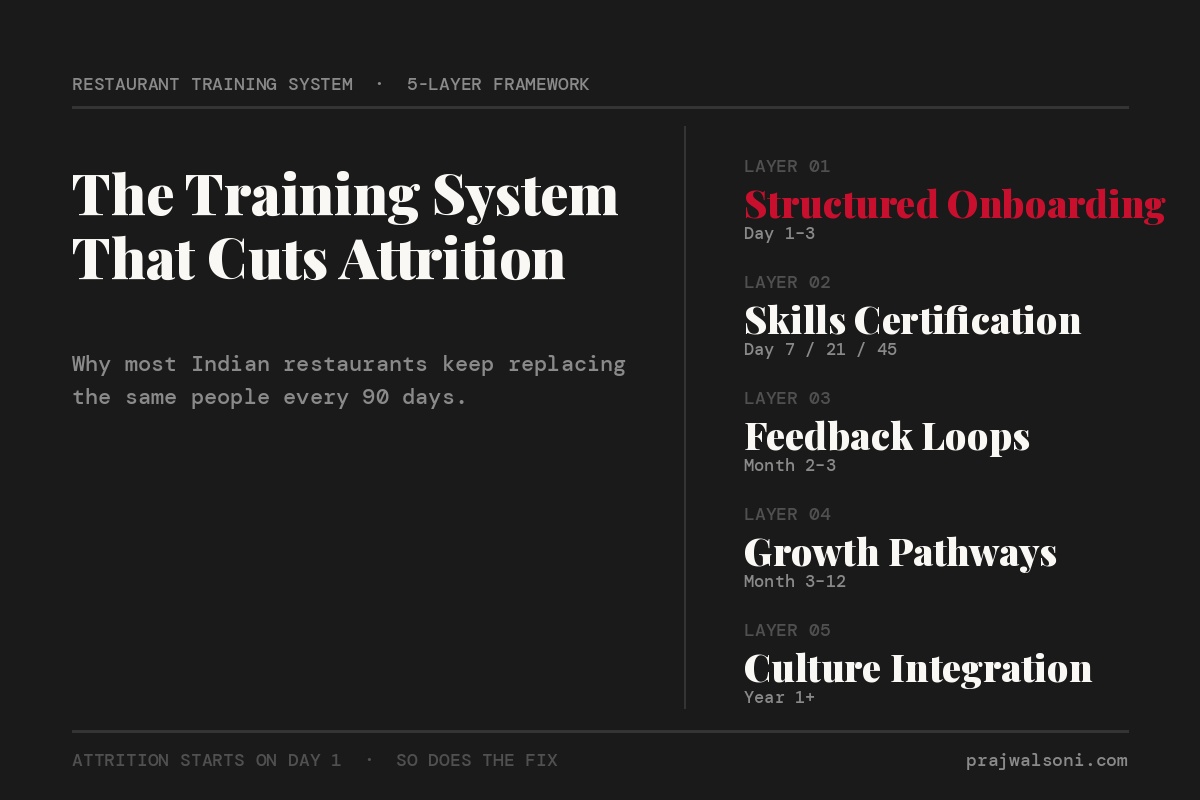
These layers are sequential, not parallel. You cannot install Layer 3 (decision authority) before Layer 1 (operational literacy) because a manager making decisions without understanding the numbers will make expensive ones. Similarly, Layer 5 (team building) fails without Layer 2 (people management) because a manager who cannot give feedback will not develop new hires effectively.
The sequence matters. Operational literacy first. Then people management skills. Then decision authority with clear limits. Then financial ownership of every shift. Finally, the ability to hire and onboard independently.
Most operators in Hyderabad or Pune try to shortcut this by hiring an “experienced” manager from another restaurant. That manager brings someone else’s systems, someone else’s habits, and someone else’s problems. Sometimes it works. Often it does not, because the layers were built for a different restaurant with different margins and a different team culture.
Building your own manager takes 90-120 days if you are deliberate about it. That sounds slow until you compare it to the cost of cycling through three “experienced” hires in a year, each one lasting 3-4 months before they leave or you fire them. I have covered why 70% of restaurants fail in the first year, and the inability to build a second-in-command is one of the top reasons.
What Does Knowing All Five Layers Enable?
Knowing all five layers enables you to build a manager on purpose instead of hoping you got lucky with a hire. It also gives you a diagnostic tool. When your floor falls apart on a Saturday night, you can pinpoint which layer is missing instead of blaming the person.
If your manager cannot read the POS report, the problem is Layer 1. If staff keep quitting, check Layer 2. If you are still getting called during every service, Layer 3 is broken. If food cost creeps up every month, Layer 4 was never installed. If every new hire takes 30 days to become useful, Layer 5 needs work.
When all five layers are in place, something remarkable happens. You can work on your business instead of being trapped inside it. You can evaluate a cloud kitchen expansion. You can renegotiate your aggregator commissions. You can spend a Wednesday afternoon visiting a potential second location instead of standing at the pass counter checking plates.
Here is your action step for this week. Pick one person on your current team who has potential. Print your last seven days of POS reports. Sit with them for 30 minutes and teach them to read three numbers: daily revenue, top-selling item, and highest-waste item. That is Layer 1. Start there. Do not skip ahead.
Stop guessing. Start building. Get Design Dine Dominate, the complete restaurant business playbook from someone who has actually done it.


Leave a comment