Why Most Second Locations Fail Before Month Six
Most restaurant operators who open a second location lose money within the first six months because they confuse a busy first outlet with a replicable business. Restaurant expansion readiness is not about revenue at your current location. It is about whether your systems, team, and cash reserves can survive the strain of running two units at the same time.
I have seen this pattern repeat across Ahmedabad, Surat, and Pune. An operator does Rs 12-15 lakh a month at one location. Customers line up on weekends. The owner starts scouting a second space. Three months after opening, the first location’s numbers dip. The second location burns cash. Both units now need the owner physically present. Nobody wins.
The problem is not ambition. The problem is the absence of a diagnostic filter. Operators ask “Can I afford the rent?” when they should ask “Can my business operate without me standing in the kitchen?” Those are fundamentally different questions. One is about capital. The other is about systems. And systems are what determine whether expansion works or collapses.
This is exactly why I built the Expansion Readiness Scorecard. It is a four-component framework that forces you to evaluate your restaurant across the only four dimensions that predict second-location success. If you score below threshold on even one, you are not ready. Full stop.
What Is the Expansion Readiness Scorecard?
The Expansion Readiness Scorecard is a four-part diagnostic that measures whether your restaurant has the financial stability, operational independence, team depth, and documented systems needed to replicate itself in a new location. Each component gets scored independently. You need all four above a minimum threshold before signing any lease.
The four components are: Cash Runway, Operator Independence, Bench Strength, and SOP Coverage. Each one tests a specific failure point that kills second locations. Skip any one and you are gambling with the capital you built at your first outlet.
This is not a motivational checklist. It is a pass-fail filter. If you cannot score above 7 out of 10 on each component, your expansion timeline needs to push back until you fix the gap.
Component 1: Cash Runway Score
Your Cash Runway Score measures whether you have enough capital to fund the second location AND survive 6 months of below-target performance at both units. Most operators budget for the build-out and first month’s rent. They forget that a new location typically takes 3-5 months to reach breakeven, even in a good market.
Here is the math. Take your total monthly operating cost across both locations. Multiply by six. Add your full build-out and deposit cost for the new space. That is your minimum cash requirement. If you do not have that amount liquid, either in bank or in a confirmed credit line, you are undercapitalized for expansion.
For a typical 1,200 sq ft restaurant in a tier-2 city like Nagpur or Surat, build-out runs Rs 25-40 lakh depending on format. Monthly operating cost sits around Rs 4-6 lakh. So your minimum runway for both locations combined is roughly Rs 70 lakh to Rs 1 crore in accessible capital. Not projected revenue. Accessible capital.
Your net margins at the first location need to be consistently above 12% for at least 12 consecutive months before you even start this calculation. If your first outlet runs at 6-8% margins, expansion will not fix that. It will double it.
Score yourself: 10 means you have 9+ months of dual-unit runway. 7 means you have 6 months. Below 5 means you are funding expansion from next month’s revenue at your first location. That is a recipe for cash flow collapse.
Component 2: How Do You Measure Operator Independence?
Operator Independence measures whether your first restaurant can run at 90%+ performance when you are physically absent for two consecutive weeks. If your current location’s quality, speed, and revenue dip noticeably the moment you step out, you do not have a business ready for replication. You have a business that depends on your personal presence.
Test this before you spend a single rupee on location scouting. Take 14 days away from your first outlet. Not a vacation where you check your phone every hour. Actually hand over all decisions to your team. Monitor only the numbers, not the operations. Did food cost stay within 2 percentage points of your target? Did customer complaints stay flat or improve? Did daily revenue hold within 10% of the trailing average?
If the answer to any of those is no, your expansion timeline just moved back by 3-6 months. Because when you open location two, you will physically be there for the first 60-90 days. Your first location will run without you whether you planned for it or not.
Operators who have already scaled with discipline know this test is non-negotiable. The ones who skip it learn the hard way when their flagship location’s Swiggy rating drops from 4.3 to 3.8 in the first month of being distracted by the new outlet.
Component 3: Bench Strength Score
Bench Strength measures whether you have enough trained people to staff a second location without gutting your first one. The single biggest operational failure in restaurant expansion is pulling your best people from the original unit to “set up” the new one. Then both locations run on a weakened team.
You need a minimum of two people at your current location who can each independently manage a full shift without supervision. Not people who “know the menu.” People who can handle a Friday night rush, manage a vendor delivery issue, resolve a customer complaint, and close out the cash register accurately.
In the Indian restaurant market, the staff turnover crisis makes bench strength even harder to build. Average staff tenure in organized restaurants sits around 8-14 months according to NRAI estimates. If your best kitchen manager has been with you for only 4 months, moving them to a new location is a risk. They have not been tested through a full seasonal cycle at your first outlet yet.
Score yourself honestly. 10 means you have a fully trained second-in-command for both kitchen and front-of-house, plus two backup candidates. 7 means you have one strong leader and one developing one. Below 5 means your first location cannot survive losing a single key person. At that score, expansion is premature.
Component 4: What Does SOP Coverage Actually Mean for Expansion?
SOP Coverage measures the percentage of your daily operations that are documented in written, step-by-step procedures that any trained employee can follow without asking you. If your recipes live in your head chef’s memory and your opening checklist lives in your memory, you do not have a scalable restaurant. You have tribal knowledge that walks out when people quit.
For restaurant expansion readiness, you need documented SOPs for at least these five areas: recipe cards with exact weights and quantities, opening and closing procedures, inventory counting and ordering, customer complaint resolution, and cash handling with daily reconciliation. These five cover roughly 80% of what goes wrong when a second location opens.
A recipe card is not “add salt to taste.” It is “add 12 grams of salt per 1 kg of gravy base.” The difference between a dal makhani that tastes the same at both locations and one that tastes different is the difference between a 12-gram spec and a “to taste” instruction. Consistency is precision, and precision requires documentation.
Your POS system, whether it is Petpooja or Posist or any other platform, should already have standardized item configurations. If your menu items have different modifier structures or pricing logic at your first location depending on who entered them, cleaning that up needs to happen before you replicate the mess in a new unit.
For operators running delivery-heavy models, your cloud kitchen SOPs also need packaging specs, dispatch timing targets, and platform-specific photo standards. Swiggy and Zomato ratings at your second location start from zero. You do not get to carry over your first location’s reputation. Every order matters from day one.
How to Apply the Expansion Readiness Scorecard to a Real Decision
Take a real scenario. You run a North Indian restaurant in Ahmedabad doing Rs 14 lakh a month. A property comes up in a high-traffic area with rent at Rs 1.2 lakh. Your instinct says grab it. The Expansion Readiness Scorecard says slow down and score yourself first.
Cash Runway: Your build-out estimate is Rs 30 lakh. Combined monthly opex for both locations would be roughly Rs 9 lakh. Six-month runway means you need Rs 84 lakh accessible. You have Rs 50 lakh in the bank and Rs 20 lakh in a sanctioned overdraft. That puts you at Rs 70 lakh. Score: 6 out of 10. Below threshold.
Operator Independence: You took 10 days off last Diwali. Revenue dropped 15% and two negative Zomato reviews mentioned inconsistent food. Score: 5 out of 10. Well below threshold.
Bench Strength: Your head chef has been with you 18 months. Your floor manager joined 4 months ago. You have no backup kitchen leader. Score: 5 out of 10.
SOP Coverage: You have recipe cards for 60% of your menu. No documented closing procedure. Inventory is done “by feel” twice a week. Score: 4 out of 10.
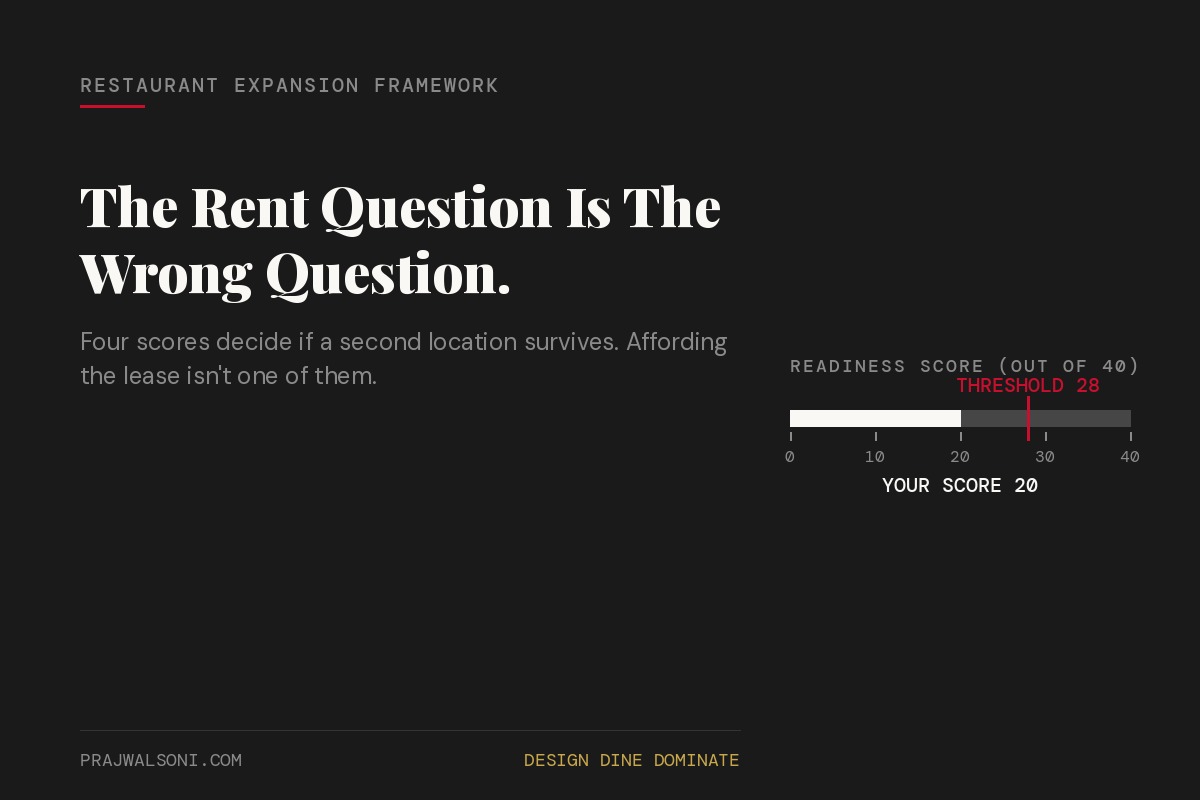
Total: 20 out of 40. You need 28 to clear the threshold. This operator is 6-9 months away from being ready. The right move is to pass on this property, fix the gaps, and wait for the next opportunity.
The scorecard does not tell you never to expand. It tells you when. And “when” is when all four components are above 7. That is the decision it enables. Not excitement. Not landlord pressure. Not FOMO because a competitor just opened a second branch. Data.
What Does This Scorecard Help You Decide Right Now?
The Expansion Readiness Scorecard answers one question: should you spend your next rupee on growing bigger, or on making your current operation stronger? For most operators, the honest answer is the second one. And that answer saves you anywhere from Rs 30 lakh to Rs 1 crore in avoidable losses.
If your Cash Runway is the bottleneck, focus on improving menu pricing and cutting waste to build reserves over the next two quarters. If Operator Independence is the gap, start delegating shift-by-shift and track the performance delta when you are not there. If Bench Strength is weak, invest in cross-training your team now rather than scrambling during expansion. If SOP Coverage is low, block two hours every week to document one procedure until you hit 90% coverage.
India’s restaurant industry is projected to reach Rs 7.76 lakh crore by 2028, according to the NRAI India Food Services Report 2024. The opportunity is massive. But opportunity rewards operators who scale with systems, not operators who scale with optimism. The tier-2 city opportunity is real. So is the risk of expanding before you are ready.
Here is your diagnostic question. Answer it honestly right now: if you left your restaurant for 14 days starting tomorrow, would your revenue, food cost, and customer ratings hold steady? If you hesitated even slightly, you know which component needs work first.
Pull your last 90 days of P&L data this week. Score yourself on all four components. Write the numbers down. If you are below 28 out of 40, build a 90-day plan to close the gap before you look at a single property listing.
Stop guessing. Start building. Get Design Dine Dominate, the complete restaurant business playbook from someone who has actually done it.

Leave a comment