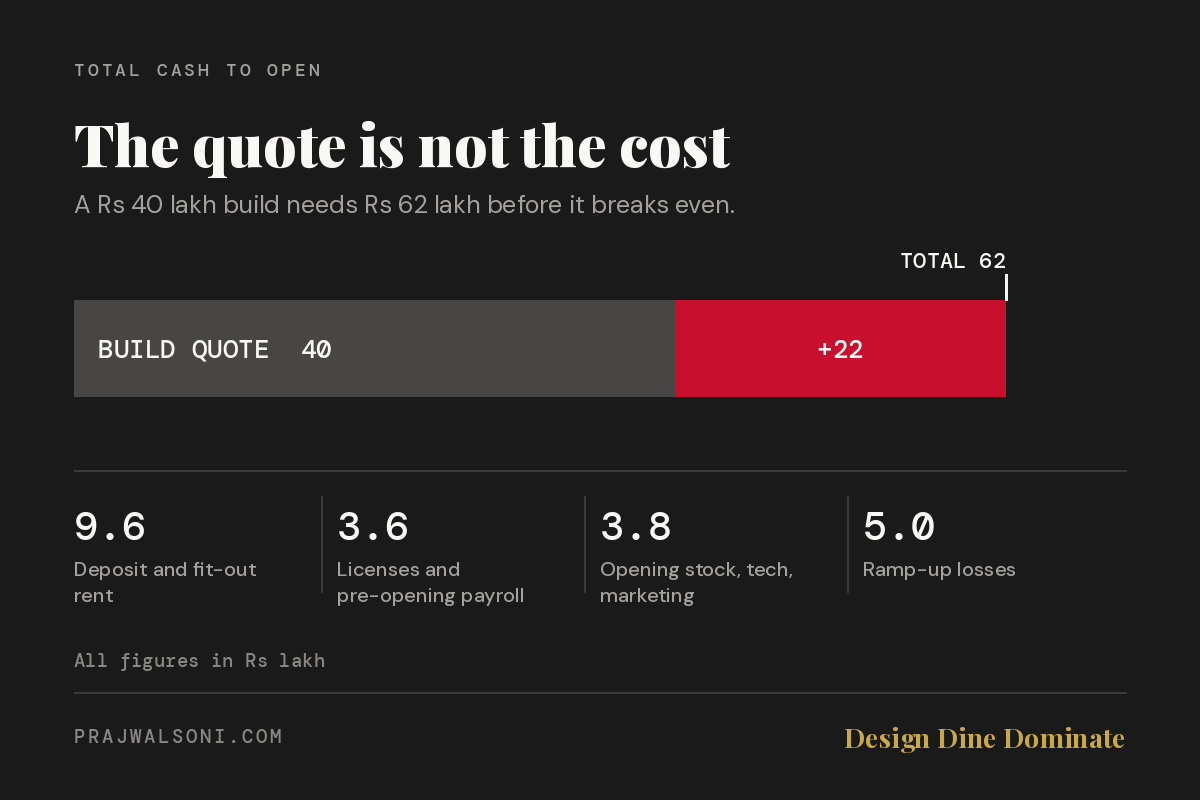
Your Rs 40 lakh outlet needs Rs 62 lakh before it pays you a single rupee. The contractor’s quote covers only the first number. Most operators in Ahmedabad, Pune, and Surat raise money against that quote and call an extra 10% a buffer. That gap is where restaurant capex planning breaks, and it usually breaks in month three.
How Much Does a New Restaurant Outlet Really Cost?
A new outlet costs its build quote plus roughly half again. For a Rs 40 lakh build, expect Rs 55-65 lakh in total cash before break-even. The extra covers rent deposits, pre-opening payroll, licenses, opening stock, and launch marketing. It also covers the losses you absorb until revenue matches monthly costs.
Capex means capital expenditure, the one-time money you spend to build and equip an outlet. Most operators plan it carefully and stop there. As a result, the cash needed to open and survive six months never makes it into the spreadsheet. Across the 18 restaurants I managed in Gujarat, the build was rarely where the money ran out.
In the outlets I have opened and consulted on, non-build cash usually runs 40-60% of the build quote. The worked example below comes out at 55%. Your figure will shift with your city’s deposit norms, your format, and how fast you ramp. Even so, I have never seen a sit-down outlet where it came close to zero.
Why Restaurant Capex Planning Misses a Third of the Real Cost
Most outlet budgets miss a third of the real cost because the contractor quote only covers what you can see. Deposits, pre-opening salaries, and ramp-up losses never appear on an interior designer’s invoice. So nobody hands you a bill for them until the money is already gone. Here is the full stack for one outlet.
Take a worked example. Picture a 1,500 sq ft casual dine-in in Pune with a Rs 40 lakh build quote, GST included. That quote covers interiors, kitchen equipment, exhaust, HVAC, and furniture. Rent is Rs 1.2 lakh per month. Before this outlet breaks even, it still needs seven more lines of cash.
- Security deposit, Rs 7.2 lakh. Six months of rent is a common ask in Pune and Bengaluru, and some landlords push for ten.
- Rent during fit-out, Rs 2.4 lakh. You pay two months of rent while the contractor works, unless you negotiated a rent-free period.
- Licenses and compliance, Rs 1.2 lakh. This covers food licensing through the FSSAI FoSCoS licensing portal, trade license, fire NOC, and CA fees. A liquor license sits far above this.
- Pre-opening payroll and trials, Rs 2.4 lakh. Your kitchen team joins three to four weeks early, and every trial batch of biryani burns real stock.
- Opening stock, smallwares, and tech, Rs 2.5 lakh. First inventory, plates, uniforms, and a Petpooja or Posist setup with hardware all land in the same fortnight.
- Launch marketing, Rs 1.3 lakh. Aggregator ads, local food creators, and opening offers eat this within the first month.
- Ramp-up losses, Rs 5 lakh. Five months of shrinking losses pile up before revenue covers costs.
Those seven lines add Rs 22 lakh to the Rs 40 lakh build. Total cash needed is Rs 62 lakh. In other words, the quote you negotiated so hard covers only about 65% of what the outlet actually consumes.
The GST Line Most Operators Forget
Standalone restaurants on the 5% GST rate cannot claim input tax credit. Input tax credit means offsetting the GST you paid on purchases against the GST you collect. So the GST on contractor invoices and most kitchen equipment, often 18%, becomes a sunk cost. If your Rs 40 lakh quote excludes GST, add roughly Rs 7.2 lakh on top.
Before you sign, ask the contractor to write the GST treatment on the quote itself. My complete guide to GST for restaurants explains when the 18% with ITC route applies instead. For most standalone outlets, it does not.
What Does an Unfunded Gap Do to an Operator by Month 3?
An unfunded gap turns into unpaid vendors by month three. The operator delays the contractor’s final payment, stretches supplier credit, and pauses marketing. Footfall then drops just when the outlet needs repeat customers most. As a result, the ramp-up stretches and the outlet burns cash for longer than planned.
Ramp-up period means the months between opening and the point where monthly revenue covers monthly costs. Every extra month in that period adds another loss to a pile you never budgeted for. This is the mechanism behind why so many restaurants fail in their first year. Usually the concept works. The cash plan does not.
Two Ways to Open the Same Pune Outlet
Operator A raises Rs 50 lakh. That covers the Rs 40 lakh build plus a Rs 10 lakh buffer, which feels generous at 25%. However, the six pre-opening lines from the list eat Rs 17 lakh. So Operator A opens Rs 7 lakh short and covers it by holding back the contractor’s last payment.
Months one to three lose another Rs 4 lakh. By the end of month three, Operator A owes roughly Rs 11 lakh to the contractor, suppliers, and a relative. To cope, the owner cancels the second phase of launch marketing and pauses aggregator ads. Suppliers start asking for cash on delivery, and the kitchen quietly switches to cheaper paneer.
Delivery makes it worse during ramp-up. Swiggy and Zomato charge 15-30% commission depending on city, volume, and plan, plus 18% GST on that commission. Settlement arrives weekly, so cash lags every order. Launch discounts also come out of your share. Read the real math behind aggregator commission rates before you count delivery revenue in month two.
Operator B raises Rs 66 lakh. That is the full Rs 62 lakh plus a Rs 4 lakh contingency. Because the money is there, Operator B pays every supplier on time and quality holds. Marketing also runs through the full launch window. In my experience, steady marketing and consistent food can pull break-even forward by a couple of months. Same outlet, same menu, same dal makhani, different survival odds.
Operator A’s outlet may be just as viable as Operator B’s. Yet profitable outlets still collapse when cash timing breaks. I explain that trap in how profitable restaurants go bankrupt on cash flow. Survival depends on the gap between total cash needed and cash raised.
How Should Restaurant Capex Planning Change Before Your Next Lease?
Budget for total cash to break-even and treat the build quote as one line inside it. That total has four layers: build, pre-opening, ramp-up losses, and contingency. Raise or borrow against the full number before you sign the lease. If you cannot fund it, shrink the format until you can.
When I worked in restaurant operations in Germany, opening costs sat as their own section in every business plan. Build and launch were two separate budgets with separate owners. Most operators I consult for merge them, so the launch budget quietly becomes whatever is left. Here is the sequence I use with clients.
- Get the build quote with exclusions written down. Ask what the contractor left out. Exhaust ducting, electrical load upgrades, and gas pipelines are the usual gaps.
- Price pre-opening line by line. Use the seven lines above as your template. Then replace my Pune numbers with your actual rent, deposit norm, and staff count.
- Model ramp-up month by month. Start month one at roughly half your break-even revenue and climb from there. Check your assumptions against realistic dine-in margins for 2026 rather than your best week.
- Add a contingency of 10-15% of build cost. Treat it like rent. You do not touch it for upgrades, extra seating, or a nicer neon sign.
- Price your borrowing into the ramp-up. Business loan rates move with the Reserve Bank of India’s policy repo rate. EMIs start before profits do, so they belong in your monthly loss model.
Cloud kitchens follow the same logic with a smaller build and heavier aggregator exposure. The fit-out might be a fraction of a dine-in’s, but ramp-up leans entirely on delivery apps. Review the cloud kitchen profitability metrics before assuming a faster break-even.
Second and third outlets are where this hurts most. The first outlet’s cash flow often funds the new build, so one underfunded opening can drag both down. I break that pattern down in why operators fail when scaling restaurants.
The Short Version for Your Next Outlet
- A Rs 40 lakh build typically needs Rs 55-65 lakh in total cash before break-even.
- Pre-opening lines like deposits, payroll, licenses, stock, and marketing came to Rs 17 lakh in the Pune example.
- Standalone restaurants on 5% GST cannot recover the GST paid on fit-out or equipment.
- Delivery revenue during ramp-up arrives thinner and later because of commissions and weekly settlement.
- Fund the full number plus 10-15% contingency, or shrink the format.
What Should You Do Before Signing Your Next Lease?
Open your expansion spreadsheet this week and look at the total. If it equals the contractor quote plus a round buffer, it is incomplete. Add the seven lines from the Pune example using your own rent, deposit norm, and staff count. Then model five months of ramp-up losses and add a 10% contingency.
Compare that final number to the cash you have actually raised. If the gap exceeds Rs 5 lakh, push the lease signing back or cut the format. Also sanity-check your ramp-up against what separates 5% margins from 15% margins. A lease signed before that math is done is a bet.
Stop guessing. Start building. Get Design Dine Dominate, the complete restaurant business playbook from someone who has actually done it.

Leave a comment