Your Orders Did Not Drop Because Your Food Got Worse
You are doing the same volume of prep, the same recipes, the same packaging. But your Swiggy and Zomato orders dropped 15-20% over three months and you cannot figure out why. The answer is almost certainly not your food. It is the aggregator discovery algorithm, and it changed without anyone sending you a notification.
Both Swiggy and Zomato continuously adjust how restaurants appear in customer search results, category listings, and homepage feeds. These changes happen silently. No email. No dashboard alert. One week you are showing up in the top 8 results for “biryani near me” in Ahmedabad. The next week, you are buried on page three. Your food did not change. Your ranking did.
This is the single biggest revenue risk for Indian restaurant operators who depend on aggregator platforms for more than 40% of their orders. And most operators do not even know it is happening.
How the Aggregator Discovery Algorithm Actually Decides Who Gets Orders
The aggregator discovery algorithm ranks restaurants based on a weighted mix of signals including order acceptance rate, average preparation time, customer ratings, cancellation rate, and how much you spend on platform ads. No single factor controls your ranking. But certain signals carry disproportionate weight, and those weights keep shifting.
Here is what we know from operating 23 cloud kitchen brands across both platforms. Preparation time has become a much heavier signal in 2025-2026 than it was two years ago. Swiggy and Zomato both want faster delivery because it drives customer retention on their app. If your average prep time runs above 20 minutes consistently, the algorithm pushes you down. Not by a little. Significantly.
Order acceptance rate is another brutal filter. Reject more than 5-8% of incoming orders and the platform treats you as unreliable. Your listing drops in visibility within days. The platforms do not tell you the exact threshold. But the pattern is consistent across every brand I have managed.
Ratings matter, but not the way most operators think. A 4.1 rating and a 4.3 rating do not produce dramatically different rankings. But dropping below 4.0 is a cliff. Below 3.8, you are essentially invisible to new customers. The algorithm treats sub-4.0 restaurants as risky and buries them under competitors. If your ratings are sliding, I have written about the full economics of the aggregator relationship and why understanding it matters for your bottom line.
The Pay-to-Play Layer That Most Operators Underestimate
Aggregator ad spend now directly influences organic discovery ranking, not just the sponsored listing slots. Restaurants running consistent ad campaigns on Swiggy and Zomato get a subtle boost in organic visibility too. This is the part that frustrates operators the most, because it means the algorithm is not purely meritocratic.
Both platforms deny this officially. But the data tells a different story. When I have paused ad spend for cloud kitchen brands for even two weeks, organic order volume drops by 8-12% in that window. Resume spending, and organic orders recover within a week. This pattern has repeated across brands in Surat, Ahmedabad, Pune, and Bengaluru.
The aggregator commission already runs 15-30% of your order value depending on your plan and city. Layer ad spend of Rs 8,000 to Rs 25,000 per month on top, and your effective platform cost can cross 35-40% of delivery revenue. That math is painful. But the alternative, being invisible on the platform, is worse for most operators who depend on delivery volume. Understanding your real profit margins is the only way to know how much platform cost you can actually absorb.
This creates a two-tier system. Restaurants with budget to spend on ads get visibility. Restaurants without budget get buried. The small operator running a single kitchen in Nagpur is competing for the same eyeballs as a funded cloud kitchen chain spending Rs 2 lakh a month on platform ads. The algorithm does not care about your food quality when it is sorting listings. It cares about signals.
What Changed in 2025-2026 That Made This Worse
Three specific shifts in aggregator policy and algorithm behavior have accelerated this problem in the last 12 months. First, both platforms increased the density of restaurant listings in most Indian cities. More restaurants competing for the same customer feed means your position matters more than ever. When there were 800 restaurants on Swiggy in your zone, being in the top 50 was easy. Now there are 1,500 or more in major cities. Top 50 is a different fight entirely.
Second, quick commerce platforms like Blinkit, Zepto, and Swiggy Instamart have trained customers to expect 10-15 minute deliveries. That expectation bleeds into food delivery. Both Swiggy and Zomato now prioritize restaurants that can deliver faster. Prep time under 15 minutes gets a clear ranking advantage. This benefits cloud kitchens with streamlined menus and hurts full-service restaurants trying to do delivery on the side.
Third, the platforms have quietly reduced the number of organic listing slots on the first screen. More of that prime real estate goes to sponsored listings and platform-promoted brands. The organic slots that remain are fiercely competitive. This is a monetization play by Swiggy and Zomato, and it is working for their revenue. For restaurants, it means organic discovery is harder to earn than it was even a year ago.
Five Moves That Actually Improve Your Aggregator Ranking
Improving your aggregator discovery algorithm ranking requires working on specific operational signals, not just throwing money at ads. Here are the five actions that produce measurable results based on what I have seen across the brands I consult for.
1. Get your average prep time under 18 minutes
Track your actual prep-to-handoff time, not what you think it is. Most restaurants overestimate their speed by 4-6 minutes. Use your POS data from platforms like Petpooja or Posist to pull real averages. If you are running above 20 minutes, redesign your delivery menu to remove items that slow down the line. A cloud kitchen brand I worked with in Surat cut three slow-prep items and saw their average drop from 22 to 16 minutes. Orders increased within two weeks without any other changes.
2. Keep order acceptance above 95%
Every rejected order hurts your ranking. If you are rejecting orders because you run out of ingredients during peak hours, that is an inventory problem disguised as a platform problem. Fix your prep pars. Adjust your menu availability in real time during service. Toggle off items you are running low on instead of rejecting the order after it comes in.
3. Respond to every negative review within 24 hours
The platforms track response rate to reviews. Restaurants that actively respond, especially to complaints, get a small but real ranking benefit. More importantly, unresolved complaints drag down your average rating, which triggers the sub-4.0 cliff. A quick, specific response (“We are sorry about the cold dal makhani, we have adjusted our packaging”) performs better than generic apologies.
4. Run small, consistent ad campaigns instead of big bursts
Spending Rs 15,000 in one week and then nothing for three weeks is worse than spending Rs 5,000 per week consistently. The algorithm rewards consistent activity. A steady ad presence signals to the platform that you are an active, invested restaurant partner. Budget Rs 500-800 per day on each platform if delivery is a significant revenue channel for you.
5. Build a direct ordering channel so aggregators are not your only source
This is the medium-term play that protects you from algorithm changes entirely. Every order you get through your own website, WhatsApp, or Instagram direct is an order the platform cannot take away. You save the 15-30% commission. You own the customer data. You stop being completely dependent on an algorithm you do not control. Operators running direct ordering systems alongside aggregator presence consistently report healthier margins.
The Bigger Picture for Indian Restaurant Operators
The Indian food service industry is valued at Rs 5.69 lakh crore according to the NRAI India Food Services Report 2024, projected to hit Rs 7.76 lakh crore by 2028. That is enormous growth. But the question for individual operators is whether that growth flows to you or to the platforms that sit between you and the customer.
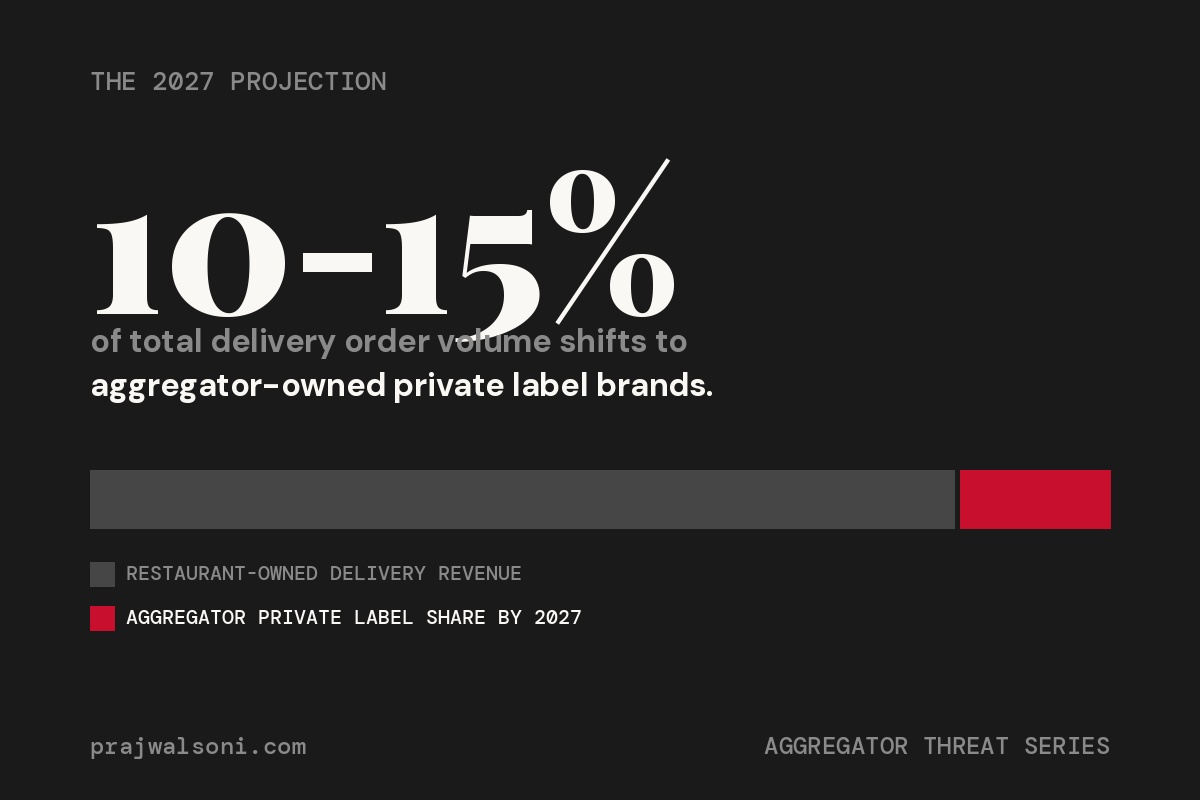
Swiggy and Zomato are publicly traded companies now. Their incentives are shareholder returns, not your restaurant’s profitability. Every algorithm change they make optimizes for their metrics: customer retention, order frequency, delivery speed, ad revenue. Your restaurant’s performance on their platform is a tool for their growth, not the other way around.
This does not mean you should abandon aggregators. For most Indian restaurants, especially in cities like Hyderabad, Pune, and Bengaluru, delivery through Swiggy and Zomato is 30-50% of total revenue. Walking away from that is not realistic. But treating it as your primary growth strategy is dangerous. The operators who scale successfully in 2026 are the ones building multiple revenue channels while optimizing their aggregator presence, not depending on it.
The tier 2 and tier 3 city opportunity is real, but those markets are also seeing rapid aggregator expansion. Operators entering Surat, Indore, Jaipur, or Nagpur thinking aggregator competition will be easier are in for a surprise. The algorithm works the same way everywhere. The playbook that protects you in Ahmedabad protects you in Rajkot too.
What You Should Do This Week
Pull your Swiggy and Zomato dashboards right now. Look at three numbers from the last 30 days: average prep time, order acceptance rate, and your average rating trend. Compare those to the previous 30 days. If any of those numbers moved in the wrong direction, that is likely why your order volume shifted.
Then check your ad spend history. Did you pause campaigns or reduce budget recently? Map it against your order volume graph. The correlation is usually obvious once you look at both on the same timeline.
Fix the operational signals first. They cost nothing. Then decide on an ad budget you can sustain weekly, not one you burn through in a burst. And start, even if it is small, building a way to reach customers without the aggregator sitting in between.
The algorithm will change again. It always does. The operators who survive those changes are the ones who do not let a platform they do not control decide whether they eat or starve.
Stop guessing. Start building. Get Design Dine Dominate, the complete restaurant business playbook from someone who has actually done it.

Leave a comment