Your restaurant does not have one inflation rate. It has five, and every menu price increase you plan should account for all of them. Most operators in Ahmedabad, Pune or Surat look at one headline number. They add 6 or 8% across the menu and expect margins to recover. Three months later, the P&L looks just as bad as before.
I watched this happen across 18 restaurants in Gujarat and 23 cloud kitchen brands. The blanket hike feels responsible. It is also why so many increases fail. Headline inflation describes the whole economy. Your kitchen buys one specific basket, pays one specific rent and sells through specific channels.
Why Should Your Menu Price Increase Not Match Inflation?
Your menu price increase should not match headline inflation because headline inflation does not measure your costs. CPI tracks what an average household buys. A restaurant buys dairy, oil, protein, labour, rent and delivery commission in its own proportions. Price to your actual cost growth, dish by dish and channel by channel, or margins keep slipping.
The Reserve Bank of India’s inflation targeting framework aims for 4% CPI inflation within a band of 2 to 6%. CPI, or Consumer Price Index, means the measure of price change across a typical household basket. Food inflation has repeatedly run ahead of that headline figure in recent years. You can pull the monthly CPI releases from the Ministry of Statistics yourself. Then put them next to your purchase invoices and watch how rarely the two agree.
Scale makes this worth getting right. The NRAI India Food Services Report 2024 values the Indian food service industry at Rs 5.69 lakh crore. In my experience, most of that revenue still gets repriced with a calculator and a gut feeling. A calculator is fine. The gut feeling is the problem, because it applies one number to five different cost problems.
What Are the Five Layers of Restaurant Inflation?
Restaurant inflation has five layers: your ingredient basket, the dish-level spread, spike versus structural costs, fixed-cost drift and channel leakage. Each layer moves at its own speed. Ignore even one of them and your price increase goes wrong. You either leave money on the table or lose customers you did not need to lose.
Layer 1: Your Basket Inflation, Weighted by Spend
Basket inflation means the price change in what you actually buy, weighted by how much you spend on each item. A North Indian kitchen might put a big share of its purchase bill into paneer, ghee, butter, cream and oil. Meanwhile, a South Indian breakfast chain in Bengaluru leans on rice, urad dal, coconut and coffee. Same city, same month, completely different inflation.
Most operators track the ingredient that spiked rather than the ingredient that matters. Cardamom doubling makes noise, but you buy it by the gram. A 10% move in dairy hurts far more when dairy is a third of your spend. So weight every price change by its share of your purchase bill.
To calculate it, list your top 15 purchase items by rupee spend for the last quarter. Note the price change on each one. Then multiply each change by that item’s share of total spend and add them up. That figure is your real food inflation, and it often sits well away from the CPI number.
Layer 2: The Dish-Level Spread
Inflation hits dishes unequally, so a uniform hike misprices most of your menu. Dal makhani carries butter and cream. Tandoori roti carries atta and gas. If dairy rises sharply while wheat stays flat, those two items need very different increases.
A blanket 8% hike then does two bad things at once. It overprices the roti, where your margin was already fat. At the same time, it underprices the dal makhani, which may be your highest-volume dish. Because volume multiplies the error, the item you sell most keeps bleeding.
So recost every recipe, not just the menu average. Recipe costing means calculating the exact rupee cost of ingredients in one portion. Petpooja and Posist both support this, but only if someone updates the purchase rates. Most kitchens I audit run recipe masters that are two or three price cycles old. If you need the base method, start with the psychology and math behind menu pricing, then feed it current costs.
Layer 3: Spike Costs vs Structural Costs
Only permanent cost increases belong on your printed menu. Temporary spikes need a kitchen response instead. Tomato prices in many cities jumped several times over within weeks in mid-2023, then fell back. Salaries and rent escalations almost never fall back.
Reprice for a spike and you create a new problem when it reverses. Regulars remember why the paneer butter masala went up. When tomato prices return to normal and your price stays, they notice. After that, they start doubting every number on your menu.
Handle spikes inside the kitchen. Rotate the daily special, adjust the gravy base for a few weeks, or pull the worst-hit dish from the delivery menu temporarily. A practical rule: if a cost stays high for two full months, move it into the menu review. Until then, absorb it or work around it.
Layer 4: Fixed-Cost Drift
Holding food cost at 30% does not protect your profit, because rent and salaries grow in rupees. Most commercial leases carry an annual escalation clause, commonly around 5%. Kitchen salaries often move faster than that. The restaurant staff turnover crisis keeps pushing experienced cooks to switch jobs for small raises.
Contribution margin means what each order leaves after variable costs like food, packaging and commission. That rupee contribution pays your rent and salaries. If fixed costs rise 7% while contribution per order stays flat, you need 7% more orders just to stand still.
So the food cost layer tells you how much to raise prices to protect your margin percentage. The fixed-cost layer tells you how much extra rupee contribution each order must carry. Skip the second one and you get healthy-looking percentages on a shrinking profit. That pattern often separates restaurants stuck at 5% margins from those clearing 15%.
Layer 5: Channel Leakage on Swiggy and Zomato
On delivery apps, every rupee of price increase loses a cut before it reaches you. Swiggy and Zomato charge roughly 15 to 30% commission, depending on city, plan and volume. On top of that, 18% GST applies to the commission amount.
Take a 25% commission as an example. Add 18% GST on it and the effective deduction becomes 29.5%. As a result, a Rs 20 price increase puts only about Rs 14.10 in your account. Recovering a genuine Rs 20 cost increase needs roughly Rs 28.40 more on the app price.
Most standalone restaurants charge 5% GST without input tax credit, so they cannot claim back that 18%. Input tax credit means offsetting GST you paid on business costs against GST you collect. The details sit in this guide on how GST works for restaurants. Packaging inflation hits delivery orders alone, which widens the gap further. This is why aggregator commission rates and how to negotiate them belong in every repricing decision.
How Do the Five Layers Combine on One Dish?
The layers stack, so one dish can need far more than your average increase while another needs nothing. Heavy dairy, high volume and a big delivery share push the number up. Here is an illustrative calculation for dal makhani. The figures are examples to show the mechanics, not data from a specific outlet.
- Basket and dish layers: food cost on a Rs 280 dal makhani rises from Rs 84 to Rs 96. Butter and cream did most of the damage, adding Rs 12 per plate.
- Spike check: the dairy increase has held for three months, so it counts as structural.
- Fixed-cost drift: rent and salaries are up roughly 6% this year. The plate’s Rs 196 contribution needs about Rs 12 more to keep pace.
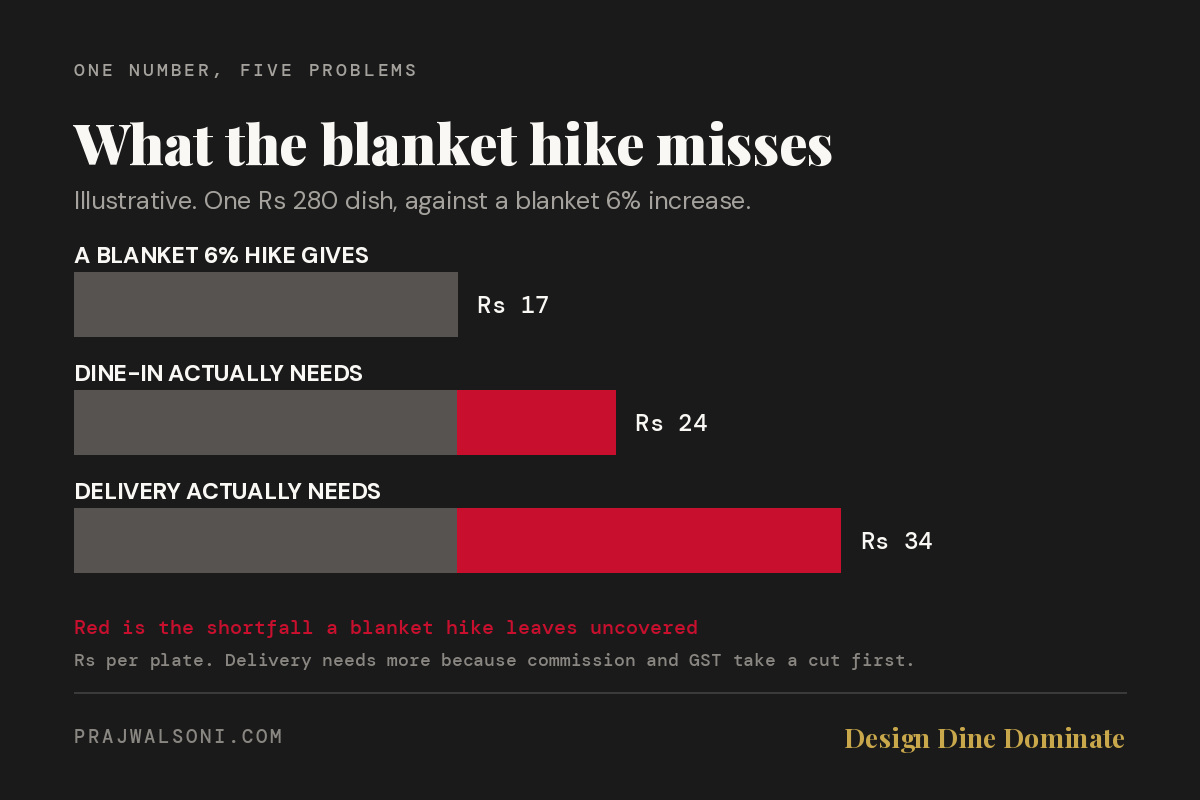
- Dine-in price: Rs 12 plus Rs 12 means roughly Rs 24 more. The menu price moves from Rs 280 to about Rs 305.
- Delivery price: Rs 24 of real recovery at a 29.5% effective deduction needs about Rs 34 more on the app.
A blanket 6% hike would have given this dish about Rs 17. It needed Rs 24 on dine-in and Rs 34 on delivery. Meanwhile, the tandoori roti built on flat-priced atta may need nothing at all. Raise it anyway and you hand customers a complaint about the cheapest line on their bill.
What a Layered Menu Price Increase Lets You Do
Pricing by layer lets you raise prices less on average while recovering more margin. You concentrate increases on the dishes and channels actually losing money. Stable items stay untouched. You also reprice on a quarterly cadence instead of one painful annual jump.
Fewer visible changes also mean fewer reasons for regulars to compare old and new prices. If 12 items move by Rs 10 to Rs 30 and 40 items stay put, many guests barely register a hike. When the whole menu jumps 8%, everyone does.
Timing matters for cash too. Every week you delay a structural increase, you pay suppliers this month’s rates while billing customers last year’s prices. That gap quietly drains working capital, a pattern I break down in this piece on restaurant cash flow management. For delivery-only brands, the channel layer often decides profitability outright. Check it against your cloud kitchen profitability metrics before touching the app menu.
The Short Version Before Your Next Repricing
Smart repricing in an inflation year comes down to five checks. Each one fixes a specific mistake that blanket hikes make.
- Your real food inflation is your purchase basket weighted by spend, and it rarely matches CPI.
- Recost dishes individually, because one blanket percentage overprices some items and underprices your best sellers.
- Put only structural cost increases on the printed menu. Handle spikes inside the kitchen.
- Price for rupee contribution as well as food cost percentage, since rent and salaries inflate in rupees.
- On Swiggy and Zomato, a 25% commission plus 18% GST means a Rs 20 hike nets you about Rs 14.
What to Do This Week
Block two hours this week and run the numbers before your next menu print or app update. Here is the order that works.
- Pull the last 90 days of purchase invoices and list your top 15 items by rupee spend.
- Calculate the spend-weighted price change. That is your real food inflation.
- Recost your top 10 dishes by volume at current supplier rates.
- Mark every cost increase as spike or structural, using the two-month rule.
- Price delivery separately, using your actual commission rate plus 18% GST on it.
Reprice only where the numbers demand it, and leave the rest of the menu alone. You will likely raise fewer items and recover more margin than any blanket hike would.
Stop guessing. Start building. Get Design Dine Dominate, the complete restaurant business playbook from someone who has actually done it.

Leave a comment