Last year, a family-dining restaurant I was advising in Ahmedabad raised its Gujarati thali by Rs 40 over one weekend. Nobody briefed the captains. The regulars heard nothing either. On Sunday, a customer who had eaten that thali every week for years asked why his bill looked different. The captain shrugged and said, “Sir, management decided.” That one sentence did more damage than the menu price increase itself.
The increase was justified. Ghee, paneer, and vegetable costs had climbed for months before it. Still, customers never heard that reason, so they filled the gap with their own. In my experience, diners accept higher prices far more often than operators fear. What they refuse to accept is feeling tricked, and their patience for that is running out.
How Should Restaurants Handle a Menu Price Increase in 2026?
Raise prices in smaller, more frequent steps and explain each increase before customers discover it. Tell regulars first, brief floor staff with a one-line reason, and disclose any portion change openly. Over the next 12 to 24 months, silent hikes will cost more in trust than they earn in revenue.
This is a forecast, so it needs evidence. The argument below rests on three shifts you can already see in your bills, your reviews, and your supplier invoices.
What Signals Show That Silent Price Hikes Are Ending?
Three signals are already visible. Aggregators have trained customers to read every line of a bill. Consumer regulators have publicly named hidden pricing as a problem. Meanwhile, input costs keep swinging, which forces operators to revise prices far more often than once every few years.
Aggregators taught customers to read every line
Swiggy and Zomato both introduced a per-order platform fee in 2023, and both have raised it since. Each revision produced screenshots, news stories, and angry threads comparing old bills with new ones. As a result, your delivery customer has spent two years learning to scan fees, taxes, and packaging charges line by line.
That customer carries the same habit into your dine-in outlet. When your paneer tikka jumps Rs 30, they notice immediately. Many will also compare your app price with your dine-in menu. So any gap between the two needs a reason your staff can say out loud.
Regulators have named hidden pricing
In July 2022, the Central Consumer Protection Authority issued guidelines barring restaurants from adding service charge by default. Then, in November 2023, it notified guidelines on dark patterns that list drip pricing as a prohibited practice. Drip pricing means showing one price upfront and revealing extra charges later. Both documents are available on the Department of Consumer Affairs website.
The dark pattern rules mainly target digital platforms and sellers, but the direction is clear. Surprise charges now carry complaint risk. Keep every tax and charge visible on the bill, in line with the GST rules for restaurants. None of this stops you from raising prices. However, hiding them is becoming a liability.
Input costs will not sit still
Tomato prices crossed Rs 100 a kg in many cities during mid-2023. Onion and edible oil have had their own spikes since. The Reserve Bank of India’s monetary policy statements have repeatedly flagged food price uncertainty as a risk to the inflation outlook.
For operators, one big price revision every three years no longer works. Most formats need food cost inside the 28-38% range, and holding that range takes smaller, frequent adjustments. Every adjustment is also a communication moment.
How Do Most Operators Raise Prices Today?
Most operators raise prices silently. They update the menu in Petpooja or Posist overnight, push new rates to the aggregators, and hope nobody notices. Some skip the price change and shrink portions instead. Both approaches worked when customers had fewer options and less visibility. That window is closing.
I have seen this pattern across restaurants I managed in Gujarat and cloud kitchen brands I operated. A biryani portion quietly loses 50 or 80 grams. The raita container gets smaller. A Rs 15 packaging charge appears on the delivery menu while the dish price stays untouched.
This is shrinkflation, which means cutting quantity or quality while keeping the price the same. Customers catch it faster than a price hike, because they eat the evidence. Then they write about it in reviews, usually with a photo.
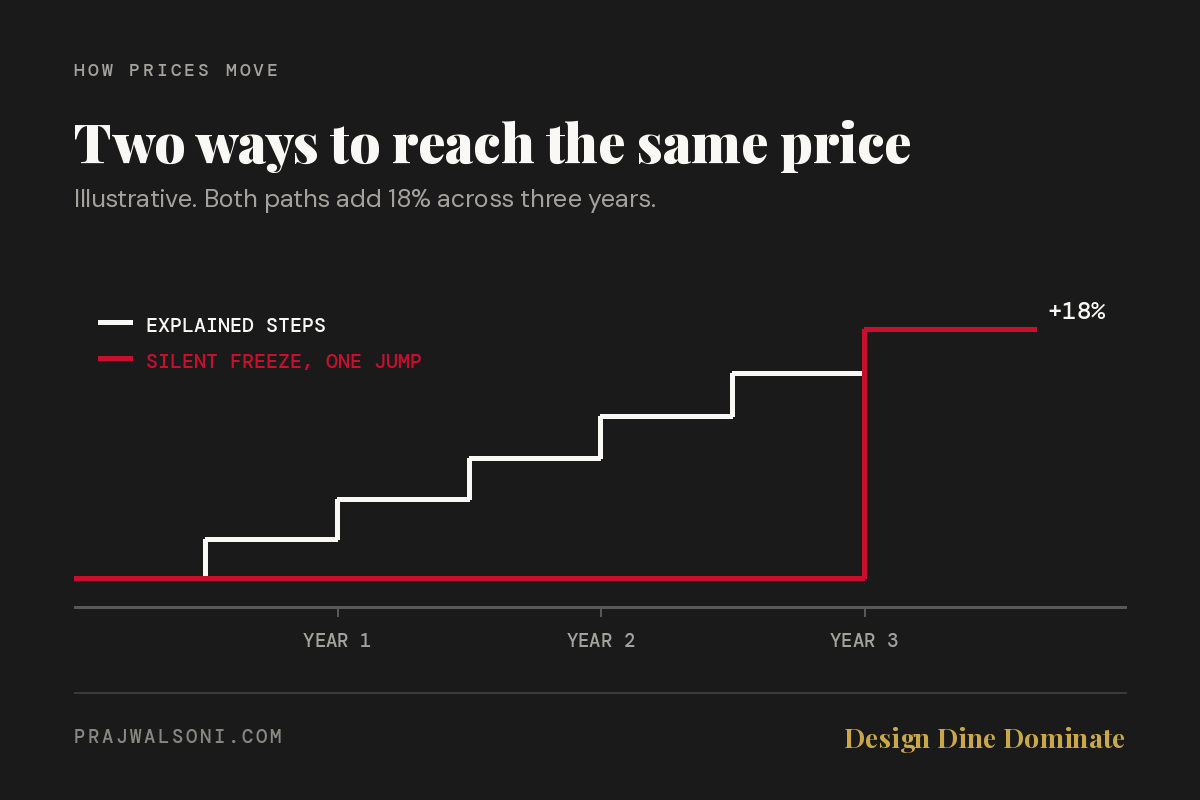
The second pattern is the long freeze. An operator holds prices for three years out of fear. Margins slide into the struggling 5-8% band. Then everything goes up 15-20% at once. That single jump is what customers remember. Our breakdown of restaurant profit margins in the 5% versus 15% range shows how fast a frozen menu eats the bottom line. The damage usually hits your bank balance first, as the guide to restaurant cash flow management explains.
Where Is Menu Price Increase Communication Heading by 2027?
Over the next 12 to 24 months, explained price increases will become standard practice among well-run restaurants. Operators will revise prices two or three times a year, in smaller steps. The ones who explain each change will keep their regulars. Silent operators will find their pricing debated in Google reviews.
Market structure supports this forecast. The NRAI India Food Services Report 2024 values the industry at Rs 5.69 lakh crore. It also shows the organised segment growing at 13.2% CAGR. CAGR means compound annual growth rate, the average yearly growth across a period. More organised brands means more choice within one scroll on an app. A customer with five alternatives will not tolerate a price change that feels sneaky.
Expect these three shifts in practice:
- Menu notes will look normal. A short line on the menu or table tent explaining a revision will stop feeling unusual.
- Staff answers will carry weight. The captain’s reply to “why is this costlier now?” will decide whether a regular comes back.
- Portion disclosure will build trust. Brands that print grams on their aggregator listings will stand out against those that stay vague.
What Does This Mean for Your Floor Staff and Aggregator Menus?
Communication becomes part of the price itself. Your captain, your cashier, and your aggregator listing all deliver the increase to the customer. If any one of them fumbles the explanation, the increase feels like a grab. So the price decision and the communication plan must happen together, on the same day.
Floor staff are the weakest link. Turnover is so high that the captain facing your oldest regular may have joined last month. The restaurant staff turnover crisis means briefings cannot be a one-time event. A new captain has no idea why the thali costs more. So they say what the Ahmedabad captain said.
Delivery menus carry separate risk. Commission of 15-30%, plus 18% GST on that commission, already pushes many operators to price higher on apps. The math behind that is in our piece on aggregator commission rates and how to negotiate them. If your app price sits above dine-in, train staff to say so plainly when asked. A clear answer earns more trust than a denial.
A 7-Step Plan for Your Next Menu Price Increase
Run the increase like a menu launch. Set the numbers from cost data, protect your most-ordered dishes, write one honest reason, and brief staff. Then tell regulars first and update every channel on the same day. The whole process takes roughly one week.
- Start with the cost sheet. Price each dish from actual recipe cost, not gut feel. The method in how to price your menu with psychology and math gives you the numbers.
- Protect your anchor items. Identify the three or four dishes regulars order most. Raise those last, or by the smallest amount.
- Write one honest reason. “Our paneer and dairy costs have risen, so we revised a few prices” works well. Vague lines about rising costs everywhere sound like excuses.
- Brief every staff member. Give captains and cashiers a two-sentence script. Rehearse it once at the pre-shift meeting.
- Tell regulars before the menu changes. A short WhatsApp broadcast a week ahead works, and so does a note with the bill. If you run a points system, the loyalty programs that actually work for Gen Z diners give you a ready channel.
- Disclose portion changes openly. If the biryani gets smaller, say so on the menu and adjust the price to match.
- Update every channel the same day. Printed menus, QR menus, Swiggy, Zomato, and your own ordering site should change together.
What to Carry Into Your Next Menu Revision
Carry these five facts into your next revision. Each one is already visible in the market today.
- Customers read itemised bills closely now, a habit aggregator platform fees have built since 2023.
- CCPA guidelines on service charge (2022) and dark patterns (2023) make hidden charges a growing complaint risk.
- Food cost volatility will push operators toward two or three smaller price revisions each year.
- Silent portion cuts get caught faster than openly announced price increases.
- Your captain’s answer to “why is this costlier?” decides whether a regular returns.
What Should You Do This Week?
Pull the date of your last price revision and the current food cost for your top 10 dishes. If any dish sits above 35%, draft the one-line reason and the staff script before you touch the menu. Then pick the date you will tell your regulars.
Stop guessing. Start building. Get Design Dine Dominate, the complete restaurant business playbook from someone who has actually done it.

Leave a comment