Picture this: you are running a restaurant in Ahmedabad when your accountant tells you food cost is 33%. You nod. Seems fine. Your POS report confirms it. But then your bank balance keeps shrinking every month, and you cannot figure out where the money goes. The problem is not your food cost number. The problem is that you are looking at one number when food cost control actually has 5 distinct layers. Most operators in the international restaurant industry only ever see layer one. The other four are where your money disappears.
What Is the Real Anatomy of Food Cost?
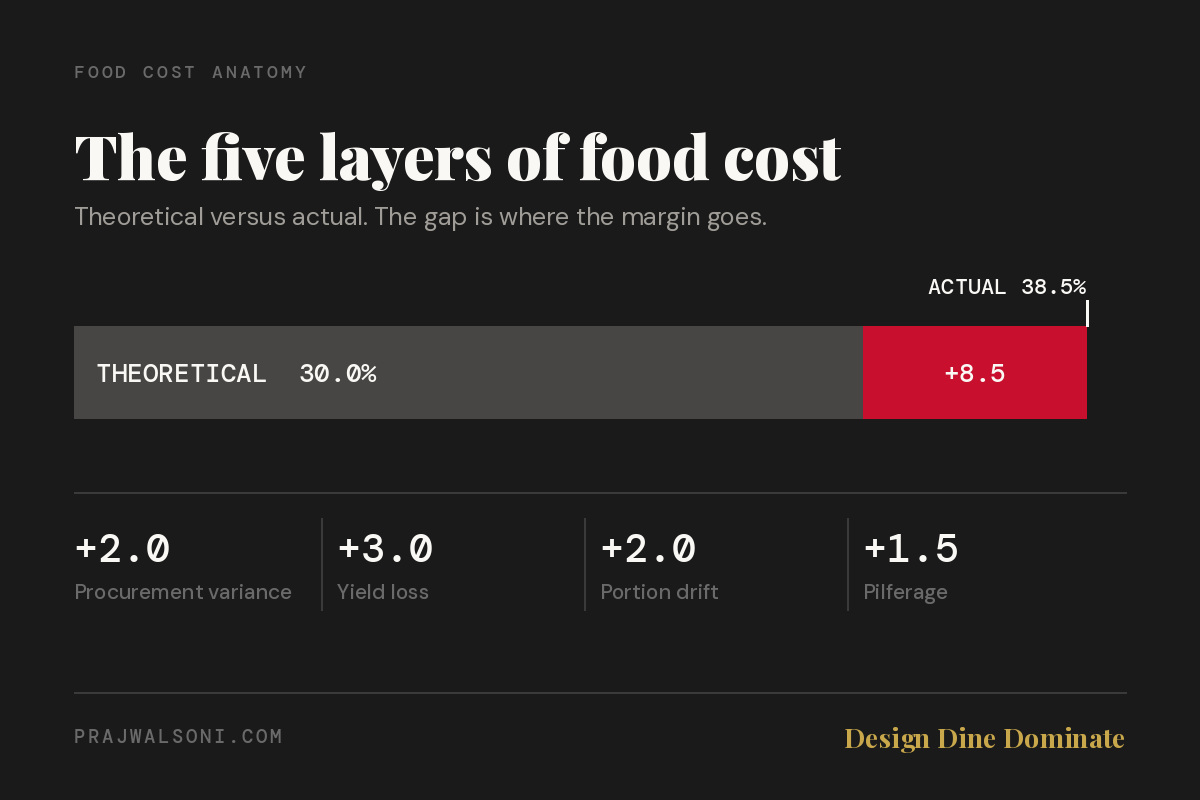
Food cost is not a single percentage. It is a stack of 5 interacting layers, each capable of leaking money independently. Your POS system calculates theoretical food cost from recipes. But actual food cost includes procurement variance, preparation waste, portion drift, and theft or pilferage. The gap between theoretical and actual food cost in restaurants I have consulted for typically runs 3 to 7 percentage points. On monthly revenue of Rs 15 lakh, that gap alone costs you Rs 45,000 to Rs 1,05,000 every single month.
Most operators treat food cost as one line item on their P&L statement. They compare it against a benchmark, say 32%, and move on. This approach hides the real problems because a 32% food cost can mean very different things depending on which layers are bleeding.
So here are the 5 layers. Each one is a separate control point. Miss any single layer, and your food cost number becomes fiction.
Layer 1: Theoretical Food Cost, the Number Everyone Trusts Too Much
Theoretical food cost is what your recipes say it should cost to produce every dish on your menu. If your dal makhani recipe uses Rs 48 of ingredients and you sell it for Rs 180, theoretical food cost is 26.7%. POS platforms like Petpooja and Posist calculate this automatically when you input recipes correctly. This number is useful as a baseline, but it is not your real food cost.
The danger here is obvious. Operators build their menu pricing on theoretical cost. They set selling prices assuming every plate will cost exactly Rs 48 to produce. In reality, no kitchen in Surat, Pune, or Bengaluru operates at theoretical precision. Ingredients vary in quality. Cooks measure by eye. Suppliers substitute items. Theoretical food cost is your starting point, not your finish line.
What makes this layer non-obvious is that most operators never update their recipe costing. They set it once during launch. Six months later, onion prices have doubled, paneer rates have shifted by 15%, and their theoretical cost is quietly wrong. If your recipe cards are older than 90 days, your theoretical food cost is already a lie.
How Does Procurement Variance Silently Inflate Your Food Cost?
Procurement variance is the difference between the ingredient price in your recipe card and the price you actually paid this week. This layer alone can swing your food cost by 2 to 4 percentage points without a single other thing changing in your kitchen. You planned for tomatoes at Rs 30 per kg. Your supplier delivered at Rs 52. That variance hits every dish containing tomatoes.
In cities like Nagpur and Hyderabad, seasonal price swings on vegetables are extreme. A restaurant running 40% vegetable-heavy dishes can see food cost jump from 31% to 36% in a single month purely from procurement variance. No waste increased. No portions changed. Just prices moved.
The fix is a weekly procurement variance report. Compare what you paid against what your recipes assume. If variance exceeds 5% on any ingredient that represents more than 3% of your total spend, you have three options. Renegotiate with the supplier. Find an alternate supplier. Or adjust your menu price temporarily. Most operators do none of these because they never measure procurement variance separately. They just see a higher food cost at month end and blame “the market.”
According to the NRAI India Food Services Report 2024, food cost for the organized restaurant segment in India ranges from 28% to 38% of revenue. Procurement variance is a major reason why restaurants in the same city, serving similar food, can have a 10 percentage point gap in food cost.
What Is Preparation Waste and Why Do Most Operators Ignore It?
Preparation waste is the ingredient quantity lost between raw purchase weight and usable cooking weight. You buy 10 kg of chicken. After cleaning, trimming, and de-boning, you have 7.2 kg of usable meat. That 28% loss is preparation waste. If your recipe assumes 10 kg input equals 10 kg usable, every dish is already under-costed before a single order fires.
This layer is invisible in most POS systems. Petpooja and Posist track recipe cost based on purchased quantity, not yield-adjusted quantity. So your system says chicken costs Rs 220 per kg. But your real cost per usable kg is closer to Rs 306 after yield loss. That is a 39% difference hiding in plain sight.
Every ingredient has a yield factor. Onions lose roughly 10% to peeling. Paneer loses 5% to crumbling and trimming. Fish can lose 40% or more depending on the cut. If you have not built yield factors into your recipe costing, your theoretical food cost is wrong at the foundation.
In restaurants I have worked with, simply adding yield-adjusted costing to recipes reveals a true food cost that is 2 to 5 percentage points higher than what the POS shows. For a cloud kitchen doing Rs 8 lakh monthly revenue, that hidden gap represents Rs 16,000 to Rs 40,000 in untracked cost every month.
How Does Portion Drift Destroy Your Margins Over Time?
Portion drift is the gradual increase in serving sizes that happens when cooks plate by visual estimation instead of weighing. Your recipe says 180 grams of biryani rice per plate. Your cook scoops 210 grams because it “looks right.” That 30-gram drift, multiplied across 150 orders a day, adds up to 4.5 kg of extra rice daily. At Rs 80 per kg, that is Rs 360 per day. Rs 10,800 per month. From one ingredient on one dish.
Portion drift is the most common and most fixable layer of food cost leakage. It requires exactly one thing: portion tools. Ladles of specific sizes. Scoops that hold exact quantities. Digital scales at every prep station. Most restaurants in India skip this because it feels slow. But the 15 seconds a cook spends weighing saves you thousands every month.
I have seen portion drift account for Rs 30,000 to Rs 70,000 per month in mid-sized restaurants across Gujarat. The fix costs under Rs 5,000 in equipment. The ROI is immediate. Yet operators resist it because they trust their cooks. Trust is good. Verification with a weighing scale is better.
Portion drift also impacts customer experience unpredictably. When one cook serves 210 grams and another serves 170 grams, your reviews on Swiggy and Zomato reflect that inconsistency. Customers write “portion size has reduced” when in fact it was never controlled in the first place. Proper food cost control through portioning solves both your margin problem and your consistency problem simultaneously.
Why Is Pilferage the Layer Nobody Wants to Talk About?
Pilferage means ingredients leaving your kitchen without becoming a sold dish. It includes theft, yes. But also unauthorized staff meals. Ingredients sent home. Items used for personal cooking during off-hours. And the category nobody tracks: dishes made wrong, discarded, and remade without any record.
In the international restaurant industry, pilferage typically accounts for 1 to 3% of total food purchases. On Rs 5 lakh monthly ingredient spend, that is Rs 5,000 to Rs 15,000 disappearing every month. Over a year, you are looking at Rs 60,000 to Rs 1.8 lakh. This number is uncomfortable because it implies your staff is responsible. But acknowledging it is the first step to controlling it.
The fix requires three systems working together. First, a closing inventory count at least twice a week, not just month-end. Second, a void and wastage log that records every dish discarded or remade, with a reason. Third, staff meal tracking where authorized meals are logged and costed. Without these three, your food cost includes a pilferage tax that you are paying blindly.
This layer interacts with all the others. If you do not track preparation waste separately, pilferage hides inside waste numbers. If you do not monitor portion drift, extra scooping looks identical to missing inventory. Each layer must be isolated for accurate financial control. That is the only way to diagnose where your food cost actually breaks down.
How Do These 5 Layers Interact in a Real Restaurant?
These layers do not operate in isolation. They compound. A restaurant with 2% procurement variance, 3% yield loss not accounted for, 2% portion drift, and 1.5% pilferage has an 8.5 percentage point gap between theoretical and actual food cost. If theoretical is 30%, actual is 38.5%. That is the difference between a healthy 15% net margin and barely surviving at 6%.
The compounding effect explains why two restaurants with identical menus and identical prices can have wildly different profitability. One controls all 5 layers. The other trusts POS reports. The gap between them grows every single month.
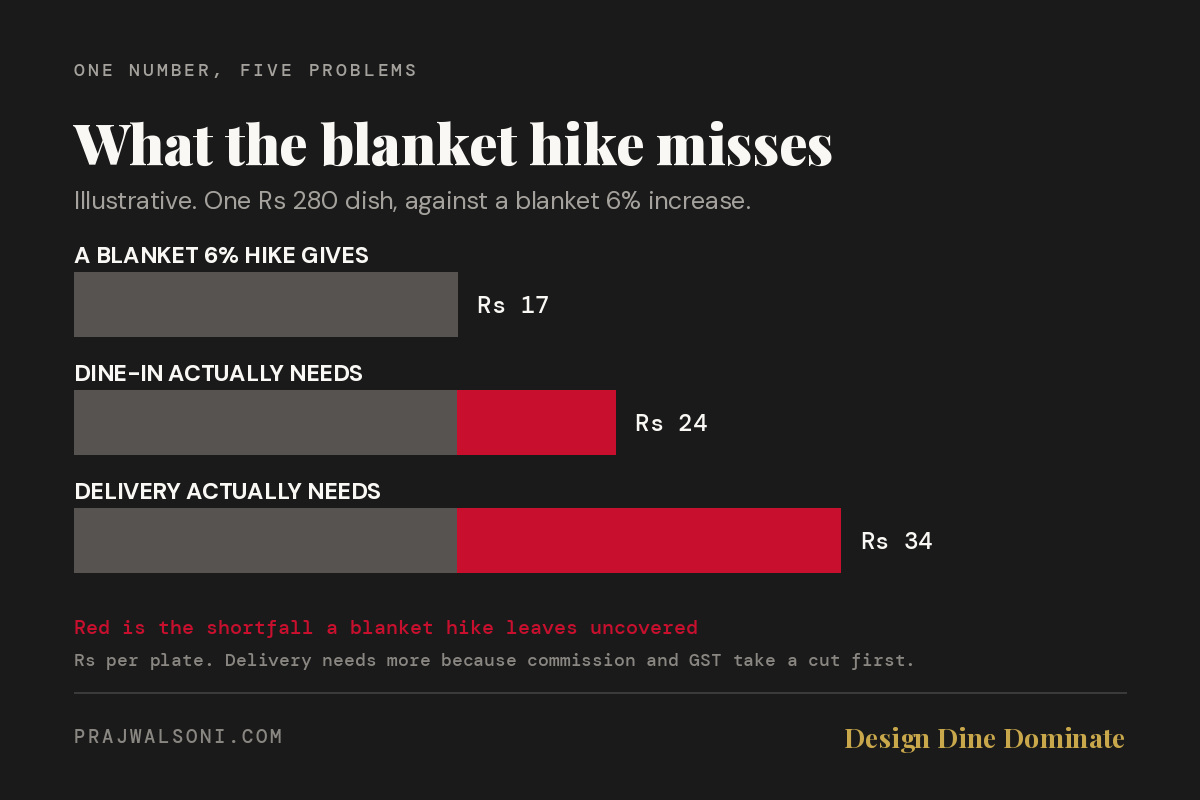
When you add aggregator commissions of 15 to 25% on delivery orders, the margin for error shrinks dramatically. A dine-in order with 38% food cost still leaves room for recovery through beverage margins. A Zomato delivery order with 38% food cost plus 22% commission means you have 40 paise left from every rupee to cover rent, labor, electricity, and profit. That math does not work.
What Does Knowing All 5 Layers Actually Enable?
When you track all 5 layers separately, you stop making blind decisions. You know exactly where to intervene. If procurement variance is high, you fix supplier contracts. If preparation waste is above benchmarks, you train on cutting techniques or switch to pre-processed ingredients. If portion drift is the culprit, you invest Rs 5,000 in portion tools. If pilferage is the issue, you tighten inventory counts.
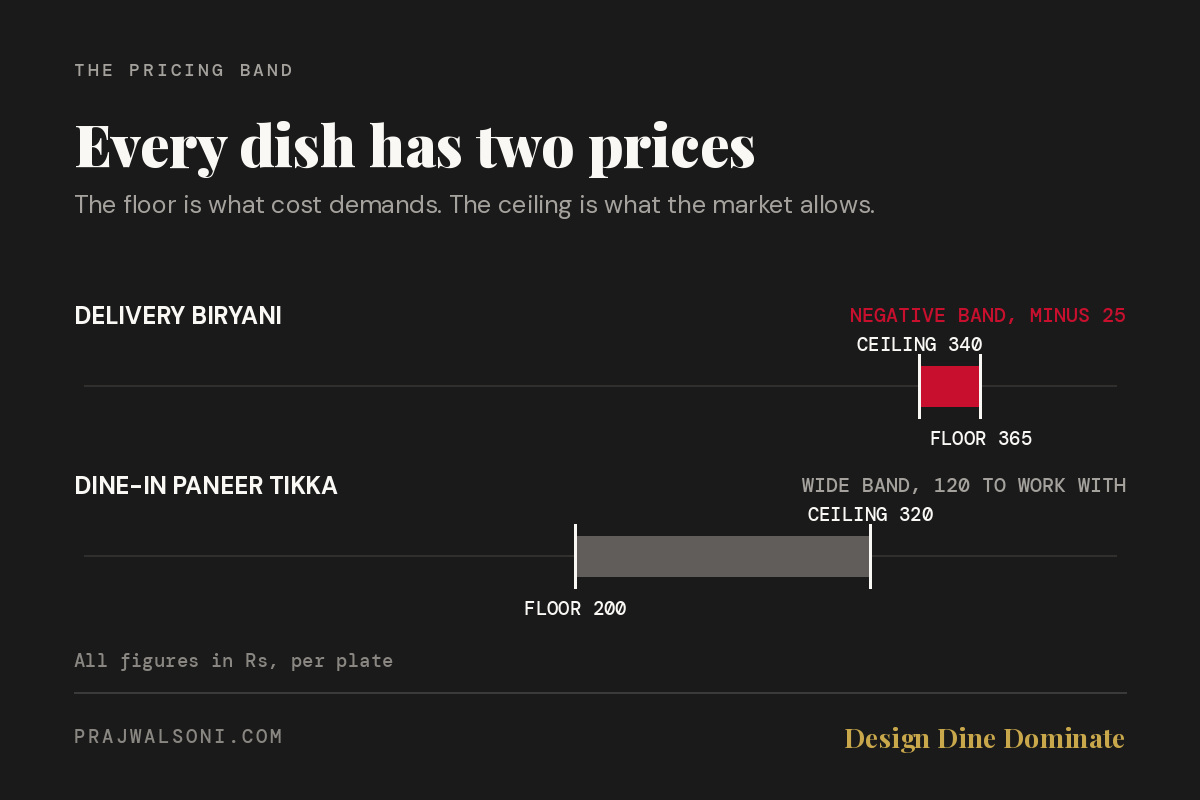
Without layer-level visibility, every food cost problem gets the same lazy solution: raise menu prices. Price increases pushed without diagnosis hurt your competitiveness on Swiggy and Zomato. They reduce order volume. And they do not fix the underlying leak. The problem returns next month, now with fewer customers.
A proper food cost control system built on these 5 layers takes roughly 4 to 6 weeks to implement. Week 1: update all recipe cards with current prices and yield factors. Week 2: install portion tools and train cooks. Week 3: start weekly procurement variance tracking. Week 4: implement bi-weekly physical inventory counts with void and wastage logs. By week 6, you have a complete picture of where every rupee goes. As the RBI’s inflation data shows, ingredient costs in India are not stabilizing anytime soon. Building this system now is not optional.
Key Takeaway
- Theoretical food cost from your POS is a starting point, not your actual food cost. Update recipe cards every 90 days minimum.
- Procurement variance can swing food cost by 2 to 4 percentage points monthly. Track it weekly against recipe assumptions.
- Preparation waste from yield loss hides 2 to 5 percentage points of cost that most POS systems never capture.
- Portion drift is the easiest and cheapest layer to fix. A Rs 5,000 investment in portion tools can save Rs 30,000 or more monthly.
- Pilferage requires systematic inventory counts, void logs, and staff meal tracking. Without all three, you cannot isolate this layer from other waste.
Here is your action for this week. Pull your last 30 days of purchase invoices. Compare the top 10 ingredients by spend against the prices in your recipe cards. Calculate the variance for each. If even 3 of those 10 ingredients show more than 5% variance, you have found the first layer that needs fixing. Then move to the next. If you want to scale your restaurant without scaling your losses, build the system layer by layer.
Stop guessing. Start building. Get Design Dine Dominate, the complete restaurant business playbook from someone who has actually done it.

Leave a comment