Picture This: Revenue Is Up, But the Bank Balance Keeps Shrinking
Picture this: you are running a biryani brand in Surat with two cloud kitchen locations. Monthly revenue just crossed Rs 9 lakh. Orders are growing 12% quarter on quarter. Your Swiggy ratings sit above 4.3. By every vanity metric, you are winning.
But your bank account tells a different story. After rent, salaries, packaging, raw materials, aggregator commissions, and GST, you are pulling roughly Rs 38,000 a month. For two kitchens. That is Rs 19,000 per location. A delivery rider in the same city earns more.
This is exactly what happened with a client I worked with in Surat in late 2024. A biryani-focused cloud kitchen doing honest volume on Swiggy and Zomato but bleeding Rs 1.8 lakh every month in avoidable losses. The reason was simple but painful. Nobody had ever done a proper restaurant breakeven analysis. Nobody had separated fixed costs from variable costs. So nobody knew how many orders per day were needed just to stop losing money.
What Is Restaurant Breakeven Analysis and Why Do Most Operators Skip It?
Restaurant breakeven analysis tells you the exact revenue point where your total costs equal your total income. Below that point, every day is a loss. Above it, every rupee starts contributing to actual profit. Most operators skip it because they confuse positive cash flow with profitability.
Breakeven means the minimum monthly revenue where your restaurant stops bleeding. It requires separating your costs into two buckets. Fixed costs stay constant whether you sell 10 orders or 300. Rent, salaries, insurance, POS subscription, and equipment EMIs fall here. Variable costs move with every order. Raw materials, packaging, aggregator commissions, and delivery charges belong in this bucket.
The formula is straightforward. Breakeven Revenue equals Fixed Costs divided by Contribution Margin Ratio. Contribution Margin Ratio equals Revenue minus Variable Costs, divided by Revenue. If your fixed costs are Rs 2.4 lakh per month and your contribution margin ratio is 0.40, your breakeven revenue is Rs 6 lakh. Anything below that number means the business is underwater.
I have seen operators in Ahmedabad, Pune, and Bengaluru who have never calculated this single number. They operate on instinct. Instinct does not pay rent.
What Did the Numbers Actually Look Like in Surat?
The Surat brand’s combined monthly numbers across both kitchens looked healthy on the surface. Revenue was Rs 9.2 lakh. The owner assumed he was profitable because he had positive cash flow most weeks. He was wrong.
Here is what the cost structure actually revealed when we pulled three months of data from his Petpooja reports and bank statements:
Fixed costs per month (both locations combined):
- Rent for two kitchens: Rs 1,10,000
- Staff salaries (6 people total): Rs 1,44,000
- POS, internet, and software subscriptions: Rs 8,500
- Equipment EMIs: Rs 22,000
- Insurance and compliance: Rs 6,500
Total fixed costs: Rs 2,91,000 per month.
Variable costs per month:
- Raw material (food cost at 36% of revenue): Rs 3,31,200
- Packaging: Rs 46,000
- Aggregator commissions (averaging 22% after GST): Rs 2,02,400
- Delivery and logistics: Rs 18,000
- GST outflow (5% on dine-in equivalent revenue): Rs 46,000
Total variable costs: Rs 6,43,600 per month.
So total costs were Rs 9,34,600 against revenue of Rs 9,20,000. The brand was losing Rs 14,600 per month on paper. But that was just the accounting loss. The real bleeding was in opportunity cost and owner salary. The owner was paying himself nothing. If you factor in even Rs 50,000 as a modest owner draw, the actual monthly loss was Rs 64,600.
Over the previous 12 months, this added up to roughly Rs 1.8 lakh in real losses when you accounted for months where food cost spiked above 36% because of seasonal price increases in chicken and basmati rice.
Where Did the Restaurant Breakeven Analysis Point the Finger?
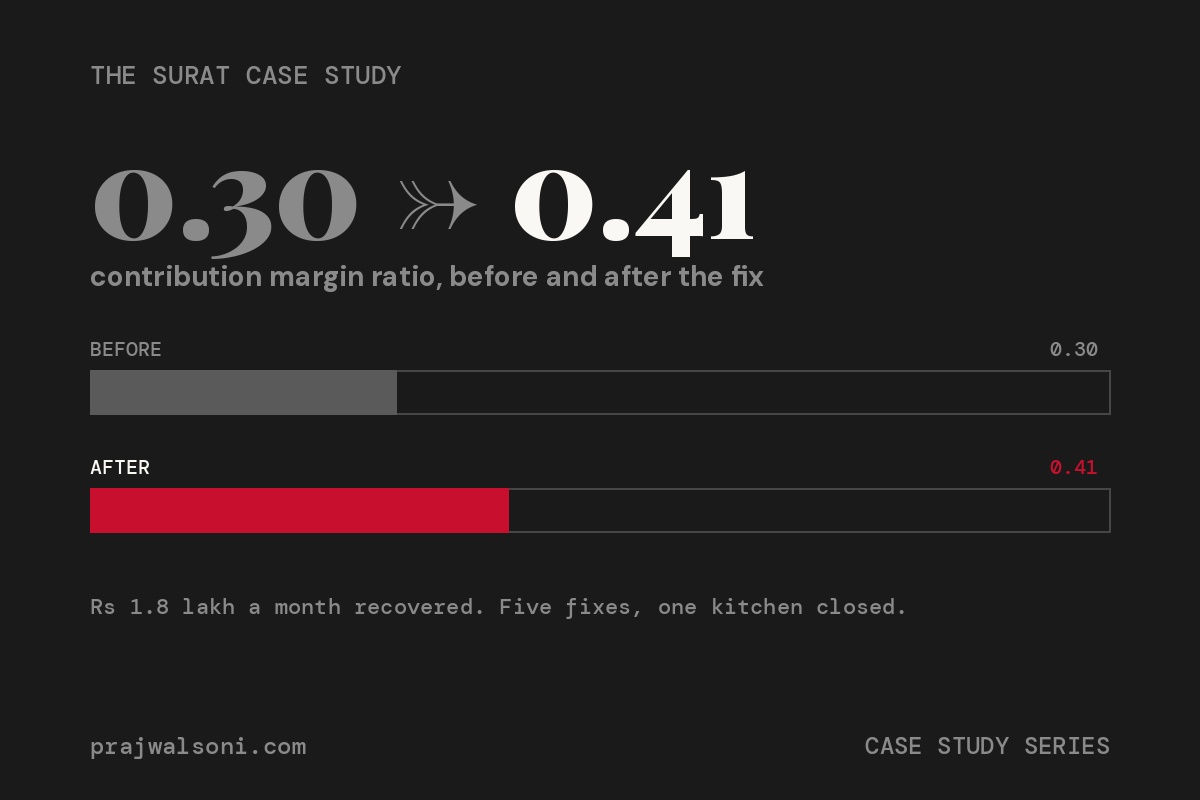
The breakeven calculation exposed three problems immediately. First, the contribution margin ratio was only 0.30. For every Rs 100 in revenue, only Rs 30 remained after variable costs. That meant the brand needed Rs 9.7 lakh per month just to break even on fixed costs alone, before any owner salary.
Second, the owner had been treating aggregator commissions as a fixed cost in his head. He budgeted a flat Rs 2 lakh for “platform fees” without connecting it to order volume. Because he never modeled it as a variable percentage, he could not see how every new order on Swiggy at low ticket sizes was actually diluting his margin further. I have written about this exact trap in detail in my piece on how aggregator commission rates actually work.
Third, the food cost at 36% was workable for a dine-in restaurant with no commission burden. But for a delivery-heavy cloud kitchen paying 22% to platforms, 36% food cost left almost nothing. The combined cost of goods plus platform fees was 58% of revenue. Industry benchmarks for profitable cloud kitchens typically need this combined figure below 50%. You can see why cloud kitchen profitability requires a completely different cost structure than dine-in.
What Changed After Running the Breakeven Numbers?
The fix was not one dramatic move. It was five small adjustments that together shifted the contribution margin ratio from 0.30 to 0.41 over eight weeks.
1. Menu pruning based on contribution margin per dish
The menu had 38 items. We calculated contribution margin for each item individually. Seven dishes, including two chicken starters and a dal makhani combo, had contribution margins below 15%. They were popular but unprofitable. We removed four outright and repriced three. This alone moved food cost from 36% to 33.4%.
If you want to understand the math behind this kind of repricing, this breakdown on menu pricing covers the full method.
2. Supplier renegotiation with volume commitment
The owner was buying chicken from two different suppliers at different rates. We consolidated to one supplier with a 30-day volume commitment in exchange for a Rs 12 per kg reduction. On roughly 800 kg of chicken per month, that saved Rs 9,600. Small number, but in a business losing Rs 14,600 a month, every rupee matters.
3. Packaging downgrade without quality loss
The brand was using premium kraft paper containers for every item including sides and raita. Sides moved to standard food-grade containers. Monthly packaging cost dropped from Rs 46,000 to Rs 34,000.
4. Average order value push through combo engineering
Aggregator commissions are a percentage of order value. But a larger order does not proportionally increase food cost because the fixed kitchen labor is already there. We designed three combo meals priced between Rs 349 and Rs 499 that bundled high-margin items (rice, raita, gulab jamun) with the biryani. Average order value went from Rs 267 to Rs 334 within six weeks. This improved contribution margin on every single delivery order.
5. One kitchen closed, volume consolidated
The hardest decision. The second kitchen was covering a delivery radius that overlapped 40% with the first location. We closed it. Fixed costs dropped by Rs 88,000 per month. Revenue from that zone partially shifted to the remaining kitchen because Swiggy’s delivery radius covered most of the overlap area. Net revenue loss was only Rs 1.1 lakh, but fixed cost savings were Rs 88,000. That is a net gain of Rs 77,000 per month in cash flow terms.
This is why scaling with discipline matters more than scaling for the sake of a second location.
What Were the Results After Eight Weeks?
After eight weeks of operating with these changes, the single remaining kitchen was doing Rs 7.4 lakh per month in revenue. Fixed costs had dropped to Rs 2,03,000. Variable costs sat at Rs 4,36,600. Total costs: Rs 6,39,600.
Monthly profit: Rs 1,00,400. That is a swing of roughly Rs 1.65 lakh per month compared to the previous two-kitchen setup. The new breakeven point was Rs 4.95 lakh per month. The brand was now operating at 49% above breakeven instead of 5% below it.
The owner started paying himself Rs 50,000 per month for the first time in 14 months of operations. That is what a proper understanding of profit margins actually does. It turns phantom revenue into real money in your account.
Why Does This Keep Happening Across Indian Restaurants?
Because most restaurant operators track revenue and expenses in one flat list. They see total income minus total expenses and call it profit. This approach hides the relationship between volume and cost. When you cannot see which costs scale with orders and which stay fixed regardless, you cannot make informed decisions about pricing, volume targets, or expansion.
The NRAI India Food Services Report 2024 values the industry at Rs 5.69 lakh crore, projected to reach Rs 7.76 lakh crore by 2028. Growth is real. But a large share of restaurants still fail within the first year because revenue growth masks poor unit economics. If your contribution margin ratio is below 0.35 and you are paying aggregator commissions above 20%, no amount of order volume will save you. You will just lose money faster.
According to the NRAI IFSR 2024, the organized segment is growing at 13.2% CAGR. Operators entering this growth phase without breakeven clarity are building on sand.
Cash flow management is another piece of this puzzle. Even if your breakeven math works on paper, weekly settlement cycles from Swiggy and Zomato can create cash gaps that force you into expensive short-term borrowing. Your breakeven model needs to account for timing, not just totals.
The Principle Beyond This Case
Every restaurant, whether it is a cloud kitchen in Surat or a dine-in space in Nagpur, operates within the same financial physics. Fixed costs create your floor. Variable costs determine how much of each rupee you keep. The ratio between these two decides whether growth helps you or hurts you.
Run the breakeven calculation for your restaurant this week. Pull your last 90 days of costs from your POS, whether that is Petpooja, Posist, or whatever you use. Separate every line item into fixed or variable. Calculate your contribution margin ratio. Then calculate your breakeven revenue. If your current revenue is less than 30% above that breakeven point, you have no margin of safety. One bad month, one rent increase, one supplier price hike will push you underwater.
If you want to understand how GST compliance interacts with these calculations, particularly how the 5% without ITC structure affects your variable cost bucket, that guide covers it.
Stop guessing. Start building. Get Design Dine Dominate, the complete restaurant business playbook from someone who has actually done it.

Leave a comment