A restaurant operator in Surat once told me he had spent Rs 1.8 lakh in three months just hiring and replacing kitchen staff. Six hires in 90 days. Four quit before their second week ended. His restaurant training system was a senior cook showing the new guy around for half a shift, then throwing him on the line. That is not training. That is hoping. And hoping is expensive.
Most operators think training means showing someone the menu and pointing to the tandoor. Then they wonder why attrition stays above 60%. The problem is not that staff leave. The problem is that your system gives them no reason to stay.
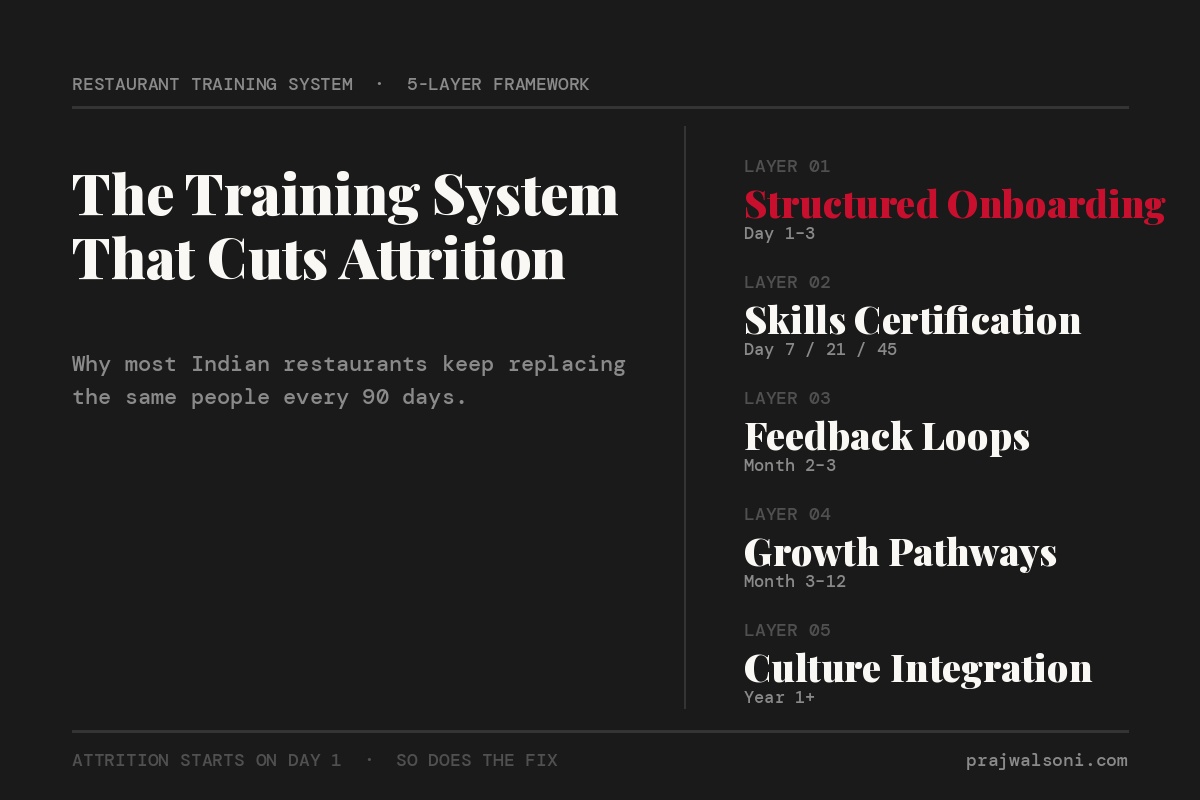
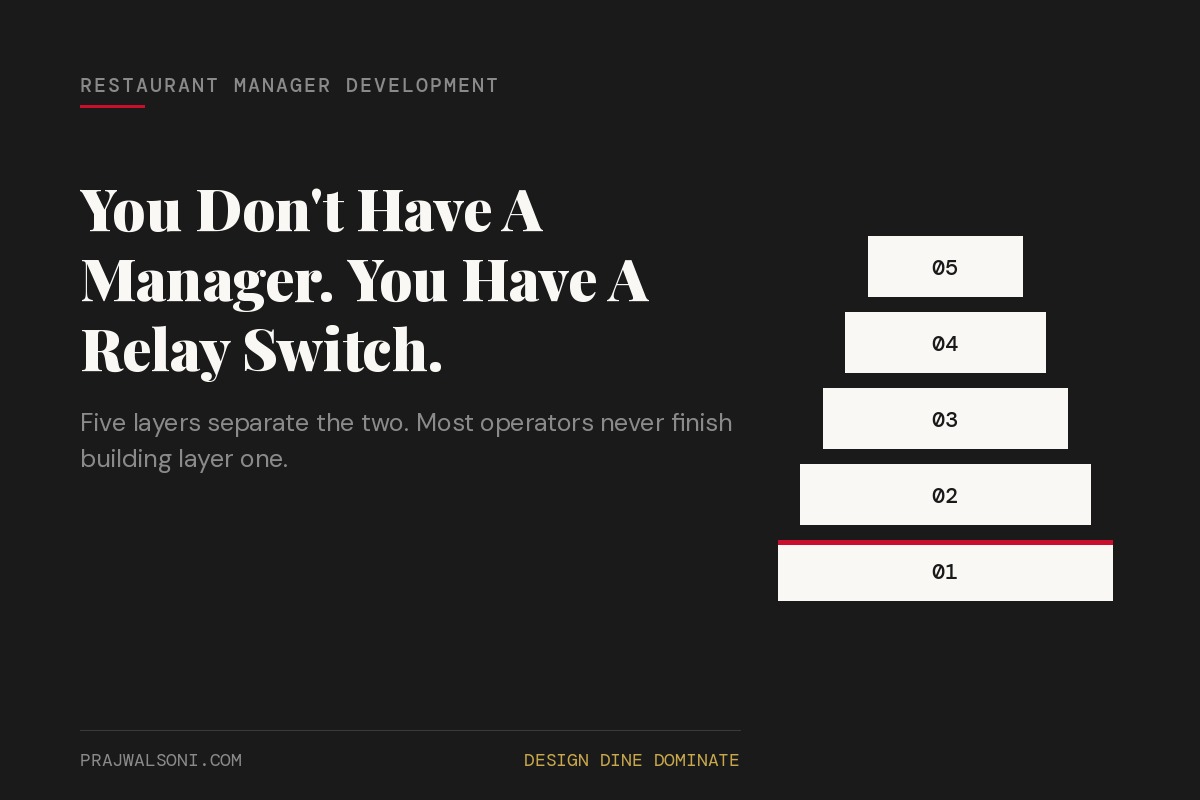
A real training system has five layers. Most restaurants have one, maybe two. When you see all five, you understand why some restaurants keep staff for years while others keep recycling the same hiring cost every quarter.
What does a complete restaurant training system actually include?
A complete restaurant training system includes five distinct layers: structured onboarding, skills certification, feedback loops, growth pathways, and culture integration. Each layer solves a different retention problem. Missing even one creates a gap that staff will walk through, usually within the first 45 days.
Think of it this way. Onboarding stops Day 1 confusion. Skills certification stops Month 1 frustration. Feedback loops stop Month 2 resentment. Growth pathways stop Month 6 boredom. Culture integration stops the quiet quitting that happens before physical quitting. Every layer works on a different timeline of attrition.
Operators who build only the first layer, a basic orientation, then blame staff quality for turnover are solving the wrong problem. The staff turnover crisis in Indian restaurants is fundamentally a systems crisis, not a people crisis.
Layer 1: Structured Onboarding That Kills Day-1 Anxiety
Structured onboarding means a defined first-week plan that covers logistics, expectations, and team introductions before a new hire touches a single plate. The goal is simple. Remove confusion before it becomes frustration.
In most restaurants across Ahmedabad and Pune, onboarding looks like this: new hire shows up, someone hands them an apron, and they shadow a senior for two hours. Then they are on their own. No written schedule. No checklist. No clarity on who to ask when confused. This is where attrition begins, on Day 1.
A proper onboarding plan covers five things in the first three days:
- Physical tour of every station, storage area, and washroom with a designated buddy, not just a manager.
- Written schedule for the first full week, printed, not texted.
- Menu tasting of at least 10 core dishes so the new hire knows what dal makhani and paneer tikka actually taste like at your restaurant.
- Clear explanation of pay cycle, tip structure, meal policy, and leave rules.
- A 15-minute sit-down with the manager on Day 3 to ask, “What is confusing you right now?”
None of this costs money. It costs 3 hours of planning once, then 45 minutes per new hire. Compare that to the Rs 40,000-80,000 you burn every time someone quits in their first month. The math is not even close.
Layer 2: Skills Certification That Replaces Guesswork
Skills certification means testing whether a staff member can actually perform each task to your standard, not just whether they have been shown how. Without certification, you have no idea who is competent and who is pretending.
Here is what I see in restaurants I consult for. A kitchen helper has been making rotis for three weeks. Nobody has checked consistency, portion weight, or speed. The head chef assumes training happened because time passed. But time is not training. Repetition without correction is just practice of bad habits.
Build a simple checklist of 8-12 core skills per role. For a line cook, that might be portion accuracy, plating speed, station cleanliness, and recipe consistency on your top 5 selling items. For a server, it might be order accuracy, upsell rate, table clearing speed, and handling a complaint without calling the manager.
How do you certify skills without making it complicated?
Keep it to a single laminated sheet per role. The manager or senior staff member observes the task, checks a box, and dates it. No software needed. A POS system like Petpooja can track sales per server for upsell metrics, but the observation-based certification is analog and fast.
Certification should happen at Day 7, Day 21, and Day 45. Three checkpoints. If someone fails at Day 21, you retrain specifically on the gap. You do not just hope they figure it out. This is also the layer where you discover whether a hire is worth keeping. Better to find out at Day 21 than at Day 90 after you have invested three months of wages.
Layer 3: Feedback Loops That Catch Problems Before Resignations
Feedback loops mean regular, scheduled conversations between staff and their direct supervisor about what is working and what is not. Without this layer, you only hear from employees when they hand you a resignation.
Most restaurants in India operate on a “no news is good news” management style. If a waiter does not complain, everything must be fine. Except the waiter is quietly applying to the restaurant across the street because he feels ignored. Nobody asked him how his shift went. Nobody noticed he covered for a sick colleague three times this month without acknowledgment.
According to the NRAI India Food Services Report 2024, the organized restaurant industry is growing at 13.2% CAGR. Operators are hiring faster than ever. But hiring without feedback systems means you are filling a leaking bucket.
Build two types of feedback into your operations:
- Weekly 5-minute check-ins. The shift manager asks each team member one question: “What made your job harder this week?” Not a performance review. Just a conversation. Write the answer down.
- Monthly 15-minute one-on-ones. Review certification progress, discuss any frustrations, and ask about goals. This is where you find out a kitchen helper wants to learn tandoor. If you give him that opportunity, he stays 8 more months instead of leaving for Rs 500 more at the shop next door.
This connects directly to how your margins move from 5% to 15%. Every replacement hire costs you training time, lower productivity, and customer experience dips during the transition. Keeping a trained person is always cheaper than finding a new one.
Layer 4: Growth Pathways That Answer “What’s Next for Me?”
Growth pathways mean visible, defined steps from each role to the next role up. When staff can see exactly what they need to do to move from helper to line cook to station head, they stay longer because the future is clear.
A dishwasher in Bengaluru earning Rs 12,000 a month will leave for Rs 13,000 at another restaurant. But a dishwasher who knows that passing his Level 2 certification at your restaurant makes him a prep cook at Rs 15,000 within four months will stay. The difference is not money. The difference is clarity.
Most restaurant operators in Tier 2 cities never map this out. Promotions happen randomly, based on seniority or whoever the owner likes. That randomness tells every other staff member that effort does not matter. So they stop trying.
What should a growth pathway look like?
For a kitchen team, it might look like this:
- Kitchen Helper (Rs 10,000-12,000). Certify on prep tasks, cleaning protocols, and storage handling.
- Prep Cook (Rs 13,000-16,000). Certify on 5 core recipes, portion accuracy, and basic inventory counting.
- Line Cook (Rs 17,000-22,000). Certify on full station management, rush-hour speed, and waste tracking.
- Station Head (Rs 23,000-28,000). Certify on training new hires, food cost tracking for their station, and shift handover protocols.
Post this on the kitchen wall. Let everyone see it. When a helper watches a prep cook get promoted because he passed his certification, it changes the energy of the entire kitchen. Suddenly, training is not something the manager forces on you. It is something you want because it leads somewhere.
Operators who are scaling across locations need this layer badly. Without defined growth paths, your best people will leave for competitors who offer them a title bump, even if the actual job is worse.
Layer 5: Culture Integration That Makes Leaving Feel Like a Loss
Culture integration means embedding staff into the identity and rhythms of your restaurant so deeply that leaving feels personal, not transactional. This is the hardest layer to build and the most powerful for long-term retention.
Most operators confuse culture with perks. Free meals. A birthday cake once a month. A Diwali bonus. Those are nice, but they are not culture. Culture is what people feel when they walk into your kitchen on a Monday morning. Do they feel owned or do they feel like they belong?
I have seen restaurants in Hyderabad where the staff eats together before every dinner service. Same table. Same time. The owner sits with them sometimes. Not to supervise. To eat. That 20-minute ritual creates more loyalty than a Rs 2,000 bonus ever could.
Culture integration includes three practical elements:
- Shared rituals. Pre-shift huddles, team meals, or even a weekly five-minute recognition where the manager names one person who did something well. Public. Specific. Not generic.
- Inclusion in decisions. Ask your line cooks what new dish they think would sell. Ask your servers which table layout works better during Friday rush. When people feel heard, they feel invested.
- Consistent treatment. The biggest culture killer in Indian restaurants is inconsistency. The owner yells at the helper but jokes with the chef. The manager enforces rules for some but not others. Inconsistency destroys trust faster than low pay.
Your dine-in profitability depends heavily on experienced front-of-house staff who know your regular customers. Every server you lose resets that relationship to zero.
How These Five Layers Work Together
Each layer addresses a different stage of the employee lifecycle. Onboarding handles the first week. Certification handles the first month. Feedback handles the second and third months. Growth pathways handle months three through twelve. Culture keeps them beyond year one.
When you build only Layer 1, you get staff who survive their first week but leave in Month 2 because nobody checked on them. When you build Layers 1 and 2 but skip feedback, you get skilled staff who resent their managers and leave for Rs 1,000 more elsewhere. When you have everything except growth pathways, your best people plateau and start looking outward.
The system compounds. A well-onboarded employee who passes certification feels competent. A competent employee who gets regular feedback feels valued. A valued employee who sees a growth path feels ambitious. An ambitious employee embedded in your culture becomes someone who trains the next hire better than you could. And that is when your restaurant starts running without you standing over every station.
This is exactly how cloud kitchen operations achieve tighter profitability. Smaller teams, higher retention, and systems that survive individual departures.
What Knowing All Five Layers Enables
When your restaurant training system covers all five layers, three things happen. Your cost-per-hire drops because people stay longer. Your service quality stabilizes because experienced staff handle edge cases better. Your management bandwidth frees up because you stop firefighting and start building.
Operators who invest in a training system also build a more consistent product. When every cook is certified on the same recipes with the same portions, your food cost variance shrinks. When every server is trained on the same upsell triggers, your average order value rises. Training is not a cost center. It is a profit driver disguised as an HR activity.
India’s food service industry, valued at Rs 5.69 lakh crore per NRAI IFSR 2024, is hiring at a pace that far outstrips the supply of trained restaurant workers. The operators who build training systems will not just retain staff. They will attract better candidates because word travels. In Surat, Nagpur, and every other city, kitchen workers talk. They know which restaurants treat people well and which ones churn through bodies.
This week, pick one role in your restaurant. Map the five layers for just that role. Write the onboarding checklist, define the certification tasks, schedule the first weekly check-in, draft a simple growth pathway, and identify one culture ritual you can start immediately. One role. Five layers. That is where this begins.
Stop guessing. Start building. Get Design Dine Dominate, the complete restaurant business playbook from someone who has actually done it.

Leave a comment