Every Slow Ticket and Wasted Ingredient Traces Back to Your Kitchen Layout Flow
Kitchen layout flow is the single biggest operational variable most restaurant operators never audit. A poorly sequenced kitchen forces your team to walk more, wait more, and waste more. Every extra step between prep and pass costs you seconds per plate. Those seconds compound into 15 to 25 minutes of lost output per rush hour. In a busy Ahmedabad or Pune kitchen doing 200 covers a night, that gap translates directly into missed orders, slower table turns, and food sitting under heat lamps until quality drops.
I have consulted for kitchens across Gujarat where the owner spent Rs 18 lakh on interiors and Rs 40,000 on kitchen planning. The ratio is backwards. Your dining room makes the first impression. Your kitchen makes the margin. According to the NRAI India Food Services Report 2024, the organized restaurant segment is growing at 13.2% CAGR. Operators entering this growth wave with broken kitchen flow will scale their inefficiencies, not their profits.
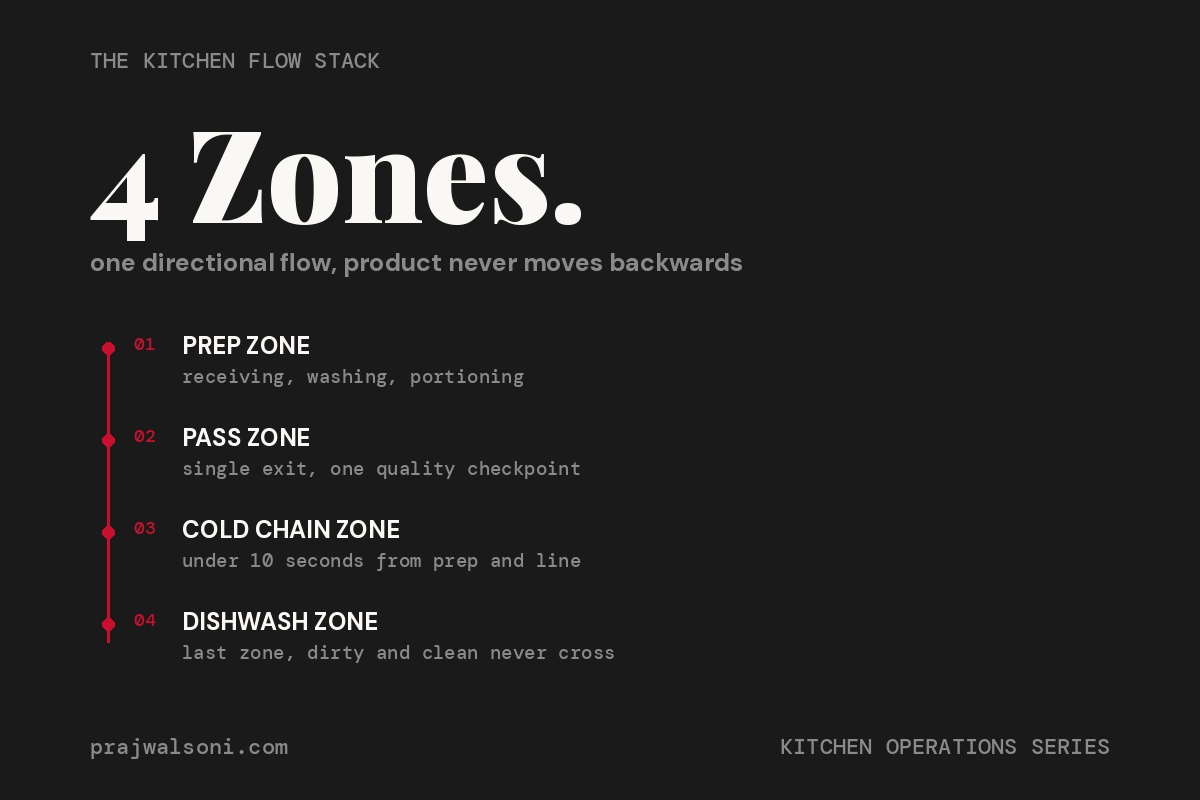
The framework I use to fix this is called the Kitchen Flow Stack. It breaks your back-of-house into four zones, each with a specific function, and then sequences them so product moves in one direction from raw to finished. No backtracking. No cross-contamination. No wasted motion.
What Is the Kitchen Flow Stack?
The Kitchen Flow Stack is a four-zone layout framework that sequences your prep zone, cooking and pass zone, cold chain zone, and dishwash zone into a single directional flow. Product enters from receiving, moves through prep, hits the cooking line, exits at the pass, and dirty items return through dishwash without crossing the clean path. The name tells you the function: four layers stacked in sequence so nothing moves backwards.
Most kitchen layouts in restaurants across Surat, Nagpur, and Bengaluru are designed around available space, not around operational logic. The landlord gives you an L-shaped room. You put the tandoor where the gas line is. You place the fridge where there is a plug point. Dishwash goes in the corner because nobody wants to look at it. Six months later, your chef is walking 40 feet to grab mise en place that should be 4 feet away.
The Kitchen Flow Stack fixes this by making zone sequencing the first decision, not the last. You design for flow, then fit equipment into the flow. Not the other way around.
How Does the Prep Zone Affect Kitchen Speed and Waste?
Your prep zone controls both your food cost and your ticket time because it determines how ready your ingredients are before the first order fires. A disorganized prep zone means your line cooks are doing prep during service. That is the most expensive labor mistake in any kitchen. You are paying a skilled cook Rs 18,000 to Rs 25,000 a month to chop onions during rush hour instead of plating biryani.
In the Kitchen Flow Stack, the prep zone sits immediately after receiving. Raw ingredients come in through a dedicated entry point, get weighed, washed, and portioned in the prep zone, and then move forward to either the cold chain zone for storage or directly to the cooking line. Product never goes backwards from cooking to prep. If your cooks are walking back to the prep table during service, your layout has failed.
Here is what a functional prep zone requires:
- A receiving area with a weighing scale and a checklist for supplier deliveries. Every delivery gets checked against the purchase order before anything enters the kitchen.
- Washing stations separate from cooking sinks. Cross-use of sinks is a food safety violation and a speed killer.
- Dedicated cutting and portioning surfaces with portion guides posted visibly. Portion drift is how your food cost goes from 32% to 38% without anyone noticing.
- A staging shelf or pass-through that feeds directly into the cold chain or cooking zone. No dead ends.
I have seen restaurants in Hyderabad where the prep table is next to the dishwash station. Dirty plates stacking up 3 feet from where someone is cutting paneer. That is not just a hygiene risk. It is a speed problem because the prep cook is constantly moving out of the way when dishwash staff need access. Your margins depend on eliminating exactly these kinds of invisible friction points.
Why Does the Pass Zone Decide Your Revenue Per Hour?
The pass is where finished dishes leave the kitchen, and it directly determines how many orders you can push per hour. A bottlenecked pass means food backs up on the line, quality drops, and your front-of-house team starts fielding complaints. In delivery-heavy operations on Swiggy and Zomato, a slow pass means cold food, bad ratings, and lower platform ranking.
In the Kitchen Flow Stack, the pass sits at the end of the cooking line, facing the service door or the packaging station for delivery. It is the single point of exit for all finished food. No plate or parcel should leave the kitchen from anywhere else. One exit point means one quality checkpoint.
What makes a pass zone work?
The pass needs a heat lamp or hot holding surface, a ticket rail or KDS screen, and enough counter space for at least 6 plates to sit without stacking. If your pass cannot hold 6 plates simultaneously, you will bottleneck during any rush that produces more than 3 orders per minute.
A common mistake is placing the pass too far from the cooking line. If your chef has to carry a plate of dal makhani more than 5 feet to reach the pass, you are losing 3 to 5 seconds per dish. Over a 3-hour dinner service doing 120 covers, that is 6 to 10 minutes of dead walking time. Scale that across a month and you are looking at roughly 3 to 5 hours of wasted labor.
For cloud kitchen operators running multiple brands from one kitchen, the pass zone becomes even more critical. Each brand’s orders need a separate staging area at the pass so riders pick up the right parcels. I have worked with cloud kitchen setups where mix-ups at the pass were causing 4 to 6 wrong deliveries per day. At an average order value of Rs 350, that is Rs 1,400 to Rs 2,100 in daily refunds and replacement costs.
How Should the Cold Chain Zone Be Positioned?
The cold chain zone must sit between prep and cooking, accessible to both but not blocking either. Cold storage is where portioned ingredients wait until they are needed on the line. If your walk-in or reach-in refrigerator is across the kitchen from the cooking line, your cooks will hoard ingredients at their stations. That hoarding causes temperature abuse, spoilage, and inconsistent portioning.
In the Kitchen Flow Stack, the cold chain zone is positioned so that prepped ingredients move from the prep zone into cold storage in under 10 seconds. The cooking line can pull from cold storage in under 10 seconds. This two-way adjacency is non-negotiable.
Most restaurants I consult for in Gujarat have their cold storage placed based on electrical outlet locations or wherever the unit physically fits. A restaurant in Surat had their deep freezer in a storage room 30 feet from the cooking line. The result was predictable. Cooks would pull a full day’s worth of chicken out in the morning and leave it on the counter. By lunch service, the product had been sitting at room temperature for 3 hours. Spoilage rates were running almost double what they should have been.
Your cold chain zone also needs clear temperature monitoring. A simple digital thermometer on each unit, checked twice daily, is the minimum. FSSAI guidelines require cold storage at 4°C or below for perishables. If your units are running at 7°C or 8°C because the door gets opened 60 times during service, you are both violating food safety norms and accelerating waste.
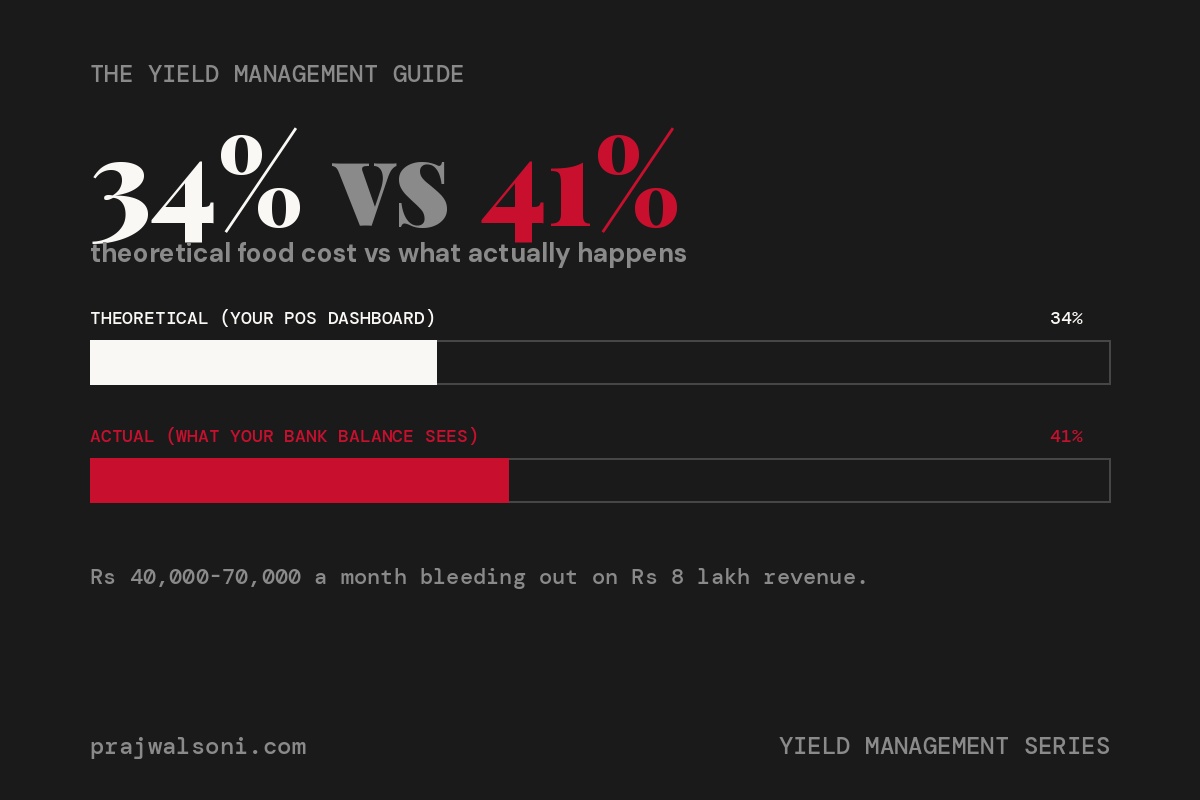
Food waste from poor cold chain management is one of the least visible margin killers. It does not show up as a single large expense. It shows up as your food cost running 3 to 5 percentage points higher than your recipe cards say it should.
Where Should the Dishwash Zone Go?
The dishwash zone must be the last zone in the flow sequence, positioned so dirty items enter from the service area and clean items exit toward storage or the prep zone. Dirty and clean paths should never cross. This is the most commonly violated principle in restaurant kitchens across India.
In the Kitchen Flow Stack, dishwash sits opposite the prep zone, separated by the cooking line and pass. Dirty plates come in from the dining room or packaging area, get washed, and cleaned items return to storage shelves that feed back into the prep and cooking zones. The flow is circular but directional. Nothing moves against the current.
A dishwash zone needs three things to function without slowing down the rest of the kitchen:
- A scraping and soaking station where food waste is removed before washing. This prevents drain blockages and reduces wash time by roughly 30%.
- A washing station with adequate water pressure and drainage. Under-sink grease traps are mandatory per local municipal codes in most Indian cities.
- A drying and staging rack that feeds clean items back toward storage. If clean plates stack up at dishwash because there is no staging space, your dishwasher slows down and your service team runs out of plates during peak hours.
The biggest layout mistake with dishwash is placing it next to the pass. Dirty plates coming in from service should never pass through the area where finished food is going out. In one Bengaluru restaurant I reviewed, the dishwash return path went directly past the pass counter. Servers carrying dirty plates were colliding with servers picking up fresh orders. The result was slower service, occasional dropped plates, and a kitchen team that was constantly irritated.
How Do You Diagnose Your Current Kitchen Flow?
You diagnose your kitchen flow by tracing two paths: the product path and the waste path. If they cross at any point, your layout is costing you money. Stand in your kitchen during a busy service and watch where your team walks. Count how many times someone crosses from one side of the kitchen to the other. Every crossing is wasted motion.
Here is a diagnostic you can run this week:
- Draw a simple floor plan of your kitchen on paper. Mark where each zone currently sits: prep, cold storage, cooking line, pass, dishwash.
- Draw a line showing the path an ingredient takes from delivery to finished plate. Then draw a second line showing the path a dirty plate takes from the pass back through dishwash.
- Count every intersection where these two lines cross. Each crossing is a contamination risk and a speed bottleneck.
- Measure the distance your cooks walk from cold storage to their station. Anything over 8 feet needs to be fixed.
If you find 3 or more crossings, your kitchen flow is working against you. The Kitchen Flow Stack framework says these two paths should never intersect. Product flows forward. Waste flows in a separate return loop.
Operators who are scaling to multiple locations need to fix flow at the first kitchen before replicating. If you copy a broken layout into your second location, you copy the inefficiency too. I have seen this happen with cloud kitchen brands expanding across cities. The same cramped, crossed-path layout gets duplicated in Pune, then Nagpur, then Ahmedabad. Each location inherits the same 3 to 5 percentage point food cost inflation.
What Decision Does the Kitchen Flow Stack Enable?
The Kitchen Flow Stack enables one critical decision: whether to renovate your current kitchen or accept the margin penalty. Once you trace your product path and waste path, you can calculate the cost of crossed flow in wasted labor, spoiled ingredients, and slower ticket times. Then you compare that annual cost against the one-time cost of rearranging your zones.
In most cases, the renovation pays for itself within 4 to 8 months. Moving a refrigerator 10 feet costs Rs 5,000 to Rs 15,000 including plumbing and electrical. But if that move saves your cook 3 minutes per service hour, you are recovering roughly 45 minutes of productive labor per day. Over a month, that is over 22 hours of labor recovered. At an average kitchen labor cost of Rs 120 per hour, that is Rs 2,640 per month in recovered productivity from one equipment move.
Your menu pricing assumes a certain food cost percentage. If your kitchen flow is inflating that food cost by 3 to 5 points through waste and spoilage, your menu math is wrong. Fixing the flow fixes the math.
For operators running delivery-heavy brands through Swiggy and Zomato where commissions already eat 15 to 30% of order value, you cannot afford to lose another 3 to 5% to kitchen inefficiency. The combined margin pressure will push you below the 5 to 8% net margin danger zone that separates struggling restaurants from sustainable ones.
The Diagnostic Question You Need to Answer Right Now
Can a raw ingredient travel from your receiving area to a finished plate at the pass without any team member crossing the path that dirty dishes take back to dishwash?
If the answer is no, your kitchen layout flow is costing you money every single service. The Kitchen Flow Stack gives you the framework to fix it zone by zone, starting with wherever the crossing is worst.
Pull out a piece of paper this week. Sketch your floor plan. Trace both paths. Count the crossings. That sketch is worth more than any Rs 2 lakh kitchen consultant report because it tells you exactly where your money is leaking.
Stop guessing. Start building. Get Design Dine Dominate, the complete restaurant business playbook from someone who has actually done it.

Leave a comment