Picture this: you are running a restaurant in Pune when you sign a lease for a second outlet in Baner. Rent is Rs 2 lakh a month. The contractor finishes the fit-out on time, the chefs join, and you announce a pre-Diwali launch. Then the FSSAI license process stalls because the food safety officer wants a document you thought was optional.
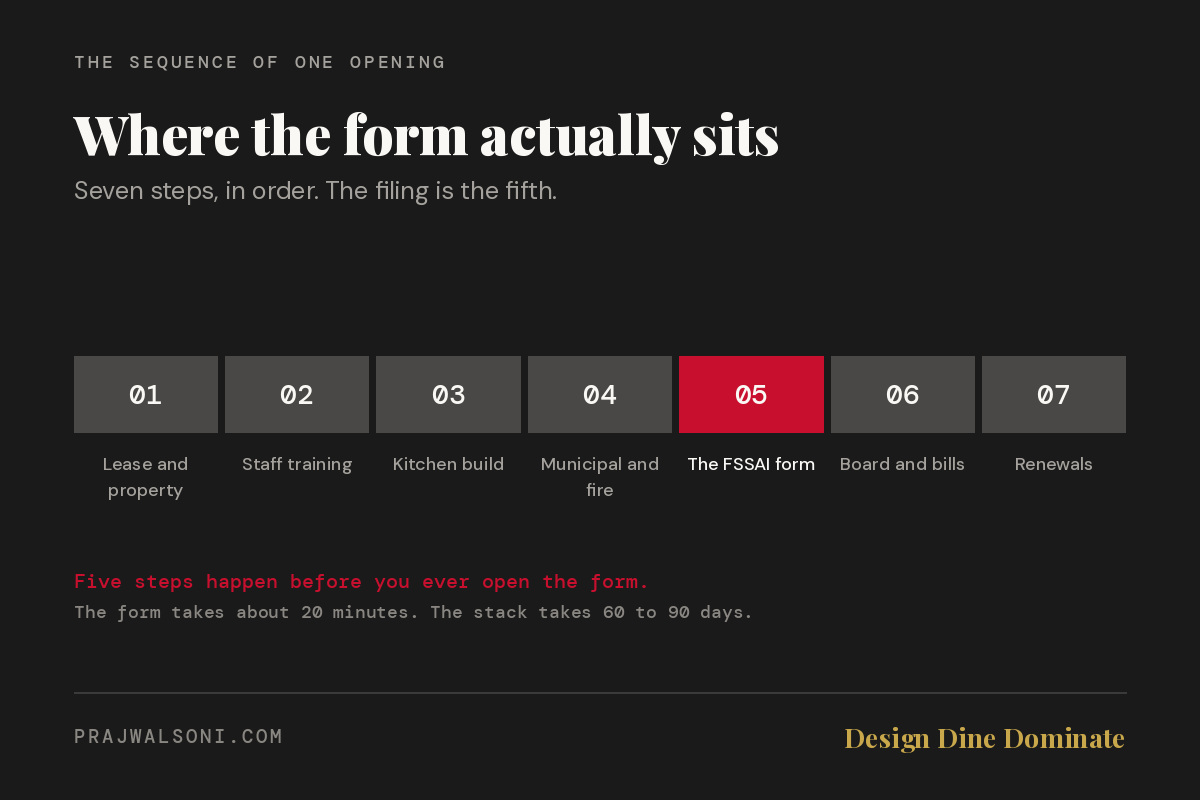
Six weeks later, you are still paying rent on a kitchen that cannot legally cook. That is roughly Rs 3 lakh in rent alone, before a single salary. Nobody lied to you about the form. In fact, filling it on the portal takes about 20 minutes. What breaks openings is everything the form depends on.
Across 18 restaurants in Gujarat and 23 cloud kitchen brands, I never once dealt with just one license. Health and safety licensing is always a stack of five layers. Most operators only see the top one, and they plan their opening date around it.
How Long Does the FSSAI License Process Really Take?
On paper, FSSAI gives itself up to 60 days to grant a state license after you submit a complete application. In my experience, a dine-in restaurant should plan 60 to 90 days for the full health and safety stack. That includes the municipal health license, fire NOC, staff certification, and kitchen inspection running alongside FSSAI.
Most operators picture the license as one online form on the FSSAI FoSCoS portal. FoSCoS means Food Safety Compliance System, the government portal where you apply, renew, and modify food licenses. You upload documents, pay the fee, and wait. That picture breaks in one specific place. The form sits near the end of the process, and the layers underneath it decide your real timeline.
This matters more every year. The NRAI India Food Services Report 2024 puts organized segment growth at a 13.2% CAGR, or compound annual growth rate. Every one of those new outlets clears this stack before it serves a single plate of dal makhani. Pre-opening delays are also one of the quieter reasons behind why most restaurants fail in their first year.
Layer 1: Why Does the FSSAI License Process Depend on Other Licenses?
Because state authorities treat health and safety as one chain. FSSAI wants proof of premises, and many states also ask for a municipal NOC. The municipal department, in turn, often wants your fire NOC first. Get the order wrong and every department sends you back to another department.
NOC means no-objection certificate, a document where one department confirms it has no problem with your operation. The names change by city. Some municipal corporations call it a health license, others a trade license. In Ahmedabad, Surat, or Pune, each comes with its own inspection and its own queue. Fire NOC rules also vary, usually by seating capacity, floor area, and building height.
The failure point nobody expects is the rent agreement. If the lease is in your personal name but the application is under your company, expect a query. Property records that show residential use create the same problem. That one usually fails at the municipal level, and the whole chain stops with it.
The license also belongs to the premises, so every new outlet restarts this chain from zero. That is one reason restaurant scaling without discipline breaks so many second outlets.
Layer 2: The Category You Pick on Day One Decides Your Next Year
Your FSSAI category depends on projected annual turnover, and many restaurants outgrow the cheapest option within months. Basic registration covers turnover up to Rs 12 lakh a year. A state license covers Rs 12 lakh to Rs 20 crore. Central licensing applies above Rs 20 crore and to certain specific business types.
Do that math monthly. Rs 12 lakh a year is Rs 1 lakh a month, or about Rs 3,300 a day. For example, a small biryani counter in Nagpur doing 40 orders a day at Rs 250 crosses that easily. Still, I see operators file for basic registration because the fee is Rs 100 a year. A state license costs a few thousand rupees a year, so the saving is tiny next to the risk.
The risk is simple. Once you cross the threshold, you are operating under the wrong category. A food safety officer who compares your sales to your registration will not accept that you planned to upgrade.
Cloud kitchens running multiple brands face a sharper version of this. Because the license sits with the kitchen, all brands share one turnover figure. Five brands doing Rs 40,000 a month each add up to Rs 2 lakh a month, far past basic registration. Track cloud kitchen profitability metrics brand by brand, but license on the kitchen total.
Food categories need the same care. If you start selling packaged cakes or pickles made in-house, check whether you need a license modification. Packaged food also brings labelling rules that a plate of paneer tikka never triggers.
Layer 3: Can Your Kitchen Pass an Inspection Before It Opens?
Only if you built it to Schedule 4 from the start. Schedule 4 means the hygiene and sanitary rules under the FSSAI licensing regulations that every food business must follow. The licensing authority can inspect before granting your license. A kitchen designed for looks instead of hygiene fails here and costs weeks of rework.
The failures I see most often in kitchen audits are boring. Floor drains slope the wrong way. There is no dedicated hand-wash basin, so staff wash hands in the prep sink. Windows above the tandoor section have no fly mesh. Veg and non-veg raw material share one shelf in the cold room.
Water is the quiet trap. Many state authorities ask for a potable water test report from a recognized lab. That report can take a week or more, so order it the day the plumbing goes live. Waiting until the inspection date turns a simple lab queue into an opening delay.
So the real clock starts when the kitchen becomes inspection-ready. Plan your fit-out finish date as your licensing start date. Every week of rework is rent with zero revenue. That is the same cash drain behind profitable restaurants that still go bankrupt.
Layer 4: The People Your License Quietly Depends On
Your license depends on trained, medically fit staff, and that layer breaks every time someone resigns. Licensed food businesses need at least one FoSTaC-trained Food Safety Supervisor on each premises. Food handlers also need medical fitness certificates, renewed every year. An inspector can ask to see both.
FoSTaC means Food Safety Training and Certification, the FSSAI program that trains and certifies food handlers. You can find accredited courses on the FSSAI FoSTaC training portal. Larger kitchens need more than one supervisor, roughly scaling with the number of food handlers.
Turnover is the hidden problem here. Most kitchens certify one person, usually the head chef. When that chef leaves for a quick service restaurant chain in Bengaluru, your compliance walks out too. Given the restaurant staff turnover crisis, that risk shows up every few months.
For this reason, certify two people per outlet, never one. Medical certificates follow the same logic. A new tandoor cook joining in month four needs one before starting on the line. Build it into onboarding through a tie-up with a nearby clinic.
Layer 5: Why Does Your License Start Expiring the Day You Get It?
Because an FSSAI license runs for a fixed term of one to five years, and staying compliant takes ongoing work. You must renew before expiry, print the license number on bills, and file modifications when key details change. Miss the renewal window and you are operating without a valid license.
Since October 2021, FSSAI requires food businesses to print their license or registration number on bills and receipts. That makes your Petpooja or Posist bill template a compliance document. If a new outlet prints the first outlet’s number on its bills, every receipt becomes a violation. Check every template whenever you add an outlet.
Changes in the business also trigger paperwork. A partner exit, added food categories, or a new legal structure all need attention on FoSCoS. Some need a simple modification. Others may need a fresh application, so check before you restructure.
Renew well before expiry. FSSAI charges a per-day late fee, and a fully lapsed license can force a fresh application. Swiggy and Zomato also ask for a valid FSSAI number, and an expired one can pause your listing. Delivery-heavy outlets feel that pause instantly, on top of the aggregator commission rates they already pay.
Put the renewal date in the same compliance calendar as your GST filings for restaurants. Then review your category every quarter against actual sales.
How Do the Layers Stack in the FSSAI License Process?
The layers multiply delays because each one waits on another. A rent agreement problem stalls the municipal license, which stalls any FSSAI application needing a municipal NOC. Staff certification and water testing can run in parallel, so start them early. Sequencing correctly is how you pull a 90-day timeline closer to 60.
I plan every new outlet in this order. It keeps the slow layers moving while the fast ones wait.
- Before signing the lease, confirm commercial use in the property records. Put the lease in the same name as your applicant entity.
- In the first week of fit-out, send two staff for FoSTaC training and book their medical checks.
- During fit-out, build to Schedule 4 and order the water test the day plumbing goes live.
- Once the kitchen is inspection-ready, apply for the municipal license and fire NOC where your city requires them.
- In the same week, file on FoSCoS under the category that matches your projected turnover.
- Before opening day, put up the Food Safety Display Board and add the license number to your bill template.
- After opening, set renewal reminders and check your category against sales every quarter.
Seeing all five layers turns licensing into a project with a critical path. A critical path means the chain of tasks where any delay pushes back your opening date. Agents can file forms for you. They cannot fix a floor drain, a lease in the wrong name, or a certified chef who just resigned.
What to Remember Before You Sign the Lease
You decide most of your licensing timeline before you ever apply. The lease, the kitchen design, and your staff plan set the pace. These five points carry the most weight. Each comes from a layer most operators only discover when it delays their opening.
- FSSAI gives itself up to 60 days for a state license, but the full stack usually needs 60 to 90 days.
- Basic registration ends at Rs 12 lakh a year, which is just Rs 1 lakh a month.
- The license belongs to the premises, so every new outlet and multi-brand kitchen restarts the chain.
- Certify at least two staff under FoSTaC so one resignation does not break compliance.
- Your license number must appear on bills, which makes your billing template part of compliance.
What to Do This Week
Pull out your current FSSAI license and check three things today. Look at the expiry date, then compare the category against your last 12 months of sales. Next, pick up one bill from each outlet and match the printed number. Opening a new outlet? Match the lease name to your applicant entity before you sign.
File the modification on FoSCoS this week if the category is wrong. Start renewal now if expiry falls within six months. Those two fixes take less time than one Saturday dinner service.
Stop guessing. Start building. Get Design Dine Dominate, the complete restaurant business playbook from someone who has actually done it.

Leave a comment