Aggregators keep 15-30% of every order, yet most operators still believe B2B clients deserve the lowest price. A tech park in Pune or an office in Ahmedabad asks for 300 lunches a day. The first instinct is to cut the menu rate and close the deal. That instinct drives most of the B2B restaurant pricing I see across kitchens.
The reasoning sounds solid. Bigger volume, predictable demand, one invoice instead of 300 small ones. So the bulk buyer gets the bulk discount, and everyone shakes hands.
That belief is wrong, and it quietly turns your biggest contract into your worst-paying channel.
Should B2B Restaurant Pricing Be Lower Than Your Menu Price?
No, not by default. B2B restaurant pricing should start from your net retail realization, not your menu price. Once you subtract aggregator commission and GST on that commission, a Rs 220 menu item often nets far less. A B2B quote below that net figure makes the contract worse than delivery. Price it as its own product.
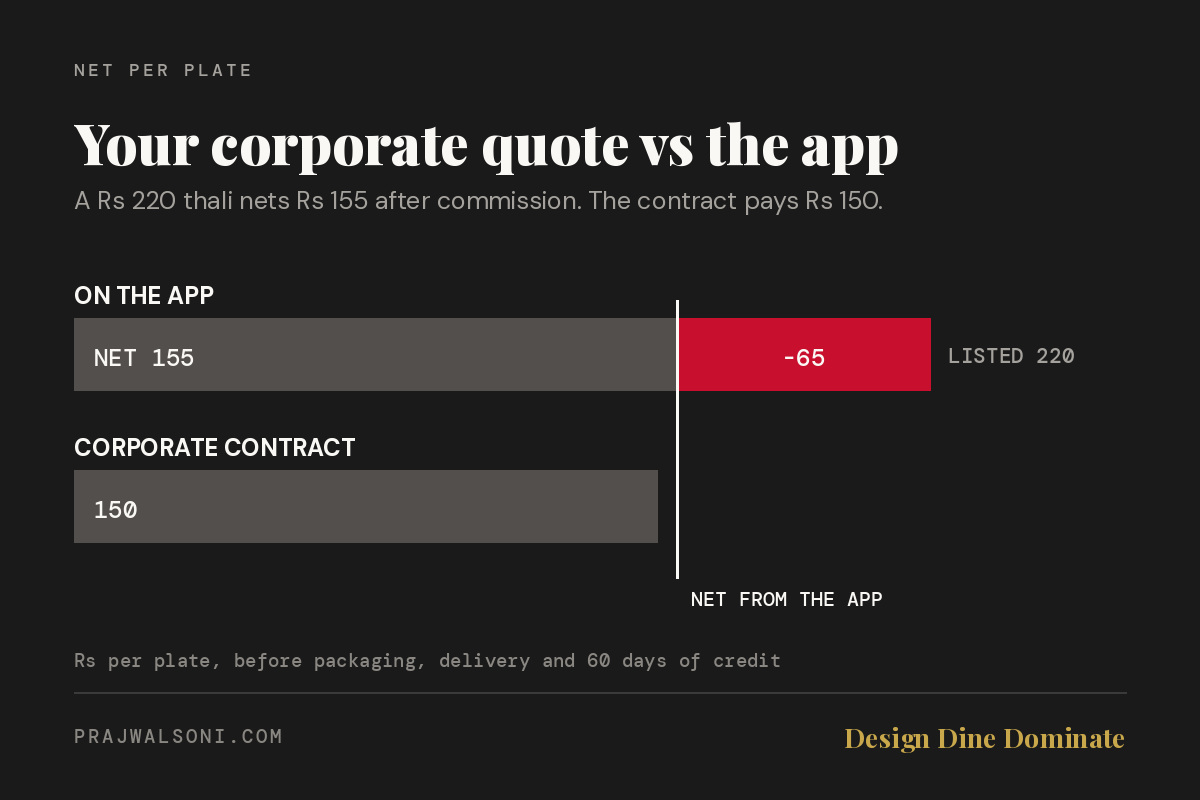
Net realization means the money that actually lands in your bank per order. Take an illustrative thali listed at Rs 220 on Zomato. At a 25% commission, the platform keeps Rs 55. GST at 18% on that commission adds roughly Rs 10 more. So you net about Rs 155, before any discount you fund.
Now look at the corporate quote. The office manager asks for Rs 150 a plate, and 300 plates sounds big. You agree on the spot. But you deliver it yourself, in bulk packaging, on 60-day credit. That means a Rs 150 corporate thali can pay you less than the same thali on Zomato at Rs 220.
Most operators never run this comparison. They hold the B2B quote against the menu card, see a big cut, and call it a volume discount. The menu card is the wrong benchmark. Your payout statement is the right one.
Commission varies by city, volume, and plan, so check your own number. My breakdown of how aggregator commission rates really work in 2026 shows where the real figure hides.
Why Do Operators Discount Bulk Orders in the First Place?
Operators discount bulk orders because the logic comes from manufacturing, where volume genuinely lowers unit cost. Procurement teams also negotiate hard, and losing a 300-meal contract feels expensive. The belief has a real basis. It simply ignores how restaurant costs behave on a bulk lunch order.
Some of the gains are real. In my experience across cloud kitchen brands, confirmed B2B counts cut wastage because you prep to a known number. Fixed costs also spread across more plates. And a signed contract looks good when you sit across from a bank or investor.
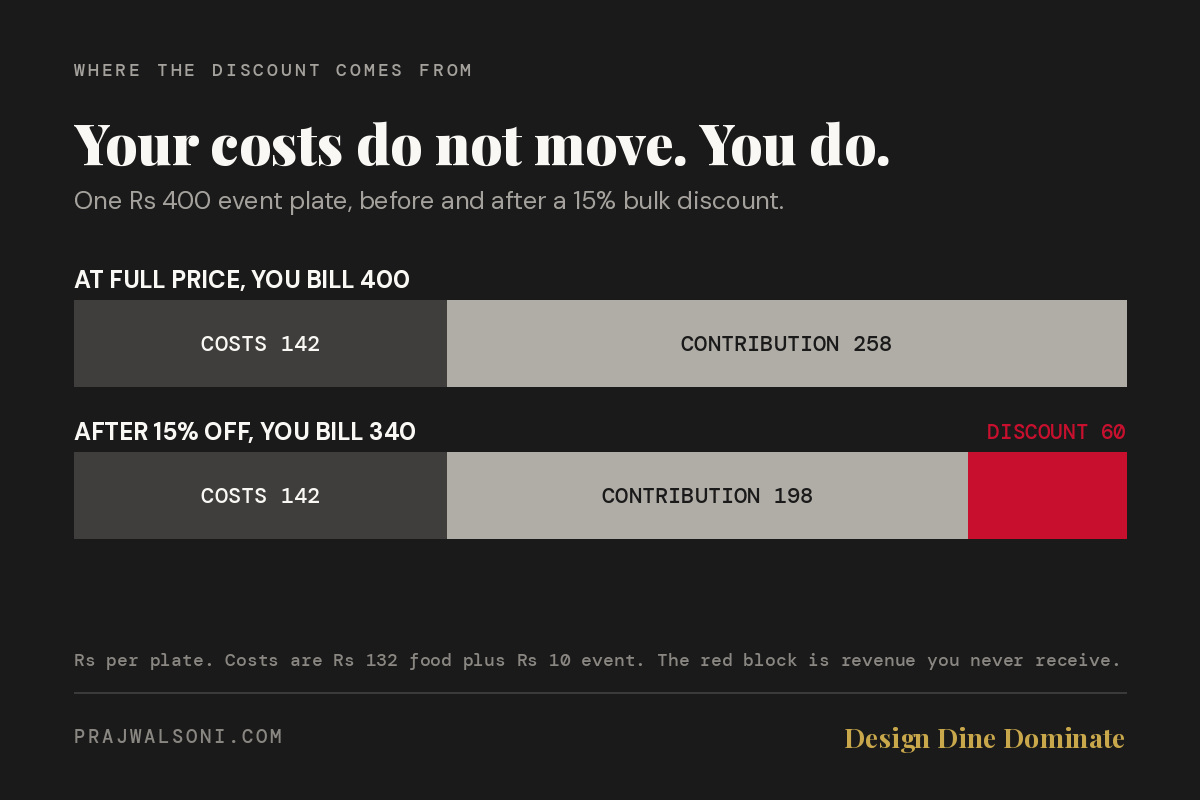
But food cost per plate barely moves with volume. Your paneer, dal, and basmati cost about the same per portion at 300 plates as at 30. Bulk supplier rates help a little. They rarely fund a deep price cut. Food cost typically runs 28-38% of revenue, and every rupee you discount pushes that percentage higher.
The NRAI India Food Services Report 2024 values the industry at Rs 5.69 lakh crore. Its organized segment is growing at 13.2% CAGR. Organized operators win corporate contracts on systems, and pricing is the first system a procurement team tests.
What Does a B2B Order Actually Cost You?
A B2B order carries costs your retail orders never show. Think bulk packaging, your own delivery run, an early prep shift, and customization. Then add the cost of waiting 30-90 days for payment. Most operators price only the food, yet these extra lines decide whether the contract makes money.
The Service Costs Nobody Puts on the Quote
In my experience, containers, cutlery kits, and the vehicle run often add Rs 2-10 per meal on a bulk lunch. A 6am prep shift means extra wages or overtime. Jain plates, less-spicy versions, and name labels slow the line down. Labour already runs 18-28% of revenue depending on format. When a contract needs its own shift, you drift toward the top of that range.
The Credit Period Is a Hidden Interest Bill
Swiggy and Zomato settle weekly. Corporate clients often pay in 45 to 90 days. Working capital means the cash that keeps your kitchen running between paying suppliers and getting paid. If you buy paneer today and collect in 60 days, you fund that gap yourself. On an overdraft, that gap carries interest you never priced in.
Run the numbers on that 300-plate contract at Rs 150. You invoice Rs 45,000 every working day. Across a 60-day cycle with about 52 working days, roughly Rs 23 lakh sits with the client. This gap is one reason profitable restaurants still go bankrupt on cash flow.
The law gives small operators some protection here. With Udyam registration as a micro or small enterprise, the MSMED Act caps agreed payment terms at 45 days. Section 43B(h) of the Income Tax Act also delays the buyer’s tax deduction on late payments to such suppliers. Ask your CA how it applies to you, and register on the Udyam portal if you have not.
How Should You Build a B2B Restaurant Pricing Structure?
Build B2B restaurant pricing in four layers: food cost, service cost, credit cost, and target margin. Then check the total against your net retail realization. If the B2B price lands below that net figure, the contract needs a strong capacity reason. Otherwise, renegotiate or walk away.
- Food cost per plate. Use recipe costing, not memory. A thali with dal makhani, paneer, jeera rice, rotis, and gulab jamun has an exact number.
- Service cost per plate. Add packaging, cutlery, delivery, extra prep labour, and labelling for the month. Divide by plates delivered.
- Credit cost per plate. Calculate the interest on the cash you front for the payment period. Spread it across the plates.
- Target margin. Contribution margin means price minus every variable cost per plate. Decide the rupee contribution you need, then add it.
- Net realization check. Compare the final price to your last aggregator payout per order. Below that line, stop and ask why.
For the arithmetic behind each layer, read the psychology and math behind menu pricing. The same discipline applies here, with extra cost lines added.
When a Lower B2B Price Actually Makes Sense
There is one valid reason to quote below net retail. If the order fills dead kitchen hours, extra volume covers fixed costs you pay anyway. A breakfast contract running 7am to 10am, when your delivery orders are near zero, fits that rule. Rent typically runs 8-15% of revenue, and it charges you whether the burners run or not. Price that slot for contribution, and write the reason into the contract.
Discipline like this is what separates a 5% margin restaurant from a 15% one. A lunch contract at peak hours never qualifies, because those burners already have paying work.
Quote GST Separately on Every B2B Price
Quote every B2B price exclusive of GST, and show the tax line clearly. Section 17(5) of the CGST Act generally blocks input credit on food for employees, with narrow exceptions. So GST is a real cost for most corporate buyers. The rate on a corporate supply contract can also differ from your restaurant rate. Confirm it with your CA, check the official GST portal, and read my complete GST guide for restaurants.
Why Should Your Corporate Menu Never Match Your Retail Menu?
Never sell the same item at two visible prices. The employee eating your Rs 150 office thali will open Swiggy on Saturday and see Rs 220. You instantly look like you overcharge. Build a separate corporate menu with fixed combos, different portions, and its own names, so nobody can compare line by line.
An Executive Veg Meal with dal, sabzi, jeera rice, two rotis, and a sweet has no retail twin. That separation also protects you when you raise retail prices later. Put the corporate rate card on its own annual review cycle.
Track B2B as its own channel in your P&L. Measure contribution per plate, payment days, and wastage separately, the same way you track cloud kitchen profitability metrics in 2026. B2B is one of the few channels where you own the customer and pay zero commission. Pricing it below delivery wastes the exact advantage that direct channels built to escape aggregator commission give you.
B2B Restaurant Pricing in Five Lines
Every B2B quote should beat your net delivery payout, carry its own cost lines, and sit on a separate menu. These five points cover the whole method.
- Benchmark every B2B quote against net retail realization, never against the menu card.
- Aggregators keep 15-30% plus 18% GST on commission, so your net per order is lower than you think.
- B2B adds packaging, delivery, prep labour, customization, and credit cost to every plate.
- Discount only when the order fills idle kitchen hours, and write that reason into the contract.
- Keep corporate items separate from your Swiggy and Zomato menu so prices never collide.
What Should You Do This Week?
Pull your last B2B quote and rebuild it with the four-layer sheet. Then compare it to your actual net payout per aggregator order. If the corporate price sits below that number, renegotiate before the next renewal. This takes about an hour with your recipe costing and one payout statement.
- Open last week’s Zomato or Swiggy payout statement. Divide net payout by total orders.
- Rebuild your biggest B2B quote with food, service, credit, and margin per plate.
- Put the two numbers side by side on one sheet.
- If B2B comes out lower, book a meeting with the client’s admin team. Bring the new corporate menu and rate card.
Stop guessing. Start building. Get Design Dine Dominate, the complete restaurant business playbook from someone who has actually done it.

Leave a comment