Why Most Central Kitchen Investments Fail Before They Scale
A central kitchen for restaurants works only when the volume of food produced, the distance it travels, and the menu it serves all clear specific thresholds. Most operators invest Rs 15-30 lakh in commissary infrastructure without testing these thresholds first. The result is a facility that costs more per meal than running independent kitchens at each outlet.
I consulted for a biryani brand in Surat running four outlets. The owner had leased a 1,200 sq ft commissary space in an industrial zone. Rent was Rs 45,000 a month. He hired three dedicated cooks, bought a walk-in cooler, and started centralized prep for all four locations. Within 90 days, his per-unit food cost had gone up, not down. The reason was simple. His four outlets were collectively doing around 280 orders a day. That volume did not justify the fixed cost of a separate facility, separate staff, and daily cold chain transport.
This pattern repeats constantly. Operators see large QSR chains running commissary models and assume the same structure applies at three or four outlets. It does not. Cloud kitchen profitability depends heavily on whether you consolidate production at the right scale. Too early, and you are subsidizing an empty kitchen with money that should be going into marketing or menu development.
So before you sign a commissary lease, you need a structured test. That is what the Central Kitchen Viability Test does.
What Is the Central Kitchen Viability Test?
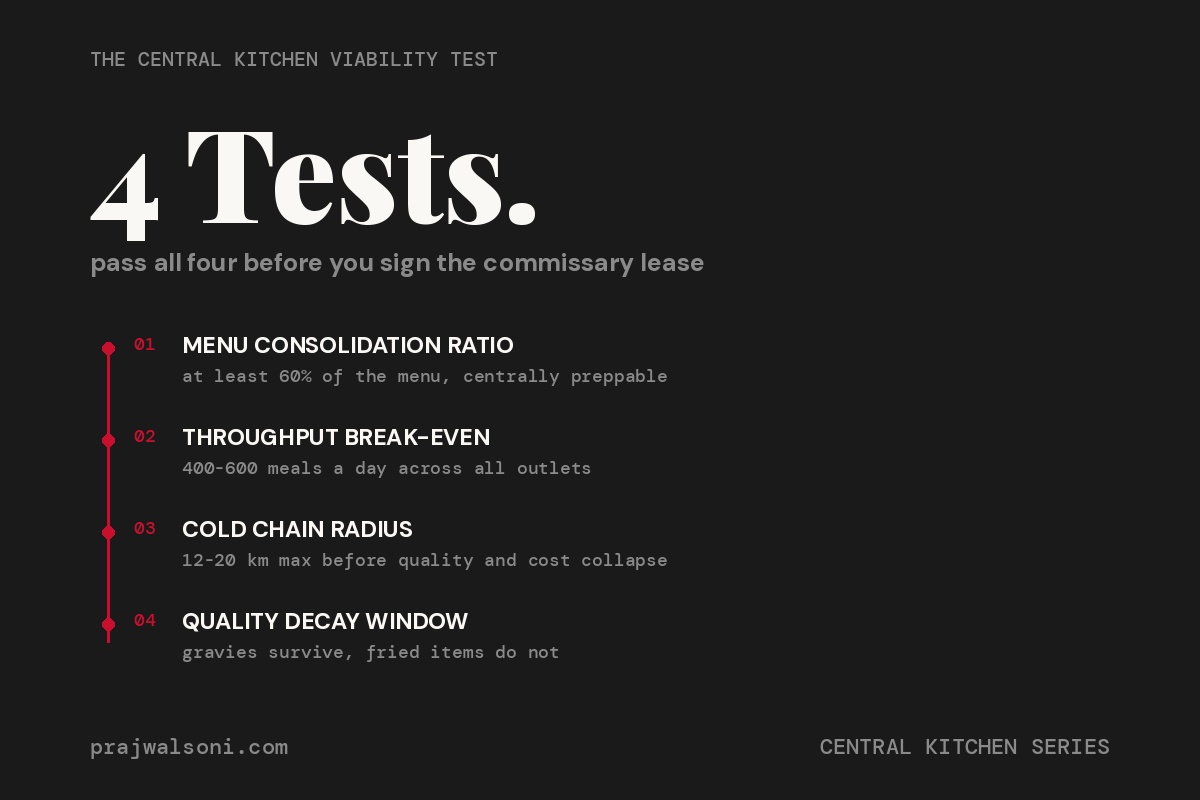
The Central Kitchen Viability Test is a four-component diagnostic that tells you whether commissary operations will reduce your costs or increase them. It forces you to validate volume, menu structure, logistics, and product integrity before committing capital. Each component produces a clear pass or fail signal. If even one component fails, the commissary model is premature for your operation.
The four components are:
1. Menu Consolidation Ratio — what percentage of your menu can actually be centrally prepped without quality loss.
2. Throughput Break-Even Point — the minimum daily production volume where commissary costs fall below individual kitchen costs.
3. Cold Chain Radius Limit — the maximum delivery distance from commissary to outlet before logistics costs destroy savings.
4. Quality Decay Window — the time between commissary production and final plating at the outlet, and whether your food survives it.
The name tells you exactly what it does. No clever branding. Just a viability check before you spend real money.
How Does Menu Consolidation Ratio Work?
Menu Consolidation Ratio measures the percentage of your menu items that can be prepped centrally without compromising quality at the point of service. A ratio below 60% means your commissary will run at partial capacity while your outlets still need full kitchens. That defeats the purpose entirely.
Consider a North Indian restaurant with 45 menu items. Gravies like dal makhani, makhani base, and korma paste consolidate well. You can batch-cook these in a commissary, vacuum pack them, and reheat at the outlet. Tandoori items, however, require live fire. Rotis need to be made fresh. Paneer tikka tastes different when reheated versus charred to order. So out of 45 items, maybe 25 can be centrally prepped. That gives you a consolidation ratio of roughly 55%.
At 55%, you still need a functioning kitchen at each outlet with staff, gas, and equipment for the remaining 20 items. Your commissary handles only half the menu, but you are paying full rent and full staffing for it. The math does not work unless you push that ratio above 60%, ideally above 70%.
QSR formats have an advantage here. A burger brand where patties, sauces, and buns can all ship from a central location might hit a consolidation ratio of 85%. Assembly at the outlet requires minimal equipment. Menu design directly impacts whether commissary operations make financial sense. If your menu was not built for central prep, you will spend more trying to force it.
To calculate your ratio: list every menu item, mark which ones can ship from a commissary without quality loss, and divide that count by the total. Be honest. If your biryani needs dum cooking at the outlet, do not count it as centrally preppable just because you can parcook the rice.
What Is the Throughput Break-Even Point for a Central Kitchen?
The Throughput Break-Even Point is the daily production volume at which your central kitchen’s total cost per meal drops below the per-meal cost of cooking at individual outlets. Below this volume, your commissary is a liability. Above it, the savings compound with every additional outlet you add.
Calculating it requires two numbers. First, your commissary’s total daily fixed and variable cost. This includes rent, staff wages, utilities, raw material transport, packaging, and cold chain logistics. Second, your per-outlet kitchen cost for producing the same items independently. Include kitchen staff wages, ingredient cost at retail quantities, gas, electricity, and the kitchen space’s share of rent.
In most consulting projects I have worked on across Ahmedabad and Surat, the break-even sits between 400 and 600 meals per day for a commissary serving 4-6 outlets. Below 400 daily meals, the overhead of maintaining a separate facility, staff, and transport infrastructure eats into whatever savings you gain from bulk purchasing.
Bulk purchasing is real. Buying onions, tomatoes, and cooking oil for 6 outlets from one commissary gives you volume discounts of 8-12% compared to each outlet purchasing independently. But those savings need to exceed the added costs of commissary rent, commissary-specific staff, packaging, and daily transport. Operators often overestimate ingredient savings and underestimate logistics costs.
For restaurants dealing with thin profit margins, getting this calculation wrong means the commissary becomes a fixed-cost burden that drags every outlet’s profitability down. Pull your outlet-level P&L statements before committing. If your combined daily output across all outlets sits below the break-even threshold, wait until you have the volume.
How Far Can Your Central Kitchen Ship Food?
Cold Chain Radius Limit defines the maximum distance from your commissary to any outlet, beyond which transport costs and food safety risks cancel out your production savings. For most restaurant operators in Indian cities, this radius sits between 12 and 20 kilometres depending on traffic conditions, vehicle type, and whether you are transporting hot food or cold prep.
Every additional kilometre adds fuel cost, time, and temperature risk. A commissary in the industrial area of Ahmedabad serving outlets in Satellite, Prahlad Nagar, and SG Highway works because those are within a 15 km radius with manageable traffic. But if you try to serve an outlet in Gandhinagar from the same commissary, you add 25 km of highway distance. During summer months, your cold chain for items like paneer-based gravies or dairy desserts like gulab jamun becomes unreliable without refrigerated transport.
Refrigerated vehicles cost Rs 8-12 lakh to purchase or Rs 25,000-40,000 monthly to lease. If your commissary model only works with refrigerated transport, that cost must be included in your throughput break-even calculation. Most operators use insulated boxes instead, which keep food safe for roughly 90 minutes in moderate weather. In cities like Nagpur or Hyderabad during peak summer, that window shrinks to 60 minutes.
Before you finalize a commissary location, map every current and planned outlet on Google Maps. Measure the driving distance, not the straight-line distance. Factor in peak traffic times because your dispatch usually happens between 10 AM and 11 AM, which is rush hour in most Indian cities. If any outlet falls outside your safe radius, that outlet stays on independent production.
Operators who plan to scale across multiple locations often position the commissary first and then choose outlet locations based on the radius. That is the smarter sequence. The opposite, opening outlets wherever rent is cheap and then trying to serve them all from one commissary, leads to cold chain failures and inconsistent food quality.
What Is the Quality Decay Window and Why Does It Kill Commissary Models?
The Quality Decay Window is the time gap between food leaving your commissary and being served to the customer at the outlet. Every minute in this window degrades texture, temperature, and taste. If your food cannot survive this window, your commissary model will produce complaints, refunds, and rating drops that cost more than the operational savings.
Certain dishes handle the window well. Gravies, sauces, marinades, and pre-portioned ingredients travel without significant quality loss if stored correctly. These items are designed to be reheated or assembled at the outlet. They have a long quality decay window, sometimes 24-48 hours when refrigerated.
Other dishes collapse. Fried items lose crispness within 20 minutes. Dosas cannot be centrally made and reheated. Biryani rice absorbs moisture during transit and arrives mushy. Masala chai loses its fresh aroma within an hour. If these items form a significant part of your menu, your commissary cannot handle them. And if you force them through the commissary anyway, your Swiggy and Zomato ratings will reflect the quality drop within weeks.
Aggregator platforms amplify this problem because delivery adds another 20-30 minutes after the food leaves your outlet. So the total quality decay window for a commissary-to-outlet-to-customer journey can stretch to 90 minutes or more. That is fine for a sealed gravy container. It is fatal for a crispy vada pav.
Test this before investing. Prepare your top 10 menu items at a temporary central location. Transport them to your outlet using the same method you plan to use. Plate them and taste them. Compare against food prepared fresh at the outlet. If more than 3 items show noticeable quality loss, your menu needs restructuring before commissary operations make sense.
How Do You Apply the Central Kitchen Viability Test to Your Operation?
Run all four components in sequence. If any single component produces a fail result, do not invest in a commissary until you fix that specific gap. Here is how each decision plays out in practice.
Suppose you run a chain of 5 South Indian restaurants across Pune. Your menu has 50 items. You test the Menu Consolidation Ratio and find that chutneys, sambar, batter, and coconut-based gravies can all be centralized. That is 32 items. Your ratio is 64%. Pass.
You calculate the Throughput Break-Even Point. Your 5 outlets collectively serve 520 meals daily. Your commissary estimate, including a Rs 35,000 monthly lease in Hinjewadi, 4 staff, transport, and packaging, works out to a daily fixed cost of Rs 8,500. Dividing that by 520 meals gives a commissary overhead of roughly Rs 16 per meal. Your current per-outlet prep cost for the same items runs Rs 22 per meal. Savings of Rs 6 per meal. Pass.
Cold Chain Radius Limit: your farthest outlet is in Kothrud, 18 km from Hinjewadi. During morning traffic, that is 50 minutes. With insulated containers, your food stays safe. Tight, but passable. Pass.
Quality Decay Window: you test your top items. Sambar travels well. Batter stays fresh when refrigerated. But your dosa station still needs to be live at each outlet. Your medu vada needs fresh frying. You accept that 18 items stay outlet-produced. The 32 centralized items survive the window. Pass.
All four components passed. You proceed. But change any single variable, say the Kothrud outlet moves to a location 28 km away, or your daily orders drop to 350, and you need to retest before continuing.
This discipline separates operators who build sustainable commissary operations from those who invest Rs 25 lakh and then spend 18 months trying to justify the expense. Cash flow management in multi-outlet operations demands this kind of pre-investment rigour.
The Diagnostic Question You Need to Answer This Week
If you are considering a central kitchen for restaurants in your chain, answer this one question first: what is your combined daily meal output across all outlets that the commissary would serve?
If you do not know this number with confidence, you are not ready. Pull your outlet-level sales data from your POS, whether that is Petpooja, Posist, or whatever system you run. Calculate the average daily meals per outlet for the last 60 days. Multiply by the number of outlets. Compare that against the throughput break-even point for a commissary in your city.
If the number clears the threshold, run the other three tests. Menu Consolidation Ratio. Cold Chain Radius Limit. Quality Decay Window. All four must pass.
Do not let the excitement of “scaling” push you into a commissary lease that your current volume cannot support. I have seen operators in Bengaluru and Ahmedabad commit to 3-year commissary leases at Rs 50,000-80,000 a month when their outlet network was producing fewer than 300 meals daily. That is not scaling. That is adding a fixed cost that makes every meal more expensive to produce. Understanding why restaurants fail often comes down to exactly this kind of premature infrastructure spending.
A commissary is a production decision, not a growth signal. Treat it like one. Test before you build.
Stop guessing. Start building. Get Design Dine Dominate, the complete restaurant business playbook from someone who has actually done it.

Leave a comment