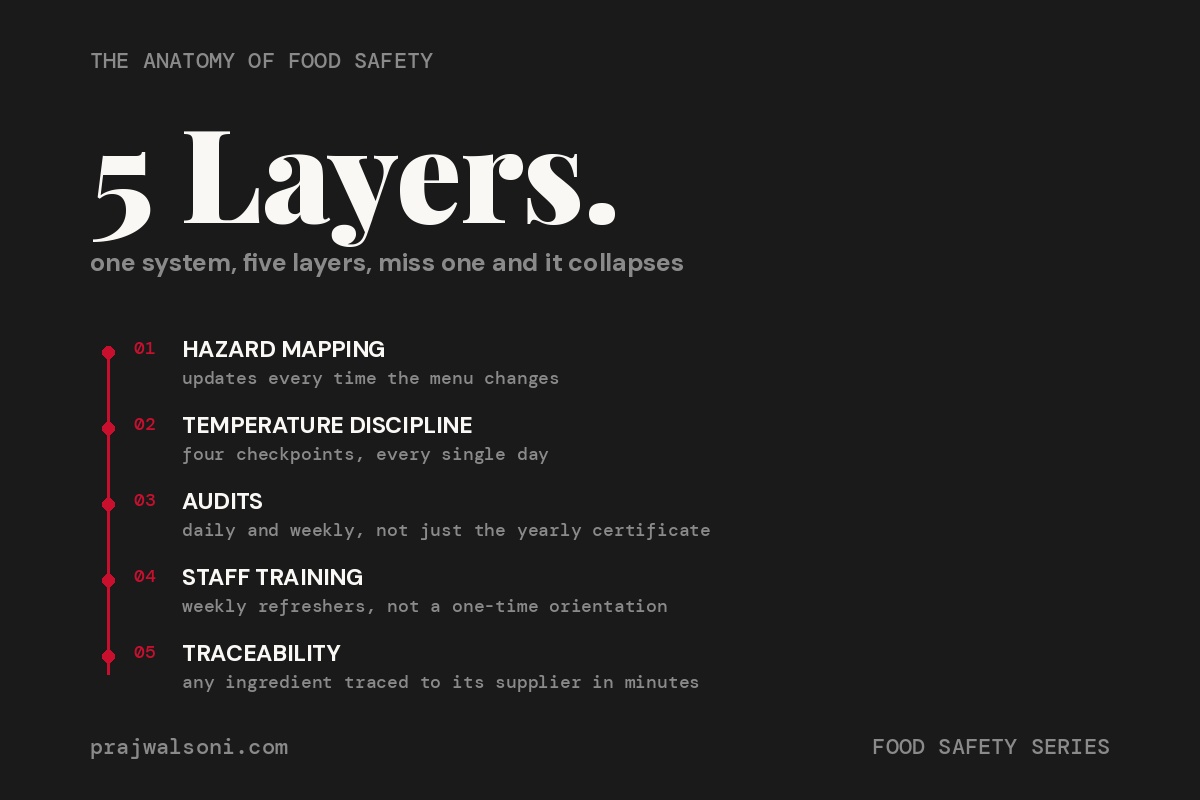
Picture this: you are running a restaurant in Pune when an FSSAI inspector walks in on a Tuesday afternoon. Your licence is current. Your fire extinguisher is charged. But the inspector opens your walk-in cooler, points a thermometer at the paneer, and it reads 14°C instead of the required 4°C. That single reading triggers a notice, a potential fine of Rs 5 lakh, and a food safety system restaurants rely on gets exposed as decoration. Most operators in the international restaurant industry think a food safety system means a laminated poster on the wall and a yearly audit file. It is not. A real food safety system has five distinct layers, and if any one of them is missing, the whole thing collapses under pressure.
What Does a Food Safety System Actually Mean for a Restaurant?
A food safety system is a set of documented, enforced, and monitored practices that prevent contamination, spoilage, and cross-contamination at every stage from receiving raw materials to serving a plate. It is not a certificate. It is an operating discipline that runs every hour the kitchen is open.
Most operators confuse compliance with safety. Compliance means your paperwork satisfies an inspector. Safety means your systems actually prevent a customer from getting sick. These are two different outcomes, and only one of them protects your business long term.
The NRAI’s India Food Services Report 2024 values the industry at Rs 5.69 lakh crore. As this market grows toward Rs 7.76 lakh crore by 2028, regulatory enforcement is scaling with it. FSSAI has increased its inspection cadre and introduced risk-based auditing in cities like Ahmedabad, Bengaluru, and Hyderabad. Operators who built their food safety around a once-a-year file are now getting caught mid-service.
I have consulted for kitchens where the HACCP manual was pristine and untouched. Literally never opened after the day it was printed. The staff did not know it existed. That is not a system. That is a prop. So let me break down the five layers that make a food safety system actually functional.
Layer 1: Hazard Mapping, Not Just a HACCP Document
Hazard mapping means identifying every specific point in your kitchen where contamination can enter, multiply, or spread. HACCP, which stands for Hazard Analysis and Critical Control Points, provides the framework. But most restaurants treat HACCP as a document to buy from a consultant, not a map to use daily.
The non-obvious part is this. Your hazard map changes with your menu. When you add a new biryani variant that uses raw chicken marinated overnight, you have introduced a new critical control point. If nobody updates the hazard analysis, your system has a blind spot. In restaurants I have worked with, roughly 40% of menu changes happen without any update to the HACCP plan.
A functional hazard map includes three things. First, a list of every ingredient that enters your kitchen ranked by biological risk. Raw chicken, eggs, and dairy sit at the top. Second, the exact temperature and time limits for each stage of storage, prep, and cooking. Third, a clear record of who checks each control point and when. If you cannot answer “who checks the oil temperature on the fryer at 3pm,” your hazard map is incomplete.
Operators who get this layer right catch problems before they become complaints. Those who skip it discover the gap when a customer posts a food poisoning complaint on Google, and by then the damage to your already thin margins is real.
Layer 2: Temperature Discipline as a Daily Habit
Temperature discipline means measuring, recording, and acting on cold chain and hot holding temperatures at fixed intervals every single day. This is the layer where most food safety systems in the international restaurant industry break down completely.
FSSAI requires cold storage below 5°C and hot holding above 63°C. The danger zone between 5°C and 63°C is where bacteria double every 20 minutes. Yet in many kitchens across Surat and Nagpur, nobody owns a calibrated probe thermometer. Staff guess temperatures by touch. That is not food safety. That is hope.
Here is what operators miss. Temperature logs are not bureaucracy. They are your legal defence. If a customer files a complaint and you can show timestamped temperature records proving your cold chain was intact, you have evidence. Without logs, you have nothing but your word against a lab report.
A probe thermometer costs Rs 800 to Rs 2,000. A food safety violation fine starts at Rs 2 lakh under the Food Safety and Standards Act, 2006. The math is obvious, yet most operators skip this investment. Temperature checks should happen at receiving, during storage, during cooking, and at service. Four checkpoints per item category per shift. Your POS system on platforms like Petpooja or Posist cannot track this for you. This is a manual discipline backed by a simple log sheet.
How Do Audits Actually Work in a Restaurant Kitchen?
Audits work by comparing what your SOPs say should happen against what actually happens on the kitchen floor during a live shift. An audit that only checks paperwork is theatre. A real audit walks the line, opens the cooler, checks dates on containers, and watches a cook handle raw chicken.
There are three types of audits most restaurants need. First, daily self-audits conducted by a shift lead using a simple 15-point checklist. Second, weekly internal audits by a manager or owner covering deeper items like pest control logs, supplier invoices for traceability, and equipment calibration. Third, quarterly external audits by a certified food safety auditor or FSSAI-registered third party.
The problem I have seen repeatedly is that operators invest in the quarterly external audit because it produces a certificate they can frame. But they skip the daily and weekly layers entirely. This is like going to the doctor once a year but never checking your blood pressure at home. By the time the quarterly audit catches a problem, you have been serving unsafe food for weeks.
I wrote about how operational discipline breaks down during scaling, and audits are the first casualty. When you open a second location, the daily audit habit at the first location disappears because the owner is no longer present to enforce it. Build the audit into your shift handover process. Make it non-negotiable. If your staff turns over frequently, the audit checklist becomes even more critical because new hires do not carry institutional memory.
Layer 4: Staff Training That Goes Beyond Day One
Food safety training must be ongoing, practical, and tested through observed behaviour on the floor, not just a one-time orientation session on a new hire’s first day. Most restaurants in the international restaurant industry train food safety exactly once. After that, the topic never comes up again until something goes wrong.
The typical training gap looks like this. A new cook joins your kitchen in Ahmedabad. On day one, someone shows them the handwashing station and explains colour-coded chopping boards. By day three, they are cutting vegetables on whatever board is closest because nobody reinforced the practice. Within two weeks, they are doing exactly what the previous cook did, which may or may not follow your SOP.
Effective food safety training has three components. First, a short visual SOP posted at each station showing the exact procedure for that station. Not a 40-page manual. A single laminated card with pictures. Second, a weekly 10-minute refresher during pre-shift briefing covering one specific topic. This week it is handwashing technique. Next week it is allergen identification. Third, random observed checks where a manager watches a cook perform a task and provides immediate correction if needed.
FSSAI mandates that at least one person per food business must hold an FOSTAC (Food Safety Training and Certification) certificate. But that single certified person cannot be the only one who understands food safety. Every person who touches food needs functional knowledge. The cost of a FOSTAC course runs roughly Rs 1,000 to Rs 1,500 per person. For a kitchen team of six, that is under Rs 10,000 total. Compare that to the cost of one batch of dal makhani that gives 30 customers stomach trouble. The reputational damage alone will cost you lakhs in lost orders on Swiggy and Zomato because negative reviews compound fast on aggregator platforms.
Layer 5: Traceability and Supplier Accountability
Traceability means being able to track any ingredient in your kitchen back to the supplier, the delivery date, and the batch it came from within minutes. This is the layer most restaurant operators do not even know exists, and it is the one that saves you when a contamination incident happens.
When a food safety incident occurs, the first question FSSAI or a court will ask is: where did this ingredient come from? If you cannot answer that question with a paper trail, you absorb 100% of the liability. If you can show a dated invoice, a supplier FSSAI licence number, and a receiving log with temperature at delivery, you shift accountability to where it belongs.
Practically, traceability works like this. Every delivery gets logged with date, supplier name, item, quantity, and receiving temperature. Containers in storage get labelled with the delivery date and a use-by date. When you use an ingredient, you follow FIFO, which means first in first out. The oldest stock gets used first. Simple, but almost no restaurant in a city like Surat or Nagpur actually enforces FIFO consistently.
This layer also forces you to hold suppliers accountable. If your chicken supplier delivers product at 12°C instead of below 4°C, you reject it and document the rejection. Most operators accept warm deliveries because they do not want to run out of stock during dinner service. That short-term fix creates a long-term liability. Your food cost might sit in the healthy 28-35% range, but if you are accepting compromised raw materials, your actual cost includes the risk of a shutdown.
How Do These Five Layers Work Together?
These five layers create a closed loop where each one reinforces the others. Hazard mapping tells you what to watch. Temperature discipline gives you the daily data. Audits verify that the data is real. Training ensures staff know what to do. Traceability gives you a safety net when something goes wrong despite all other layers.
Remove any one layer and the system develops cracks. A kitchen with perfect hazard mapping but no temperature logs cannot prove compliance. A kitchen with trained staff but no audits will drift within weeks because human behaviour requires reinforcement. A kitchen with audits but no traceability cannot contain a supplier-originated problem.
Restaurants that implement all five layers typically see fewer customer complaints, lower food waste from spoilage, and better audit scores. In my experience consulting across Gujarat, the investment to build a proper food safety system for a single kitchen runs Rs 15,000 to Rs 40,000 including training, thermometers, signage, and initial audit fees. The cost of not having one starts at Rs 2 lakh in fines and goes up from there, not counting the revenue you lose from a damaged reputation on aggregator platforms where ratings determine visibility.
What Knowing All Five Layers Enables You to Do
When you understand all five layers, you stop treating food safety as a compliance chore and start using it as a competitive advantage. You can confidently bid for catering contracts that require HACCP certification. You can onboard new staff faster because your training system is visual and station-specific. You can protect your dine-in margins by reducing waste from spoiled inventory.
You also build a kitchen that can survive an unannounced inspection on its worst day. Not because you scrambled to clean up, but because the systems run regardless of who is watching. That is the difference between a food safety system that exists on paper and one that actually protects your restaurant.
Key Takeaway
- Hazard mapping must update every time your menu changes, not just when a consultant visits.
- Temperature logs at four daily checkpoints are your legal defence, not bureaucracy.
- Daily self-audits and weekly internal audits matter more than the quarterly external certificate.
- Staff training needs weekly 10-minute refreshers and observed floor checks, not a one-time orientation.
- Traceability protects you from supplier-originated contamination and shifts liability where it belongs.
This week, do one thing. Pick up a probe thermometer and check the temperature of every item in your walk-in cooler right now. Write down the readings. If anything is above 5°C, you have found your first gap. Fix it today. Then build the other four layers around it.
Stop guessing. Start building. Get Design Dine Dominate, the complete restaurant business playbook from someone who has actually done it.

Leave a comment