More SOPs Do Not Mean Better Operations
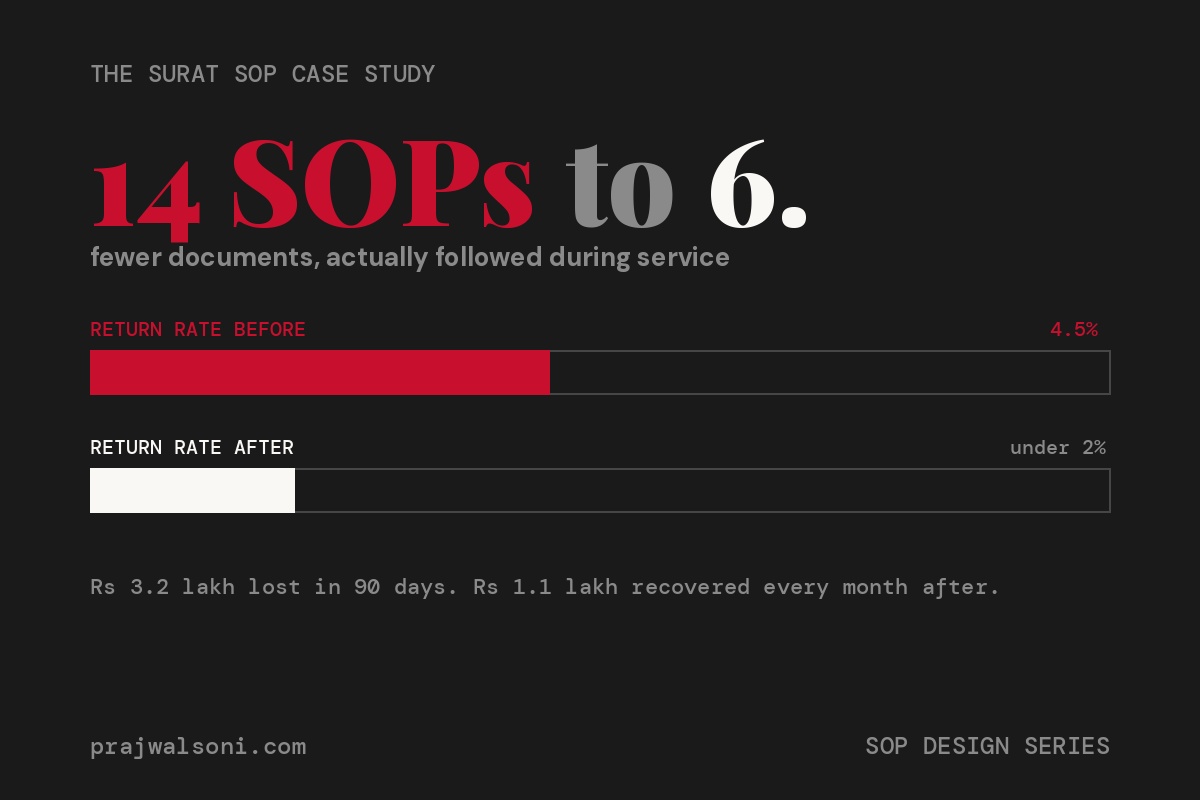
Most restaurant operators assume that having written SOPs means their kitchen is documented. It does not. A Surat-based cloud kitchen brand I consulted for had 14 SOPs printed, laminated, and pinned to the kitchen wall. Every single one was being ignored. In 90 days, that gap between paper and practice cost them Rs 3.2 lakh in food waste, rework, and inconsistent output. Restaurant SOP design is not about writing procedures. It is about building documentation that your team actually uses during live service, in the chaos of a 200-order evening on Swiggy and Zomato.
Proper restaurant SOP design produces documentation that changes staff behaviour on the line. Anything else is paperwork theatre. The difference between the two determines whether your food cost sits at 32% or 39%.
What Did the Surat Cloud Kitchen Actually Look Like?
This was a cloud kitchen running three brands out of a single unit in Surat. North Indian, biryani, and Chinese. Monthly revenue was roughly Rs 9.5 lakh across all three brands. The owner had invested in proper kitchen setup. Good equipment, a reasonable layout, and a team of seven people including two senior cooks.
On paper, everything looked fine. The 14 SOPs covered opening procedures, closing procedures, oil temperature for frying, marination timings, and portion weights for biryani. All of them were written in English. Three of the seven kitchen staff could not read English fluently.
That was the first crack. But it was not the biggest one.
The real problem was that the SOPs described what to do but never how to verify it was done. No checkpoints. No visual references. No accountability loop. A cook could skip the marination timer by 20 minutes, and nobody would know until the customer complaint landed on Zomato two hours later.
Where Was the Rs 3.2 Lakh Actually Leaking?
The losses came from three specific areas, not from one dramatic failure. Most kitchen bleeding works this way. It is slow, distributed, and invisible until you measure it.
1. Portion drift on biryani. The SOP said 320 grams of rice per container. Actual portions ranged from 290 to 380 grams depending on who was on the line. On a biryani brand doing 60 orders a day, that variance added up to roughly Rs 28,000 per month in extra rice alone. Over 90 days, that was Rs 84,000.
2. Oil usage in the Chinese brand. The SOP mentioned “use fresh oil for deep frying.” It did not specify how many batches before the oil needed changing, or how much oil to pour into the kadai for a specific batch size. Cooks were using 40% more oil than necessary because there was no reference quantity documented anywhere. Monthly oil cost was Rs 18,000 higher than it should have been. Over 90 days, Rs 54,000.
3. Rework and returns on the North Indian brand. Inconsistent gravy thickness was the biggest complaint. One cook used 200ml water per batch of dal makhani. Another used 300ml. Customers got different products on different days. Restaurant profit margins do not survive a 4.5% return rate on aggregator platforms. Returns and rework over the quarter totalled roughly Rs 82,000.
Add the smaller losses from inconsistent marination, wasted prep due to unclear par levels, and paneer tikka portions that varied by 30 grams per plate. The total came to Rs 3.2 lakh in 90 days.
Why Did 14 Written SOPs Fail to Prevent Any of This?
Written SOPs fail when they are designed for auditors instead of for cooks. That is the core problem in most restaurant SOP design. The documents exist to prove that management created a system. They do not exist to change behaviour on the kitchen line during a rush.
I identified five specific failures in how the SOPs were built:
First, language mismatch. SOPs were in English. Most kitchen staff in Surat, Ahmedabad, and Pune communicate in Hindi or Gujarati. A procedure nobody can read is not a procedure.
Second, no visual anchors. Every SOP was text-only. No photos of what 320 grams of rice looks like in the container. No image of the correct oil level in the kadai. Kitchen staff work with their eyes and hands, not with paragraphs.
Third, no verification mechanism. The SOPs described the process but did not include any checkpoint where someone confirms the step was completed correctly. Without verification, documentation is just suggestion.
Fourth, no consequence for deviation. When a cook skipped a step, nothing happened. No flag. No correction. No conversation. The SOP had no teeth.
Fifth, no update cycle. Two of the 14 SOPs referenced a menu item that had been discontinued three months earlier. When staff see outdated information on the wall, they stop trusting the entire system. This is a problem I have seen across restaurants in Bengaluru and Hyderabad as well. Dead documentation kills live documentation.
How Did We Redesign the Restaurant SOP System?
We rebuilt the kitchen documentation system from scratch in two weeks. The new system had six SOPs instead of fourteen. Fewer documents, but each one was built to actually work during service.
Here is what changed:
1. Visual-first documentation. Every SOP was a single laminated card with a photo at the top. The photo showed the correct output. Correct portion in the correct container. Correct oil level. Correct gravy consistency. Text was minimal and written in Hindi. A cook glancing at the card for three seconds could confirm whether their output matched.
2. Measurable checkpoints. Instead of “add oil to kadai,” the SOP now said “pour oil to the red line marked on the kadai.” We physically marked reference lines on pots, containers, and ladles. Cloud kitchen profitability depends on removing ambiguity from every step.
3. Shift-start verification. Every shift began with the senior cook checking three things against the SOP cards: portion tools are in place, reference markings are visible, and par levels for the shift are confirmed. This took four minutes. It saved hours of correction later.
4. Weekly SOP review. Every Sunday, the kitchen lead and the owner spent 15 minutes reviewing whether any SOP needed updating. Menu changes, supplier changes, or equipment changes triggered an immediate revision. Dead SOPs were removed the same day.
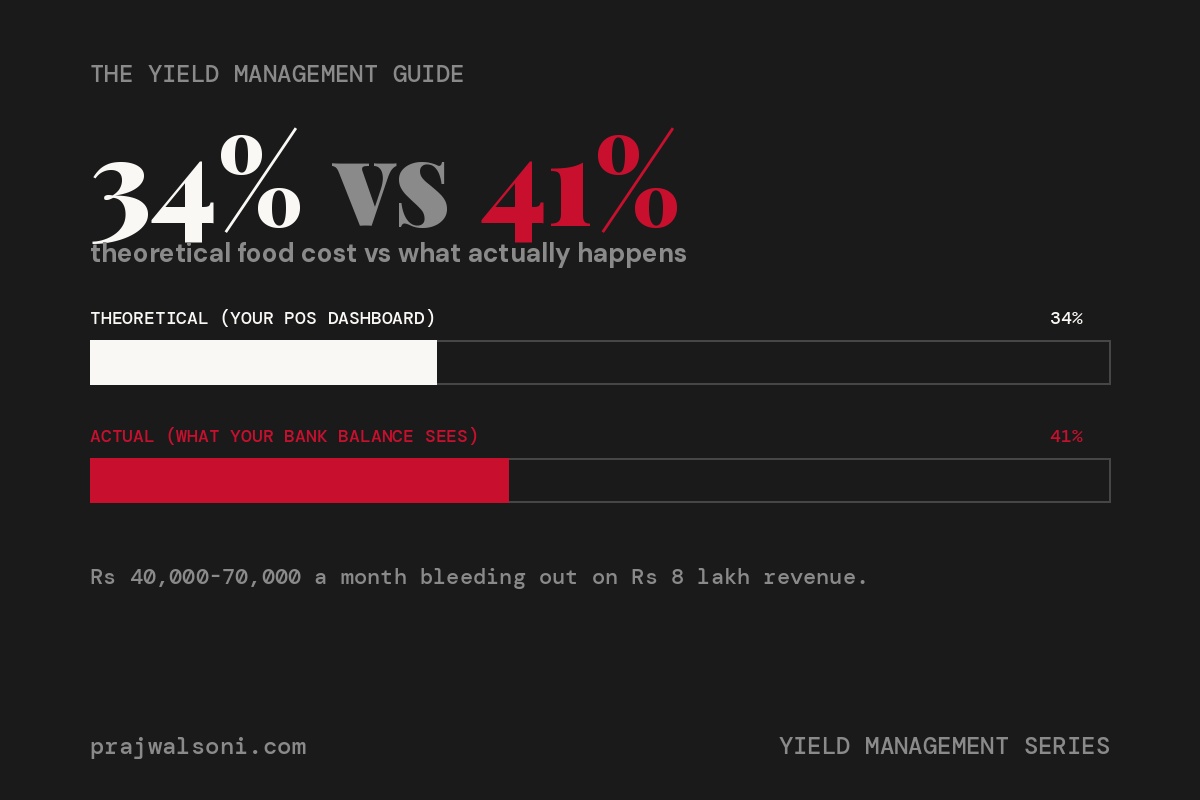
5. Accountability through POS tracking. We connected portion data to their menu pricing model using Petpooja. If theoretical food cost for biryani was 31% but actual was hitting 37%, the gap was flagged weekly. The SOP was the tool to close that gap. The POS report was the signal that the gap existed.
What Were the Results After 60 Days?
Within 60 days of implementing the new system, the numbers shifted measurably. Biryani portion variance dropped from a 90-gram spread to a 20-gram spread. Oil consumption fell by roughly 35%. Return rate on the North Indian brand dropped from 4.5% to under 2%.
The combined monthly savings came to approximately Rs 1.1 lakh. Across a quarter, that is Rs 3.3 lakh recovered, which almost exactly matched the previous quarter’s losses. The kitchen was doing the same revenue with measurably lower waste.
But the less obvious result mattered more. New staff onboarding time dropped from 10 days to 4 days. Because the SOPs were visual and referenced physical markings on equipment, a new cook could produce consistent output within their first week. In an industry where staff turnover runs as high as 80% annually according to the NRAI India Food Services Report 2024, cutting training time by 60% is not a nice-to-have. It directly reduces the cost of every employee who walks out.
The owner told me something that stuck. He said the old SOPs made him feel organised. The new SOPs made his kitchen actually organised. Those are very different things.
What Makes Restaurant SOP Design Actually Work?
Effective restaurant SOP design follows a principle I apply across every kitchen I consult for: documentation must be usable at the speed of service. If a cook cannot reference the SOP in under five seconds during a rush, it will be ignored.
Here are the non-negotiable rules:
Write for the person doing the work, not for the person approving the document. If your kitchen team reads Hindi, write in Hindi. If they respond to images, lead with images. SOPs are operational tools, not compliance artefacts.
Attach physical reference points to every measurement. Mark ladles, containers, and pots with reference lines. A “200ml ladle” means nothing if the ladle is not labelled. Physical marks eliminate guesswork faster than any written instruction.
Build a verification step into every SOP. Someone must confirm the output matches the standard. This could be a shift lead checking five plates during peak service, or a weekly food cost reconciliation through your POS. Without verification, SOPs are suggestions.
Kill SOPs that are no longer relevant. An outdated SOP on the wall tells your team that management does not care about accuracy. Remove discontinued items immediately. Update supplier names and quantities when they change. Scaling a restaurant without maintaining documentation discipline is how second and third locations fall apart.
Keep the total number of SOPs small. Six to ten SOPs covering prep, cooking, portioning, closing, and inventory is enough for most kitchens. Fourteen is too many. Twenty is a filing cabinet nobody opens. Each SOP should fit on a single A4 card.
The Principle Beyond This Case
Every restaurant I have worked with, from a single-unit thali place in Ahmedabad to a multi-brand cloud kitchen operation, has the same fundamental problem with documentation. The operators who write SOPs are not the ones who use SOPs. That gap between the person designing the system and the person executing it is where money disappears.
NRAI’s India Food Services Report 2024 values the industry at Rs 5.69 lakh crore. The organised segment is growing at 13.2% CAGR. As this growth continues, the operators who win will not be the ones with the best recipes. They will be the ones whose kitchens produce the same output on Tuesday night with a B-team as they do on Saturday night with the A-team. That consistency comes from documentation, not talent.
Your food cost target means nothing without systems that enforce it at the line level. Your dine-in profitability depends on portion accuracy across hundreds of plates a day. Your aggregator ratings depend on consistency across shifts and across staff changes.
All of that starts with SOPs that are designed for your kitchen, not for your binder.
What to Do This Week
Pick your highest-volume menu item. Stand next to the cook who makes it during peak service tomorrow. Watch whether the portion, the timing, and the output match what your documentation says. If you do not have documentation for that item, that is your answer. If you do, and the cook is not following it, ask yourself why. The answer is almost always that the SOP was designed for you to feel good about, not for the cook to use.
Rebuild that one SOP using the rules above. One visual card. One physical reference mark. One verification checkpoint. Test it for a week. Then do the next item.
Stop guessing. Start building. Get Design Dine Dominate, the complete restaurant business playbook from someone who has actually done it.

Leave a comment