Your First Restaurant’s Success Is Probably Not Replicable
Most restaurant operators believe a profitable first location means they are ready for a second. That belief is the single most expensive mistake in the restaurant expansion framework. A profitable unit does not automatically mean a scalable unit. In cities like Ahmedabad, Surat, and Pune, I have seen operators sign leases for location two within weeks of hitting consistent revenue at location one. Roughly 60% of those second locations underperform the first within six months. Not because the food got worse. Because nobody checked whether the success of location one was systematic or accidental.
Accidental success looks like this. Your chef is exceptional, but he has no documented recipes. Your location sits next to a college that drives walk-ins you did not earn through marketing. Your rent was negotiated by a family connection and sits 40% below market rate. Your food cost stays at 30% because you personally go to the mandi at 5am every morning. Remove any one of those conditions, and profitability collapses. A second location removes all of them simultaneously.
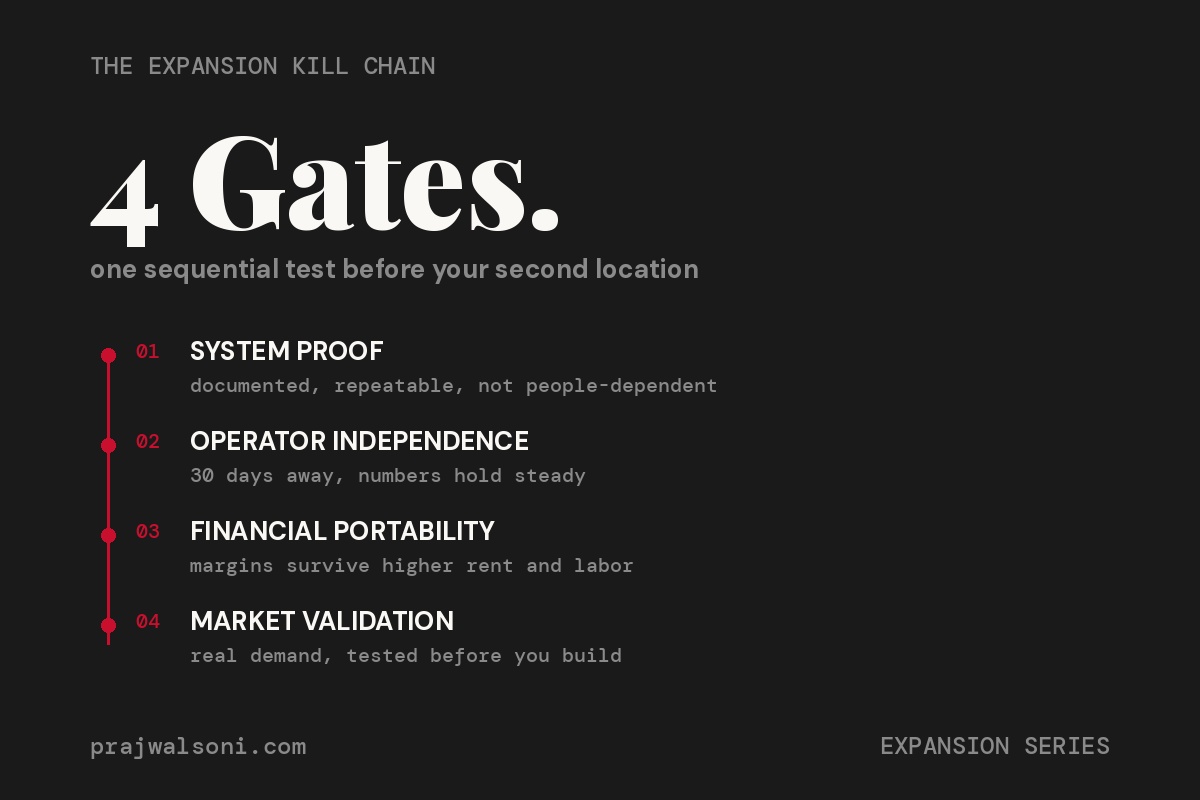
This is why I built the Expansion Kill Chain. It is a four-step diagnostic sequence that tells you whether your restaurant can actually survive being copied. Each step must pass before you move to the next. Fail at any step, and you stop. You fix it at location one before spending a single rupee on location two.
What Is the Expansion Kill Chain?
The Expansion Kill Chain is a sequential four-step framework that forces you to prove replicability before committing capital to a second restaurant location. Each step acts as a gate. You only proceed if the previous step passes. The four steps are: System Proof, Operator Independence, Financial Portability, and Market Validation.
The name is deliberate. A kill chain in military strategy is a sequence where breaking any single link stops the entire attack. In restaurant expansion, breaking any single link should stop the entire investment. Most operators skip straight to Market Validation because it feels exciting. They scout locations, calculate foot traffic, and fantasise about revenue. But they never check whether the system that created revenue at location one can even function without them standing in the kitchen.
I have consulted for operators running 18 restaurants across Gujarat. The ones who scaled successfully all passed these four gates in order. The ones who failed skipped at least two. So let me walk you through each step and show you what passing actually looks like.
Step 1: Does Your Restaurant Have System Proof?
System Proof means every process that generates revenue at your restaurant is documented, repeatable, and not dependent on any single person’s memory or talent. If your head chef walks out tomorrow and your dal makhani changes, you do not have System Proof. If your closing checklist lives in the manager’s head instead of on paper, you do not have System Proof.
Here is the test. Pick any five dishes from your menu. Ask a cook who did not create those dishes to prepare them using only your written SOPs. If the result is within 90% of the original in taste, portion, and presentation, you pass. If it falls apart, your restaurant runs on people, not on systems. People do not scale. Systems do.
System Proof covers more than recipes. It includes your cash handling process, your vendor negotiation records, your inventory count method, your order packing sequence for Swiggy and Zomato, and your customer complaint resolution flow. Every one of these must be written down in a format that a new hire can follow within their first week.
Most operators think they have SOPs because they trained people verbally. Verbal training is not documentation. Documentation means a new team can replicate your operations without calling you for help. If that sounds extreme, consider this: when you open location two, you will physically be in one place at a time. Whatever location you are not at will run on your documentation alone.
Step 2: Can Your Restaurant Run Without You for 30 Days?
Operator Independence means your restaurant maintains its revenue, food cost, and customer satisfaction scores for a full 30 days without you stepping into the building. Not checking in twice a day. Not reviewing reports every evening. Fully absent. This step tests whether your systems from Step 1 actually work under real conditions.
Run this test before you sign any lease. Tell your team you are going on a 30-day trip. Monitor only three numbers at the end of each week: total revenue, food cost percentage, and average Swiggy/Zomato rating. If revenue drops more than 10%, food cost rises more than 3 percentage points, or ratings drop below 4.0, you have failed Operator Independence.
Why 30 days? Because the first week runs on momentum. Your team remembers your instructions. Vendors deliver on habit. By week three, cracks appear. Portion sizes drift. Inventory gets sloppy. The staff member who always cut corners starts cutting bigger ones. If your systems hold through week four, they are real. If they collapse, you know exactly where the weaknesses are.
The staff turnover crisis makes this step harder but more essential. Your team will change. New people will join. If your restaurant only works with the exact humans currently in it, scaling will break you financially. I have seen operators in Bengaluru open a second outlet, spend all their time at the new location, and watch their first location’s margins collapse from 15% to 4% in eight weeks. Operator Independence would have caught that risk before any money was spent.
Step 3: Are Your Unit Economics Portable?
Financial Portability means your unit economics can survive different rent, different labour costs, and different delivery commission structures without the business model breaking. Your first location’s profitability might depend on conditions that do not exist anywhere else. This step forces you to stress-test the numbers before you commit.
Take your current P&L and rebuild it with these changes. Increase rent by 30%. Increase labour cost by 20% because you will not find the same team at the same rates in a new area. Assume Swiggy and Zomato commissions at the higher end of the 15-30% range because your new location will not have the volume-based discounts your first location negotiated over time. If the model still shows net margins above 10%, it is portable. If margins drop below 5%, the model only works under your current, specific conditions.
Financial Portability also means your menu pricing can absorb these cost increases. A paneer tikka priced at Rs 280 might work beautifully with Rs 25,000 rent in a Tier 2 city. That same paneer tikka in a high-street Pune location with Rs 70,000 rent needs to be priced at Rs 350 or above to maintain margins. Will your target customer in that new location pay Rs 350? If not, the unit economics do not port.
This is where the cloud kitchen model has an advantage. Lower rent, lower labour, smaller capital outlay. If your brand works on delivery, your second location might be a cloud kitchen instead of a full dine-in setup. Financial Portability analysis tells you which format actually makes sense for expansion, rather than assuming location two must look like location one.
What numbers should you stress-test first?
Start with these three in order. First, rent as a percentage of projected revenue. It should stay under 15%. Second, food cost including wastage. Typically 28-38% of revenue for most Indian restaurant formats. Third, total aggregator commissions including GST on the commission amount. Build your projections using worst-case assumptions, not best-case hopes. Every operator I have worked with who built projections on best-case numbers regretted it within four months.
Step 4: Have You Validated the Market Before Signing the Lease?
Market Validation means confirming that real demand exists for your specific concept at your specific price point in the specific area you are considering. Not assumed demand based on population density. Not optimism based on “there is no good biryani place here.” Actual, tested demand with data you collected yourself.
Before committing to a location in Nagpur, Hyderabad, or any Tier 2 city showing growth potential, run a minimum viable test. Set up a cloud kitchen or home delivery operation from a temporary space in that area. List on Swiggy and Zomato with your exact menu and pricing. Run it for 60 days. If you can generate Rs 3-5 lakh in monthly revenue from delivery alone with food cost under 35%, there is real demand. If you struggle to cross Rs 1.5 lakh, the market is telling you something.
This 60-day test costs you roughly Rs 2-4 lakh including rent for a temporary kitchen, initial inventory, and platform listing fees. Compare that to the Rs 15-30 lakh you would spend on a full build-out for a dine-in location. If the test fails, you lost Rs 3 lakh and gained certainty. If you skip the test and build out directly, failure costs you Rs 20 lakh and twelve months of your life.
Market Validation also includes competitive analysis. Count how many restaurants within a 3 km radius serve a similar cuisine at a similar price point. Check their Zomato ratings and review volumes. If three competitors already operate with 4.2+ ratings and 1,000+ reviews each, your entry will require significant marketing spend to capture share. Factor that into your projections.
How Does the Restaurant Expansion Framework Work in Practice?
The Expansion Kill Chain works because it forces sequential honesty. Each step builds on the previous one. You cannot test Operator Independence if you have no documented systems. You cannot assess Financial Portability if you do not know what your actual unit economics are. You cannot validate a market if you do not know whether your model survives different cost structures.
In practice, most operators discover they fail at Step 1. Their systems exist in the founder’s head. Recipes are approximate. Vendor relationships are personal. Closing procedures depend on one trusted manager. This discovery feels like bad news, but it is actually the most valuable insight possible. Because fixing Step 1 at your current location makes that location more profitable, more resilient, and less dependent on you. Even if you never open location two, passing Step 1 improves your current business.
The operators who scale with discipline typically spend 3-6 months working through Steps 1 and 2 before they even begin thinking about location scouting. That patience feels slow. But it is faster than opening a second location, watching it bleed Rs 2-3 lakh per month for six months, and then shutting it down. The NRAI India Food Services Report 2024 values the industry at Rs 5.69 lakh crore, projected to reach Rs 7.76 lakh crore by 2028. There is time. The market is growing at 8.1% CAGR. Rushing is not a strategy.
The Diagnostic Question You Need to Answer Right Now
Here is the question that determines whether you should be reading articles about expansion or articles about survival. If you left your restaurant for 30 days today, would your revenue stay within 10% of current numbers?
If the answer is yes, you have passed Steps 1 and 2. Move to Financial Portability. Rebuild your P&L with 30% higher rent and higher commission rates. If margins hold, start your 60-day market test in the area you are considering.
If the answer is no, or if you hesitated, you are not ready. Go back to Step 1. Document every process. Write every recipe with gram-level precision. Create checklists for opening, closing, and shift handover. Build the system that runs without you. Then test it by actually stepping away.
Pull your last 90 days of P&L data this week. Separate your fixed costs from variable costs. Calculate your actual contribution margin per order across dine-in, Swiggy, and Zomato. Then ask yourself: if I moved these exact numbers to a location with 30% higher rent, would this still work? That single exercise will tell you more about your expansion readiness than any site visit ever could.
Stop guessing. Start building. Get Design Dine Dominate, the complete restaurant business playbook from someone who has actually done it.

Leave a comment