The BEFORE: You Found a Location That Fits Your Budget. It Will Not Fit Your Business.
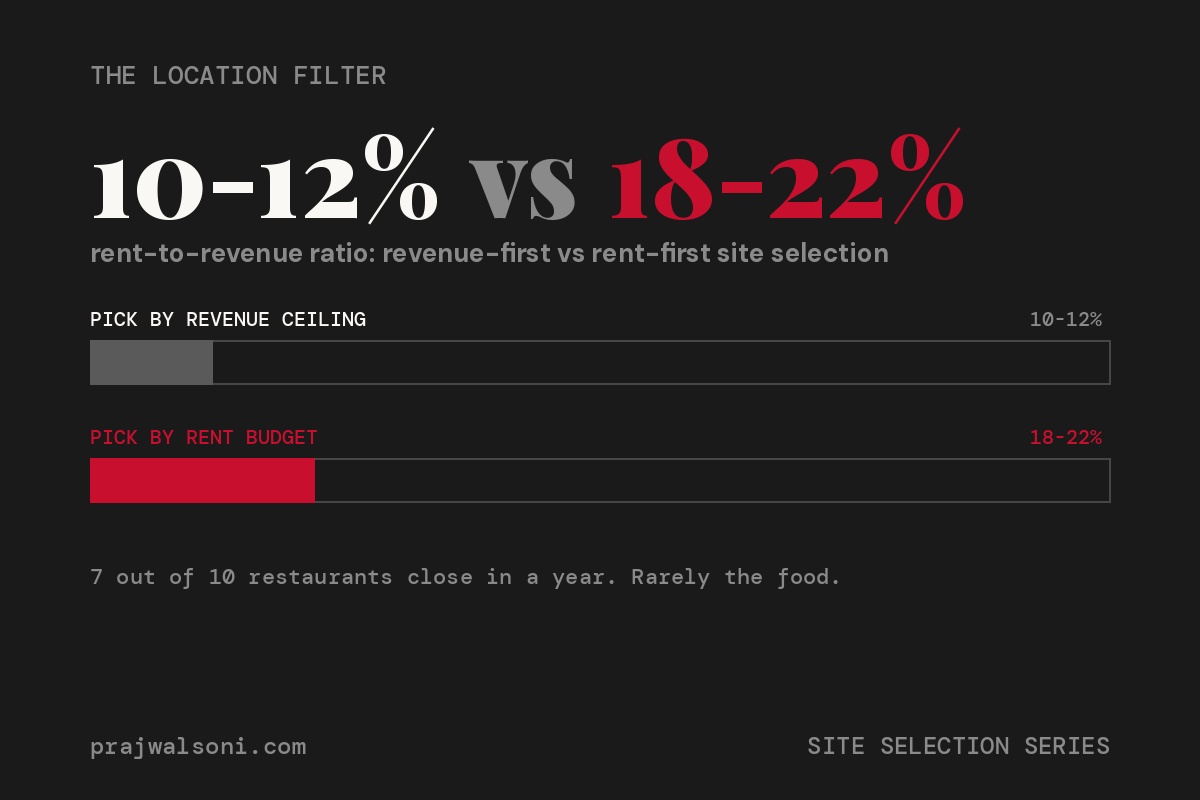
Roughly 7 out of 10 restaurants in India close within their first year, according to the National Restaurant Association of India. The single biggest reason is not bad food. It is a bad location picked for the wrong reason.
Here is what restaurant location selection looks like for most operators in Ahmedabad, Pune, or Nagpur right now. You set a rent budget of Rs 40,000 to Rs 60,000 per month. You call a broker. The broker shows you four spaces. You pick the one that “feels right” because it has road-facing frontage and the rent fits. You sign a 3-year lock-in. You spend Rs 20-35 lakh on fit-out. Then you open.
Within three months, you notice footfall is inconsistent. Lunch is dead on weekdays. Dinner picks up on weekends but not enough to cover your fixed costs. Swiggy and Zomato orders are not coming in because your area has too many competitors in the same price bracket. Your net margin sits below 5%, and you have not paid yourself a salary since you opened.
By month eight, you start discounting on aggregators just to keep volume. By month twelve, you consider shutting down. By month fourteen, the shutter goes down. Total capital lost: Rs 30-50 lakh. Time lost: over a year. Confidence destroyed.
The math was never going to work. Not because the food was wrong, but because the location could not generate the revenue you needed. You filtered by rent. You should have filtered by revenue potential. These are fundamentally different criteria, and confusing them is the most expensive mistake in this business.
The AFTER: What Happens When You Pick a Location by Revenue Ceiling, Not Rent Floor
A location picked by revenue potential gives you a realistic ceiling for monthly sales before you sign a lease. This means you know whether the site can support your concept, your price point, and your break-even target before you spend Rs 1 on fit-out.
When you do this right, here is what changes. You know the catchment population within a 2 km radius for dine-in and a 5 km radius for delivery. You know the average household income in that zone. You know how many competing restaurants already serve your cuisine type in that radius. You know the peak-hour foot traffic count on that specific street, not the entire locality.
With this data, you can calculate a realistic revenue ceiling. If your break-even requires Rs 6 lakh per month and the catchment can only support Rs 4.5 lakh, you walk away. No broker can pressure you. No “good feeling” about the space overrides the numbers.
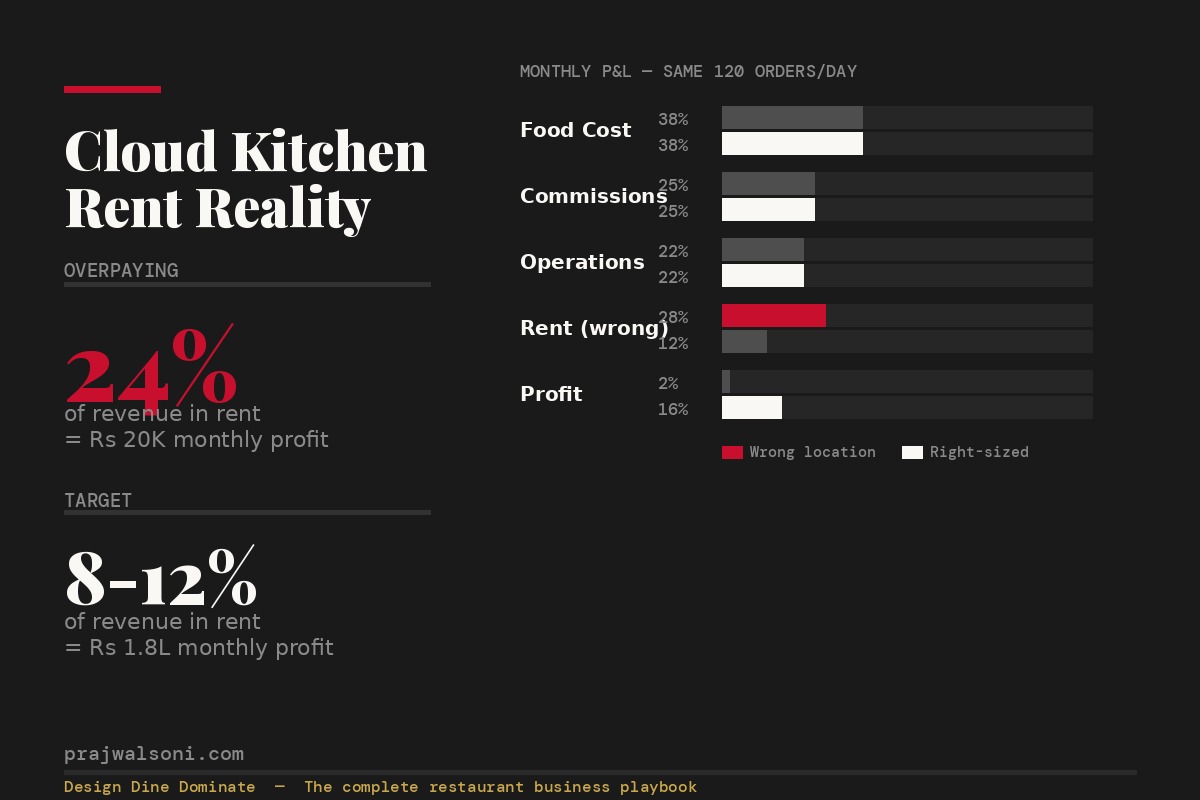
Operators who run this analysis before signing a lease typically reach break-even 40-60 days faster. Their cash flow stays positive because rent stays within 8-12% of actual revenue, not 18-22% like it does when you pick by budget alone. That gap of 6-10 percentage points on rent-to-revenue ratio is the difference between a restaurant that survives and one that bleeds out quietly.
How Do You Calculate Revenue Potential Before Signing a Lease?
Revenue potential for a restaurant location comes from three inputs: catchment population density, spending capacity of that population, and competitive saturation within your cuisine category. If any one of these three is weak, the location will underperform regardless of rent.
Start with the catchment. For a dine-in restaurant, your primary catchment is a 1.5 to 2 km radius. For a cloud kitchen, it extends to 5-7 km because delivery platforms define the service area. Count the residential societies, offices, and colleges in that zone. Use Google Maps and local ward data to estimate population. In a city like Surat or Bengaluru, ward-level census data is accessible through Census of India portals.
Next, assess spending capacity. A catchment full of Rs 15,000-per-month rental apartments tells you something different from a zone with Rs 50,000-per-month apartments. If your average ticket size is Rs 450, the first zone will not generate enough repeat visits to sustain you. The second zone might.
Finally, map competitive saturation. Open Swiggy and Zomato. Search your cuisine type from the proposed location. Count how many restaurants serve the same food within the delivery radius. If there are already 15 biryani brands within 3 km, your aggregator visibility will be buried unless you spend heavily on ads. That cost erodes your margin before you even serve your first customer.
The Rent-to-Revenue Ratio That Actually Protects You
Your rent should not exceed 10-12% of projected monthly revenue. For a cloud kitchen, this ratio should be even tighter at 6-8% because your margins depend on keeping fixed costs low. If a location costs Rs 50,000 per month in rent, your projected revenue from that site needs to be at least Rs 4.5-5 lakh monthly.
I have seen operators in Ahmedabad sign Rs 80,000 leases for dine-in spaces that struggle to cross Rs 4 lakh in monthly revenue. That is a 20% rent-to-revenue ratio. After food cost at 32%, labor at 22%, and aggregator commissions on delivery orders, there is nothing left. The location was not expensive in absolute terms. It was expensive relative to what it could generate.
What Should You Check on the Ground Before Committing to a Restaurant Location?
Physical site checks reveal problems that no broker listing or Google Maps view will show you. Do these checks on three different days, at three different times, before you even start negotiating rent.
1. Foot traffic count at peak hours. Stand outside the location between 12-2 PM and 7-9 PM on a weekday and a weekend. Count the number of people walking past in 30-minute intervals. If you are planning a dine-in concept and fewer than 80-100 people pass in a peak 30-minute window, the location likely cannot sustain walk-in traffic.
2. Visibility and access. Can someone driving at 30-40 km/h on the main road see your signage? Is parking available within 50 meters? In cities like Pune and Hyderabad, parking access alone can swing footfall by 25-30%. A first-floor location with no street-level signage will always struggle against a ground-floor option, even if the rent is half.
3. Delivery rider accessibility. If 40-60% of your revenue will come from delivery, check whether Swiggy and Zomato riders can find the location easily. A spot inside a gated complex or behind a construction zone will get fewer rider pickups, resulting in longer delivery times, lower ratings, and reduced platform visibility.
4. Neighbouring businesses. A gym, a coaching class, or an office complex next door generates predictable traffic at specific hours. A closed showroom or a furniture warehouse generates nothing. Your neighbours determine your walk-in potential more than your own marketing ever will.
Why Does Concept-Location Mismatch Kill More Restaurants Than Bad Food?
A concept-location mismatch happens when your restaurant format does not match what the catchment actually wants, regardless of how good the food is. This mismatch kills restaurants faster than quality issues because it creates a structural revenue ceiling that no amount of operational improvement can fix.
Consider a premium continental cafe with Rs 500 average ticket size placed in a student-heavy area of Nagpur where the typical eating-out budget is Rs 120-180. The food could be excellent. The ambiance could be Instagram-worthy. But the catchment cannot afford to eat there regularly. You will get curiosity visits in the first month and a slow decline after that.
The reverse is also true. A budget thali concept in a premium commercial district of Bengaluru might get lunch traffic, but the dinner crowd in that area is looking for a different experience. Your concept serves the wrong daypart for the location’s character.
Before you finalize a location, map your concept against three catchment questions. First, does the average spending capacity of the catchment match your ticket size? Second, does the catchment’s meal-occasion pattern match your operating hours? Third, does the catchment already have unmet demand for your cuisine type, or is it saturated? If even one answer is no, you need a different location or a different concept. Trying to force a mismatch by discounting your way to volume is how operators end up in the 70% that close.
The Bridge: One Framework to Filter Every Location Decision
The mechanism that separates operators who pick profitable locations from those who burn capital is a simple revenue-first site selection filter. It has one rule: calculate the revenue ceiling before you evaluate the rent.
Here is the process in three steps.
Step 1: Define your break-even revenue. Add up all your projected fixed costs for one month. Rent, salaries, utilities, loan EMIs, insurance, POS subscription from platforms like Petpooja or Posist. Then add your variable cost percentage. Food cost at 30-35%, packaging at 3-4%, aggregator commissions at 18-25% on delivery orders. Back-calculate the monthly revenue needed to cover everything and leave you with at least a 10% net margin. This number is your minimum revenue target.
Step 2: Estimate the location’s revenue ceiling. Use the catchment analysis from the previous section. Multiply estimated daily covers by your average ticket size for dine-in. Add estimated daily delivery orders from Swiggy and Zomato based on competitive density in that zone. Be conservative. Use 60% of your optimistic estimate as your working number. If this revenue ceiling is below your break-even target, do not take the location. Period.
Step 3: Verify that rent stays below 10-12% of the revenue ceiling. If the location passes Steps 1 and 2, now check the rent ratio. A Rs 70,000 rent on a Rs 7 lakh revenue ceiling is exactly 10%. That works. A Rs 70,000 rent on a Rs 5 lakh ceiling is 14%. That is a warning. Walk away or negotiate harder. Lease negotiation leverage comes from having alternatives, and doing this analysis for three sites simultaneously gives you that leverage. I have written about dine-in profitability benchmarks that make this calculation concrete.
What Most Operators Get Wrong About Tier 2 City Locations
Tier 2 cities like Surat, Nagpur, and Jaipur offer lower rents, but they also have smaller addressable markets per micro-location. The rent savings only matter if the catchment can still generate enough revenue. Lower rent with proportionally lower revenue changes nothing about your margin structure.
The growing middle class in tier 2 cities creates genuine opportunity. But that opportunity is concentrated in specific pockets. A 500-meter shift in location within the same city can mean a 40% difference in catchment spending power. In Surat, for example, the Vesu area and the Udhna area are both commercially active, but the average eating-out spend per household is dramatically different.
Do not use city-level data to justify a micro-location decision. The analysis must happen at the ward or neighbourhood level. Anything else is guessing with expensive consequences.
Your Takeaway Bullets
1. Restaurant location selection should start with revenue ceiling estimation, not rent budget. Calculate what a site can generate before evaluating what it costs.
2. The rent-to-revenue ratio must stay at 10-12% for dine-in and 6-8% for cloud kitchens. Anything above 15% will bleed you dry within a year.
3. Catchment analysis requires three inputs: population density, spending capacity, and competitive saturation. Weak performance on any one of these means the location will underperform.
4. Physical site checks at multiple times on multiple days reveal foot traffic, visibility, parking, and rider access problems that no broker listing will mention.
5. Concept-location mismatch is structural. You cannot fix it with discounts, marketing, or better food. Only a location change or concept change solves it.
What You Should Do This Week
If you are currently scouting locations, stop filtering by rent. Open a spreadsheet. List every location you are considering. For each one, fill in these columns: estimated catchment population in 2 km radius, average household income in that zone, number of competing restaurants in your cuisine type within 3 km, and foot traffic count at peak hours. Then calculate the revenue ceiling for each site using conservative assumptions.
If you already have a location, run this analysis retrospectively. Check your actual rent-to-revenue ratio for the last three months. If it is above 14%, you have a location problem. Your menu pricing and concept need to match what the catchment can bear, or you need to start planning your exit from that lease before the next renewal locks you in for another cycle.
Stop guessing. Start building. Get Design Dine Dominate, the complete restaurant business playbook from someone who has actually done it.

Leave a comment