Why Does Your Cloud Kitchen Pay Storefront Rent?
Cloud kitchen location selection should never follow dine-in logic. A delivery-only kitchen needs proximity to delivery clusters, not foot traffic. Yet most operators in Ahmedabad, Pune, and Bengaluru sign leases for ground-floor units on busy roads because that is the only location playbook they know. The result is Rs 2.5 to 3.5 lakh per month in rent for space that generates zero walk-in revenue.
I have seen this pattern across every city I have worked in. An operator launching a cloud kitchen brand walks the same high streets they would walk for a dine-in restaurant. They look at the foot traffic. They check parking. They note competing restaurants nearby. All of this is completely irrelevant for a kitchen that serves customers through Swiggy and Zomato and never sees a single customer walk through the door.
This mistake is not about laziness. It is about using the wrong mental model for a fundamentally different business format.
The Before: What Overpaying for Location Actually Costs You
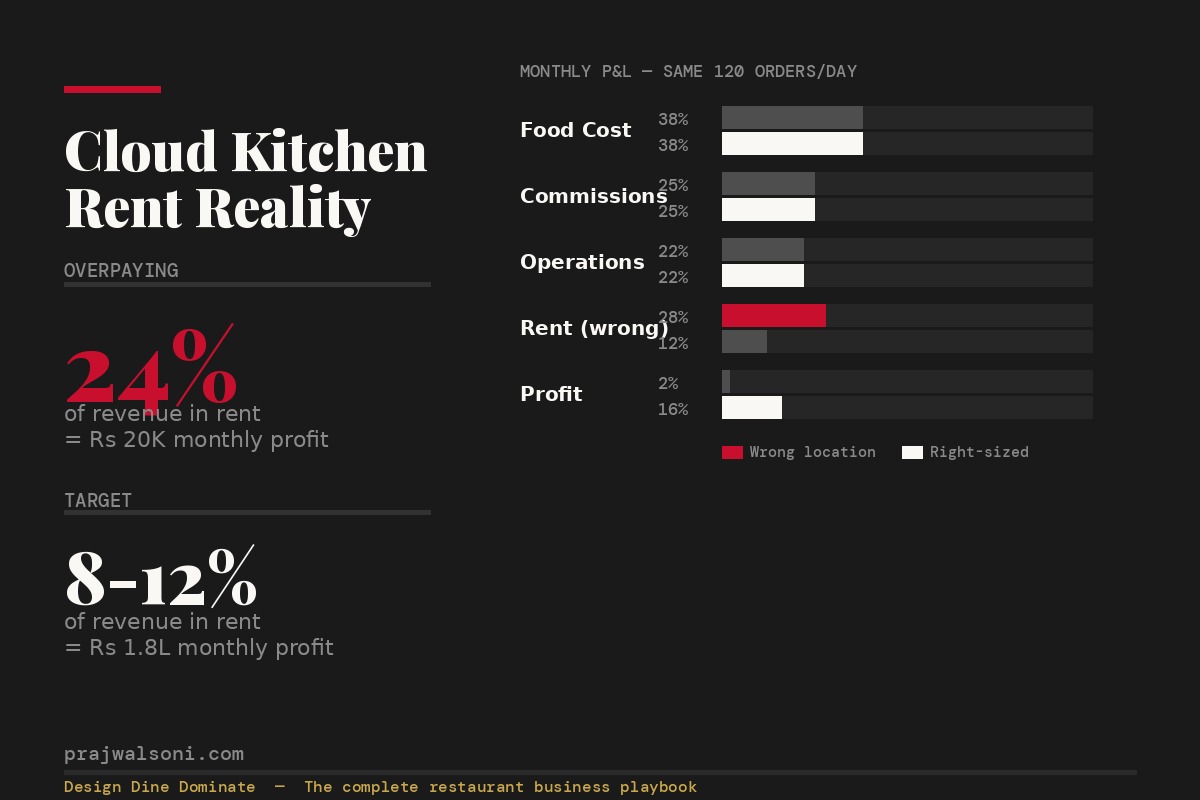
Picture this. You run two cloud kitchen brands from a 250 sq ft unit on a main road in Surat. Rent is Rs 2.8 lakh per month. You do 120 delivery orders a day across both brands. Average order value sits at Rs 320. Monthly revenue comes to roughly Rs 11.5 lakh.
Your food cost is 33%, which puts you at Rs 3.8 lakh. Aggregator commissions at roughly 22% eat another Rs 2.5 lakh. Packaging, gas, electricity, and staff salaries add Rs 2.2 lakh. Rent at Rs 2.8 lakh leaves you with roughly Rs 20,000 in profit before GST adjustments. That is not a business. That is a hobby that exhausts you.
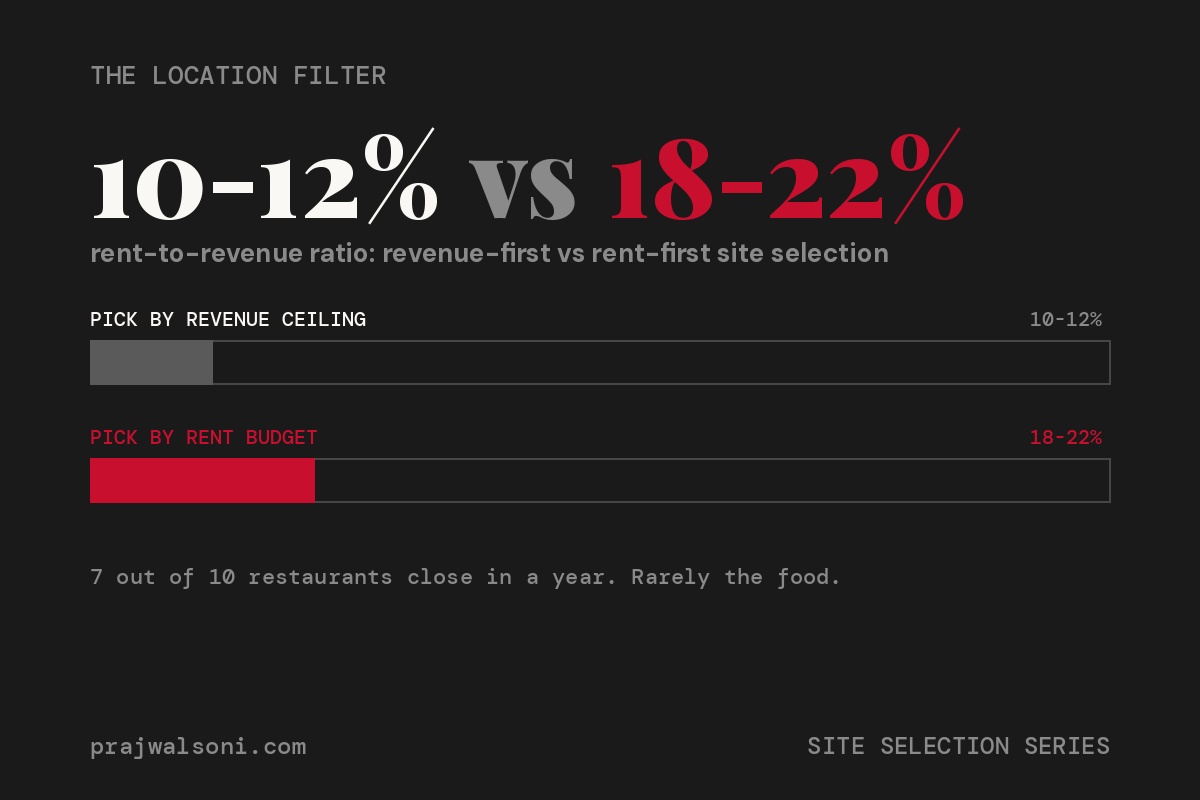
Rent at Rs 2.8 lakh represents 24% of your revenue. For a cloud kitchen aiming for profitability, rent should sit between 8% and 12% of revenue. You are paying double what the format can sustain. And the reason is simple. You picked a location built for walk-in customers you will never have.
What Does Rs 2.8 Lakh in Rent Actually Buy You?
For a cloud kitchen, expensive rent buys you exactly three things: a wider road for delivery riders, a landlord who knows the market rate for restaurants, and a false sense of legitimacy. None of these translate into more orders. Swiggy and Zomato do not rank you higher because you sit on a main road. Your listing photo does not show your shopfront. Customers search by cuisine, rating, and delivery time.
Delivery time depends on two factors. First, the distance between your kitchen and the customer cluster. Second, your kitchen’s order preparation speed. A basement unit 200 metres off the main road has the same delivery radius as the main road storefront. The rider adds 45 seconds to the pickup. That is it.
Meanwhile, that Rs 2.8 lakh monthly rent means you need 875 additional orders per month at your current margins just to cover the rent premium over a cheaper unit. That is 29 extra orders every single day. For context, most cloud kitchens in tier-2 Indian cities struggle to consistently cross 100 orders per day across all brands.
The After: What a Right-Sized Location Looks Like
A properly selected cloud kitchen location costs Rs 80,000 to Rs 1.4 lakh per month in most Indian cities outside Mumbai. It sits in a semi-commercial zone, a lane behind the main road, a basement in a commercial complex, or the ground floor of a residential-commercial mixed building. It has adequate power supply, water, proper ventilation, and legal commercial-use permission.
Same 120 orders a day. Same Rs 11.5 lakh in revenue. But now rent is Rs 1.2 lakh instead of Rs 2.8 lakh. That single change moves your monthly profit from Rs 20,000 to Rs 1.8 lakh. Same menu. Same team. Same aggregator commissions. The only difference is you stopped paying for a storefront nobody visits.
Your net margin jumps from under 2% to roughly 15%. That is the difference between a business that slowly bleeds you dry and one that actually pays you a salary.
Does a Cheaper Location Hurt Delivery Times?
No, because delivery time is a function of distance from the customer cluster, not distance from the main road. A kitchen sitting 150 metres inside a lane is still within the same 3-4 km delivery radius. Riders navigate by GPS. They do not need your kitchen to face a highway.
The real delivery time risk is picking a location that is geographically distant from your primary order cluster. If 60% of your orders come from a 2 km residential pocket in western Ahmedabad, your kitchen must be inside or adjacent to that pocket. Whether it faces a busy road or a quiet lane within that pocket is irrelevant to your delivery speed.
The Bridge: How to Select a Cloud Kitchen Location That Protects Your Margins
The mechanism is simple. Stop evaluating cloud kitchen locations like dine-in sites. Use a delivery-first location framework that prioritizes three factors in this exact order: proximity to order clusters, rent as a percentage of projected revenue, and operational infrastructure.
Step 1: Map Your Order Cluster Before You Sign Anything
Before you visit a single property, open Swiggy and Zomato as a customer from the area you are targeting. Search for the cuisine you plan to sell. Note which restaurants appear in the top 10 results. Check their delivery times. If existing kitchens in that area are delivering your cuisine in 25-35 minutes, the cluster is viable.
Then look at the residential density within a 3 km radius. Apartment complexes, IT parks, and college campuses are your primary demand generators. Count them. A cluster with 15,000+ residential units or 3-4 mid-size office complexes can sustain 80-120 daily orders for a well-rated kitchen. This is the research that actually matters, not whether the shopfront is visible from the road.
I have worked with operators who expanded into tier-2 cities and picked their locations using this cluster-first approach. The ones who mapped demand before signing a lease consistently outperformed the ones who walked high streets looking for available units.
Step 2: Set a Hard Rent Ceiling at 12% of Projected Revenue
Project your first 90 days of revenue conservatively. If you expect 80 orders per day at Rs 300 AOV, your monthly revenue projection is roughly Rs 7.2 lakh. Your rent ceiling is Rs 86,400. Not Rs 1.5 lakh because the landlord quoted it. Not Rs 2 lakh because the unit looks nice. Rs 86,400 because that is what the business math allows.
If you cannot find a suitable kitchen space within that budget in your target cluster, you have two options. Either find a smaller unit in the same area or re-examine whether your revenue projections are realistic for that location. You do not stretch the rent budget. Rent is a fixed cost. It does not care whether you had a slow Tuesday.
This discipline is what separates operators who scale sustainably from those who sign three leases in 18 months and exit the business.
Step 3: Check Operational Infrastructure, Not Aesthetics
A cloud kitchen needs five things from its physical space. Adequate electrical load for equipment, typically 15-20 kW for a two-brand operation. Reliable water supply. Proper exhaust and ventilation. Commercial-use permission or an NOC from the local authority. And a loading area where delivery riders can park without blocking traffic.
Everything else is negotiable. The unit does not need a glass front. It does not need customer seating. It does not need AC in the serving area because there is no serving area. When you remove dine-in requirements from your checklist, the pool of affordable properties doubles or triples in most Indian cities.
Basement units in commercial complexes in Pune and Hyderabad frequently meet all five criteria at 40-50% less rent than ground-floor units in the same building. The only trade-off is that your delivery riders walk down a flight of stairs. Most riders already do this in mall food courts and apartment basement kitchens. It is a non-issue.
What About Hybrid Models With Some Walk-In Traffic?
If you plan to run a hybrid model with a small takeaway counter alongside your cloud kitchen brands, then partial visibility matters. But even here, the economics are different from a full dine-in restaurant. A takeaway counter needs 50-80 sq ft of customer-facing space. The kitchen can still sit in the back, upstairs, or in a connected basement.
The mistake operators make with hybrid models is pricing the entire unit as if it needs dine-in level visibility. A takeaway window on a lane with moderate pedestrian traffic can generate 20-30 walk-in orders per day. That adds Rs 1.5-2 lakh in monthly revenue at typical AOVs. If the rent premium for that visibility is under Rs 40,000 per month, the math works. If the premium is Rs 1 lakh or more, it does not.
Always run the math on incremental revenue versus incremental rent. Visibility is not free. It has a price. That price must be justified by the walk-in orders it generates, not by the comfort it gives you as an operator.
How to Negotiate Rent for a Cloud Kitchen Unit
Cloud kitchen tenants have more negotiating power than most realize, because they are willing to take spaces that traditional restaurants reject. Landlords with basement units, upper-floor commercial spaces, and units in lanes behind the main road often struggle to find tenants. You are solving their vacancy problem.
Use these three negotiation points. First, offer a longer lease of 3-5 years in exchange for a lower monthly rate. Landlords value occupancy certainty. Second, ask for a 3-month rent-free fit-out period. Kitchen setup takes 4-8 weeks and you generate zero revenue during that time. Third, propose a revenue-share model for the first six months with a cap. For example, 8% of revenue or Rs 80,000, whichever is higher. This protects you during the ramp-up phase when orders are still building.
Many operators never negotiate because they assume the quoted rent is final. In my experience, landlords in semi-commercial zones in cities like Surat, Nagpur, and Ahmedabad are willing to drop 15-25% from the initial ask for a serious tenant with a clear business plan. But you have to ask. And you have to show them you have other options. Cash flow in the first six months depends heavily on what rent you lock in before day one.
The Real Cost of Getting This Wrong
Rent is the most dangerous cost in a cloud kitchen because it is the hardest to fix after you commit. Food cost can be adjusted in a week by reworking portions or switching suppliers. Staff costs flex with volume. But rent is locked for years. A bad location decision made in week one will drain your margins for the entire duration of your lease.
The NRAI India Food Services Report 2024 estimates that rent and real estate costs account for 8-15% of revenue across restaurant formats. Cloud kitchens should sit at the lower end of that range. If your rent exceeds 15% of revenue for more than three consecutive months, you are subsidizing your landlord’s income with your margins. That is not a business strategy. That is a slow exit.
Most cloud kitchens that shut down in year one do not fail because of bad food. They fail because fixed costs, led by rent, consume every rupee of margin before the operator can build volume. The food was fine. The location economics were not.
Your Move This Week
Pull your rent agreement right now. Divide your monthly rent by your average monthly revenue from the last 90 days. If that number is above 12%, you have a location problem. If it is above 18%, you have an urgent location problem.
Then open Swiggy and Zomato as a customer from your delivery area. Check how many kitchens within 1 km of your current location serve your cuisine. If there are three or more with better ratings and lower prices, your premium rent is not giving you any competitive advantage. It is just making your P&L harder to fix.
If you are planning a new cloud kitchen, walk the area you are targeting this week. Look for basement units, first-floor commercial spaces, and units on interior lanes. Get three quotes from three different property types within the same 2 km radius. Compare them against your 12% rent ceiling. The right unit is almost always the one you would have ignored if you were opening a dine-in restaurant.
Stop guessing. Start building. Get Design Dine Dominate, the complete restaurant business playbook from someone who has actually done it.

Leave a comment