A restaurant doing Rs 14 lakh a month in Ahmedabad decides to open a second outlet in Surat. Revenue is strong. The kitchen runs well. Customers post on Instagram without being asked. So the operator signs a lease, hires a second team, and launches within three months. By month four, the Surat outlet bleeds Rs 2.5 lakh a month in losses. The Ahmedabad outlet also starts slipping because the operator is now split between two cities. This is what scaling without a restaurant brand readiness audit looks like. I have seen this pattern repeat across at least a dozen operators I have worked with.
The problem is almost never the food. The problem is the operator confused strong revenue at one location with brand readiness to replicate. These are two completely different things. Revenue tells you customers like your product. Brand readiness tells you whether your product, systems, economics, and team can survive without you standing in the kitchen every night.
What Is the Brand Readiness Audit?
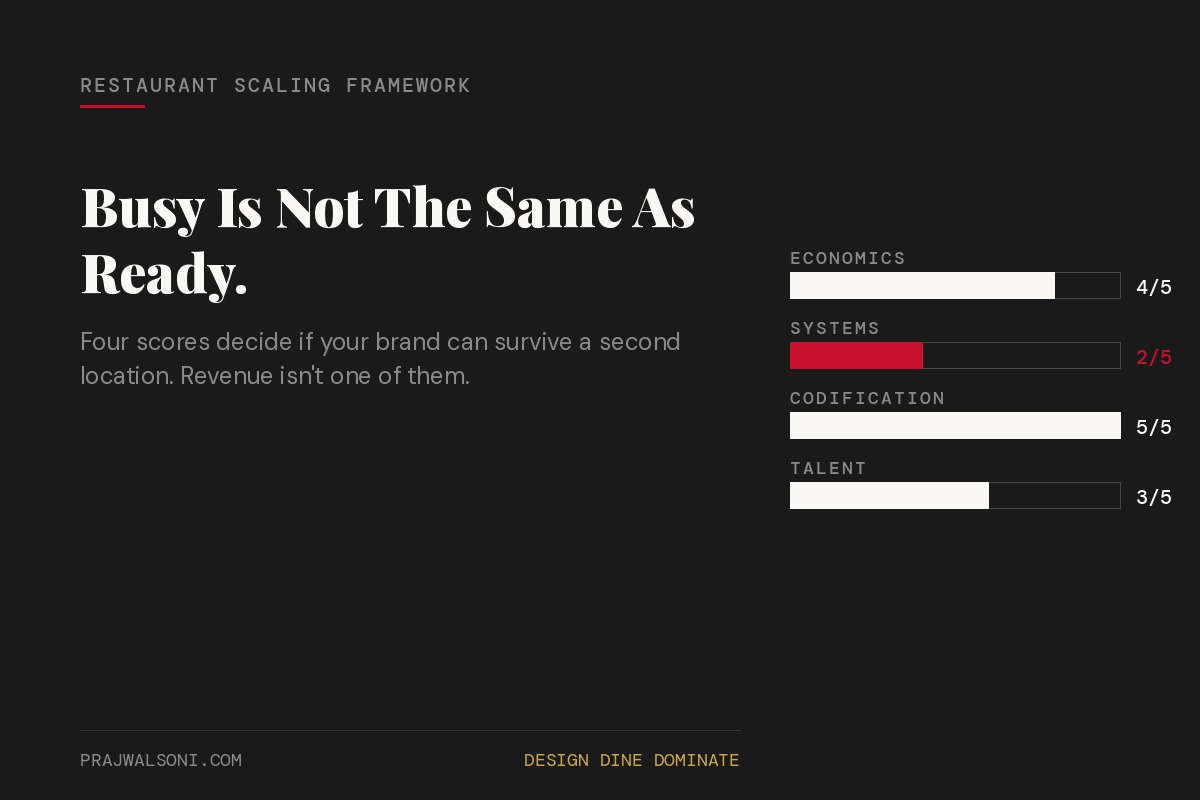
The Brand Readiness Audit is a four-component diagnostic framework that tells restaurant operators whether their brand can scale to a second location, a cloud kitchen, or a franchise model without collapsing. It evaluates four dimensions: Unit Economics Lock, System Independence Score, Brand Codification Depth, and Talent Replication Pipeline. If any one of these four scores below threshold, you are not ready to scale. You are ready to lose money faster.
This is not a growth framework. It is a pre-growth framework. You run this audit before you start looking at properties. Before you talk to franchise consultants. Before you even tell your team you are thinking about expansion. Because once you sign a lease, the clock starts and the rent does not wait for you to figure out what went wrong.
Component 1: What Is the Unit Economics Lock?
The Unit Economics Lock means your food cost, labour cost, rent ratio, and net margin at your current location have been stable for at least six consecutive months. Stable means the variance month-to-month stays within 2 percentage points. If your food cost swings from 30% to 37% depending on the season or your chef’s mood, your unit economics are not locked. They are approximate.
Most operators know their revenue number cold. Ask them their food cost for last month and they give you a range. Ask them their actual net margin after owner salary and they change the subject. That is a unit economics problem. You cannot replicate what you have not measured. For healthy Indian restaurants, food cost should sit between 28-35%, labour between 18-25%, and rent between 8-15% of revenue. Net margins in the 10-15% range signal a unit worth replicating.
The lock also means your pricing holds. If your Rs 249 biryani only works because you are getting a discount from a supplier who is also your cousin, that pricing does not transfer to a new city. Your unit economics must work with market-rate inputs, not relationship-rate inputs. Run the numbers with standard supplier pricing before you assume your margins will travel.
Component 2: How Do You Measure System Independence?
System Independence Score measures whether your restaurant can operate for 14 consecutive days without the owner making a single operational decision. Not strategic decisions. Operational ones. Can the kitchen open on time? Do purchase orders go out correctly? Does closing inventory get done? If the answer is “yes, but only because my manager calls me six times a day,” your score is zero.
This is where most operators fail the audit. They have built a business that runs on their presence. Their quality control is them tasting every dish. Their vendor management is them calling suppliers at 6am. Their cash handling is them counting the register every night. None of this scales. When you open location two, you physically cannot be in two places. If your systems depend on you, location two will operate at 60% of location one’s quality within weeks.
Practical test: take a 14-day vacation. Do not check in. When you come back, compare the revenue, food cost, customer complaints, and staff attendance to your best month. If the gap is more than 15%, your systems are not independent. Scaling without system independence is the single fastest way to destroy both your existing and new location simultaneously.
A POS like Petpooja or Posist should handle your order flow, inventory triggers, and sales reporting without manual intervention. If your team is still doing inventory on paper or WhatsApp, you have a system gap that will multiply with every new location.
Component 3: What Does Brand Codification Depth Mean?
Brand Codification Depth is the degree to which everything about your brand exists in documented, transferable form rather than in the owner’s head. This includes recipes with gram-level measurements, plating photos, supplier lists with alternates, opening and closing SOPs, menu pricing logic, brand guidelines for signage and packaging, and customer complaint response scripts.
Think of it this way. If you handed your entire operation to a competent stranger tomorrow, how many days would it take them to run it at 80% of your quality? If the answer is more than seven days, your codification is shallow. The stranger would need to call you constantly because the knowledge lives in your memory, not in a system.
I have operated 23 cloud kitchen brands. The ones that scaled successfully all had one thing in common. Every recipe was documented to the gram. Every process had a checklist. Every customer interaction had a script. The ones that struggled were the ones where the head chef “just knew” how much masala to add to the dal makhani. That knowledge walks out the door every time a chef quits. And in an industry where staff turnover runs as high as it does, that chef will quit.
The codification checklist is straightforward. Write down every single thing you do in a day. If it is not documented in a format a new hire can follow, it is not codified. SOPs are not a binder that sits on a shelf collecting grease. They are living documents your team uses daily. According to NRAI’s IFSR 2024 report, the organized restaurant segment is growing at 13.2% CAGR. Organized means documented, systematized, and replicable. You cannot join that segment with recipes in your head.
Component 4: Do You Have a Talent Replication Pipeline?
The Talent Replication Pipeline is your ability to produce trained, competent staff for a new location from within your existing team, rather than hiring entirely new people and hoping they figure it out. Scaling requires you to move at least one trusted person from location one to location two as an anchor. That means location one needs a bench of people ready to step up.
Most operators do not build a bench. They operate with the minimum viable team and everyone is already stretched thin. When expansion comes, they hire fresh for the new location and strip the old location of its best people. Both locations suffer. The new one because untrained staff cannot maintain quality. The old one because the experienced people who held it together are gone.
Building a pipeline means hiring one person above your current need at location one, six months before you plan to open location two. It means cross-training every team member on at least two roles. It means having a 30-day training program that a new hire follows before touching a customer order. This costs money upfront. Roughly Rs 40,000 to Rs 80,000 in extra salary per month depending on the role. But it is dramatically cheaper than the Rs 2-3 lakh per month you will lose when location two opens with an undertrained team.
If you are considering a cloud kitchen expansion, the talent question is slightly different but equally critical. You need a kitchen manager who can run the new kitchen independently from day one. Cloud kitchens have no front-of-house buffer. If the food is late or wrong, there is no smiling server to smooth things over. The platform rating drops and recovery on Swiggy and Zomato takes weeks.
How Do You Actually Run the Brand Readiness Audit?
Score each component on a scale of 1 to 5. Be honest. If you score yourself a 5 on system independence but your manager calls you nine times a day, you are lying to yourself and the framework cannot help liars.
Here is the scoring guide:
1. Unit Economics Lock: Score 5 if your food cost, labour cost, and net margin have been stable within 2 points for 6+ months. Score 3 if stable for 3 months. Score 1 if you do not track monthly margins at all.
2. System Independence: Score 5 if the restaurant ran smoothly for 14+ days without you. Score 3 if it ran with fewer than 3 calls per day to you. Score 1 if it cannot run a single day without you.
3. Brand Codification: Score 5 if every recipe, SOP, and brand guideline is documented and actively used. Score 3 if some are documented but not consistently followed. Score 1 if most knowledge lives in people’s heads.
4. Talent Pipeline: Score 5 if you have at least one person ready to anchor a new location and backfills ready at location one. Score 3 if you have identified the person but they are not fully trained. Score 1 if you would need to hire entirely new for location two.
Total score of 16 or above: you are ready to scale. Score of 12-15: fix the weakest component first, then reassess in 90 days. Score below 12: you are not ready. Focus on building the business you have before building a second one.
The audit takes about two hours to complete honestly. Cash flow management becomes exponentially harder with two locations, so this is two hours that can save you lakhs.
What Decision Does This Audit Enable?
The Brand Readiness Audit gives you a binary answer: scale now, or fix first. It removes the emotional momentum that makes operators sign leases too early. Revenue feels good. A landlord offering a deal on a prime Pune location feels urgent. Your investor pushing for growth feels pressuring. This framework replaces all of that pressure with a structured diagnostic.
Most operators who fail in their first year at a second location did not fail because the market was wrong. They failed because their brand was not ready to exist in two places at once. The food was good enough. The location was fine. But the systems, documentation, economics, and team could not replicate. And by the time they realized it, they were already paying rent on two properties while fixing problems that should have been solved before expansion.
Run this audit before your next conversation about growth. If you are already in expansion mode and reading this with a sinking feeling, run it anyway. A score below 12 at your existing location means you should pause expansion and fix the foundation. Pausing feels like losing momentum. Losing Rs 2-3 lakh a month at a broken second outlet feels much worse.
Your Diagnostic Question Right Now
Answer this honestly: if you disappeared for two weeks starting tomorrow, would your restaurant’s food cost, revenue, and customer ratings stay within 10% of current performance? If yes, you might be ready to start the full audit. If no, you already know which component needs work first.
Pull your last six months of P&L statements this week. Calculate food cost, labour cost, and net margin for each month. Plot the variance. If the line is flat, your unit economics are locked. If it looks like a heart monitor, you have work to do before you even think about a second location.
Stop guessing. Start building. Get Design Dine Dominate, the complete restaurant business playbook from someone who has actually done it.

Leave a comment