The Biggest Leadership Gap in Indian Restaurants Is Not Staff. It Is Managers.
Restaurant manager development is the single most neglected investment in Indian food service. Most operators promote their fastest waiter or most reliable cook, hand them keys, and expect leadership to happen automatically. It does not. What happens instead is you get a person working 14-hour shifts doing everyone else’s job because nobody taught them how to delegate, track, or hold people accountable.
I have seen this across every format. Cloud kitchens in Ahmedabad. QSRs in Surat. Fine dining in Pune. The pattern is identical. The owner burns out because the manager cannot actually manage. The staff below the manager quits because the manager micromanages instead of leading. And the profit margins that should be healthy bleed out through missed inventory counts, uncontrolled overtime, and inconsistent food quality.
This article is about building a real restaurant manager development system. Not a motivational speech. A system. Because the difference between a 5% net margin and a 15% net margin is usually not the food. It is the person running the floor.
Why Promoting Your Best Worker Fails Without a Development System
Your best performer on the floor is not automatically your best manager. Great execution and great management require completely different skills. A stellar line cook knows recipes and timing. A manager needs to know scheduling, food cost control, conflict resolution, and how to run a pre-shift briefing that actually changes behavior.
When you skip the development step, three things break immediately.
First, your new manager does everything themselves. They run food, they handle complaints, they jump on the tandoor when someone calls in sick. They are working a longer shift, not managing one. Output stays the same. Their exhaustion compounds.
Second, the rest of the team does not respect the title because they saw this person as a peer yesterday. Without a structured transition, the authority gap creates resentment on both sides. This is a major reason behind the turnover crisis Indian restaurants face. People do not quit restaurants. They quit bad managers.
Third, you lose your best individual contributor. That person who was making 200 rotis an hour or turning 15 tables a night is now stuck in a role they were never trained for. You lost a great cook and gained a mediocre manager. That is a net negative.
What Restaurant Manager Development Actually Looks Like in Practice
A proper restaurant manager development program covers four areas: financial literacy, people management, operations systems, and decision-making under pressure. You do not need an MBA framework. You need a 90-day structured program that turns a good worker into someone who can run your restaurant when you are not there.
Week 1 to 4: Financial Literacy for Managers
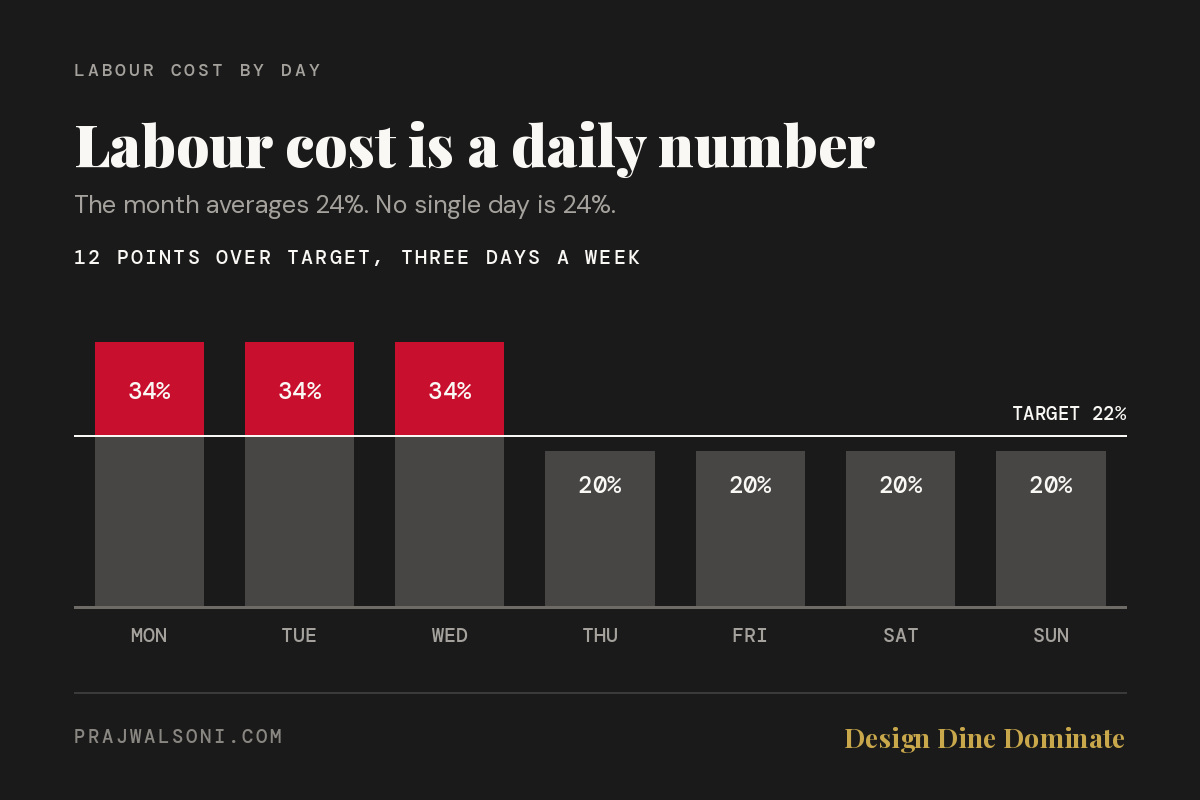
Most restaurant managers in India cannot tell you their food cost percentage. They cannot read a P&L statement. They do not know that labor running at 30% of revenue instead of 22% is the reason there is no money for equipment repairs. This is not their fault. Nobody taught them.
Start here. Teach your manager to read the daily sales report from your POS. If you use Petpooja or Posist, sit with them and walk through every line. Show them what food cost means in rupees, not just percentages. If your dal makhani costs Rs 45 to make and sells for Rs 180, that is a 25% food cost. Good. If your paneer tikka costs Rs 110 to make and sells for Rs 250, that is 44%. Bad. Make them understand how menu pricing connects to what they do every day.
By week four, your manager should be able to run a weekly food cost calculation without help. They should know the labor cost target for every shift. And they should understand that sending three people home early on a slow Tuesday saves Rs 1,200 in wages, which over a month is Rs 15,000 that goes straight to your bottom line.
Week 5 to 8: People Management and Shift Leadership
This is where most Indian restaurant operators skip entirely. They assume people management is common sense. It is not. Your manager needs to learn how to conduct a 10-minute pre-shift briefing, how to give corrective feedback without creating drama, and how to build a shift schedule that respects both the business needs and the staff’s lives.
Pre-shift briefings are the highest-return 10 minutes in any restaurant. Cover three things only: what sold well yesterday and push it today, any 86’d items or specials, and one specific service standard to focus on. That is it. No speeches. No reading from a manual. Ten minutes. Every shift.
Teach your manager to give feedback the same day, not two weeks later during some formal review nobody takes seriously. “Raju, table 7 waited 12 minutes for water. That cannot happen. Here is what I need you to do differently.” Direct. Specific. Done. No yelling. No public humiliation. That approach is why staff walks out and you spend Rs 8,000 to Rs 15,000 recruiting and training a replacement.
Week 9 to 12: Operations Systems and Decision Frameworks
A manager who runs systems does not need to be on the floor for every decision. That is the goal. Build SOPs for the 20 tasks that make up 80% of restaurant operations. Opening procedures, closing procedures, inventory counts, vendor receiving, complaint handling, and cash handling protocols.
Write each SOP as a checklist, not a paragraph. Laminate it. Put it where the task happens. Your closing checklist goes near the POS terminal. Your receiving checklist goes at the back door. Your manager’s job is not to do every item on every checklist. Their job is to verify that the assigned person completed it correctly.
Decision frameworks matter because you cannot be available for every call. Give your manager clear boundaries. They can comp a dessert for a complaint without calling you. They can send someone home if the shift is overstaffed. They cannot change a vendor, approve overtime above 10 hours per week, or alter the menu without your sign-off. Write these boundaries down. Ambiguity kills speed and creates resentment.
The Shadow Shift: How to Test Before You Promote
Never promote someone to manager without running a shadow shift first. A shadow shift means your candidate runs the floor as if they are the manager for a full week while you observe without intervening. You watch how they handle a late vendor delivery. You watch how they react when two staff call in sick. You watch whether they check food quality at the pass or just push plates out.
I use a simple scoring sheet. Five categories: problem-solving, communication with staff, communication with guests, time management, and composure under pressure. Score each 1 to 5 for every shift. If the average is below 3, they are not ready. That does not mean they are bad. It means they need more development time.
This one step saves you from the most expensive mistake in restaurant team building. Promoting the wrong person costs you twice. You lose their original role performance, and you damage team morale when you have to demote them or they quit from frustration.
Pay Structure That Keeps Managers From Jumping to the Next Restaurant
A restaurant manager in most Tier 1 Indian cities earns Rs 25,000 to Rs 45,000 per month depending on format and experience. In Tier 2 cities like Surat, Nagpur, or Indore, that range drops to Rs 18,000 to Rs 30,000. These numbers are not competitive enough to retain someone you have spent 90 days developing.
Fix this with a performance-linked component. Base salary stays market-rate. But add a monthly bonus tied to two metrics the manager can actually control: food cost percentage and staff attendance rate. If food cost stays below your target for the month, they earn an extra Rs 3,000 to Rs 5,000. If staff attendance stays above 90%, another Rs 2,000. This costs you Rs 5,000 to Rs 7,000 per month in bonus payouts, but the margin improvement from controlled food cost alone will cover that three times over.
Operators who think they cannot afford to pay managers more need to look at their margin structure differently. A good manager earning Rs 40,000 who keeps your food cost at 30% instead of 36% is saving you Rs 50,000 to Rs 80,000 a month on a restaurant doing Rs 10 lakh in revenue. The math is not even close.
Scaling Cannot Happen Without Developed Managers
Every operator who wants to open a second location hits the same wall. They cannot be in two places at once. The first restaurant suffers when they focus on the new one. The new one underperforms because they are still babysitting the first. This is not a scaling problem. It is a manager development problem.
I have written about why operators fail at scaling, and the number one reason is not money or location. It is not having a manager who can run the original unit independently. If you cannot leave your restaurant for two weeks without revenue dropping, you do not have a business. You have a job.
Cloud kitchen operators feel this even more acutely. When you run multiple brands from one kitchen, the complexity multiplies. Each brand has different prep lists, different packaging, different quality standards. Without a trained manager who understands all of it, cloud kitchen profitability collapses under operational chaos.
The Weekly Manager Check-In That Actually Works
A 30-minute weekly check-in between the owner and manager is the most underused tool in Indian restaurants. Not a casual “how is everything going” conversation. A structured review of five numbers: weekly revenue vs target, food cost percentage, labor cost percentage, customer complaints count, and staff attendance.
Pull these numbers from your POS and your attendance register. Petpooja and Posist both generate weekly reports you can review together. Spend 20 minutes on the numbers and 10 minutes on one specific improvement area for the coming week. Not five improvements. One. A manager who improves one thing per week improves 52 things in a year. That compounds.
This rhythm also protects you from surprises. If food cost crept up by 2 percentage points, you catch it in week one, not month three. If a staff member has been late six times this month, you address it before it becomes a culture problem. Small corrections weekly prevent large disasters quarterly.
Start This Week, Not Next Quarter
Pick the person on your team who has the most potential to lead. Sit them down this week. Tell them you want to invest in developing them as a manager. Show them what the 90-day path looks like. Start with the financial literacy piece because it changes how they see every decision they make on the floor.
If you already have a manager who is just working long shifts without managing, the fix is the same. Reset expectations. Start the weekly check-ins. Build the SOPs together. Give them decision-making boundaries in writing. You will see a measurable difference within four to six weeks.
The restaurants that survive and grow in India over the next five years will not be the ones with the best biryani or the flashiest interiors. They will be the ones with managers who can run a P&L, lead a team, and protect margins when the owner is not watching. That is not a talent problem. It is a development problem. And development is a system you can build starting today.
Stop guessing. Start building. Get Design Dine Dominate, the complete restaurant business playbook from someone who has actually done it.

Leave a comment