Why Your Best Worker Became Your Worst Manager
The person you promoted to manager because they were fast, reliable, and never missed a shift is probably the reason your restaurant still cannot run without you. Restaurant manager development is not about rewarding loyalty. It is about building a specific set of capabilities that most operators never deliberately teach. In restaurants across Ahmedabad, Surat, and Pune, I have seen this pattern repeat dozens of times. The owner picks the hardest worker, gives them a title and Rs 5,000 more per month, and then wonders why nothing changes.
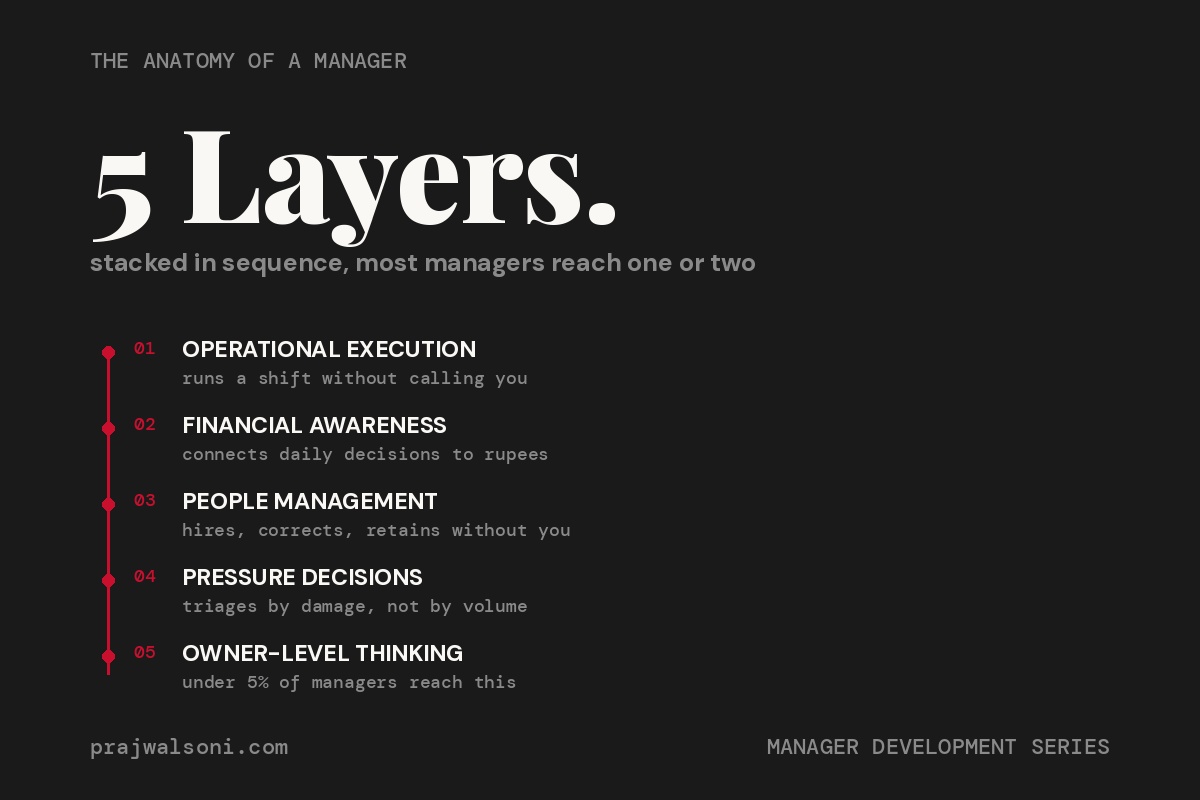
The problem is not the person. The problem is that most operators think management is one skill. It is not. It is five distinct layers stacked on top of each other. Miss even one, and the whole structure collapses. Most restaurants operate with managers who have one or two of these layers at best. That gap is why you are still the one solving every problem at 11pm.
What Does Real Restaurant Manager Development Look Like?
Real restaurant manager development means building five layers of capability in sequence: operational execution, financial awareness, people management, decision-making under pressure, and owner-level thinking. Each layer requires a different kind of training. Skipping any single one creates a manager who looks competent but crumbles the moment you step away for a week.
Most operators only train for the first layer. They teach the tasks. Open this, close that, count inventory, check the walk-in. But tasks without context produce robots, not managers. A robot follows a checklist. A manager knows why each item matters and what to do when reality deviates from the list. That distinction is worth lakhs in saved waste, retained staff, and recovered revenue every single month.
Here is how the five layers actually work, and what most operators get wrong about each one.
Layer 1: Can They Execute Operations Without Being Told?
Operational execution means the manager can open, run, and close a shift without calling you once. This is the baseline. If your manager still calls you to ask whether to accept a large party booking or how to handle a Swiggy order cancellation, they have not cleared this layer.
But here is what makes this layer non-obvious. Most operators confuse presence with execution. Your manager might be physically present for every shift. They might even work harder than anyone else. Yet if they cannot handle a broken exhaust fan, a missing delivery rider, and a customer complaint within the same 30 minutes without freezing, they are not executing. They are surviving.
Build this layer by creating an operations playbook that documents every decision your manager currently escalates to you. Track those calls for two weeks. Every question they ask you becomes a documented SOP. In restaurants I have consulted for, this exercise alone typically eliminates 60-70% of owner calls within a month.
Layer 2: Do They Understand the Money Behind Every Decision?
Financial awareness means the manager connects daily actions to rupee outcomes. A manager who does not know that wasting 200 grams of paneer per shift costs the restaurant roughly Rs 18,000 a month is making decisions blind. This layer is where most restaurant managers in India completely fall apart.
You do not need your manager to be a CA. You need them to understand three numbers cold. First, food cost percentage for every major dish. Second, the daily revenue target needed to cover fixed costs. Third, the actual cost of staff overtime versus the revenue that overtime generates. When a manager understands that running an extra staff member during a slow Tuesday lunch costs Rs 800 but generates only Rs 1,200 in additional covers, they start making different scheduling decisions on their own.
I have seen a cloud kitchen manager in Surat cut food waste by Rs 45,000 per month simply because we started sharing the weekly food cost report with them. Before that, they had no idea that overportioning dal makhani by two ladles per order was eating 3% of margin. The information changed their behaviour overnight. No lecture required. Financial awareness is not about training someone in accounting. It is about making the consequences of daily decisions visible in rupees. If you want to understand how these margins interact at scale, the breakdown of 5% versus 15% net margins will show you exactly where that money goes.
Layer 3: Can They Manage People Who Do Not Report to You?
People management means the manager can hire, train, correct, and retain staff without you intervening. This is the layer that separates a shift supervisor from an actual manager. And it is the layer where most Indian restaurant operators actively sabotage their own managers.
Here is how the sabotage works. A cook comes to you with a complaint about the manager. Instead of backing the manager and dealing with it later in private, you overrule the manager in front of the team. You just destroyed their authority. Now every staff member knows that the shortcut to getting what they want is going directly to the owner. Your manager stops trying to manage because they know their decisions will be reversed. According to the staff turnover crisis data, this pattern is one of the top reasons mid-level restaurant staff quit. They leave managers, not restaurants.
Building this layer requires two things. First, give the manager clear boundaries on what decisions they own. Can they give a verbal warning? Can they approve a day off? Can they reject a leave request during a festival weekend? Define it explicitly. Second, when staff bypass the manager to reach you, send them back. Every single time. The moment you break this rule, you reset the manager’s authority to zero.
People management also means the manager can onboard a new hire without your involvement. If every new kitchen helper still needs you to explain how things work, you have not built this layer. Create a structured onboarding process that the manager owns completely. Their ability to bring someone up to speed in the first 7 days is one of the most valuable skills a restaurant manager can have.
Layer 4: How Do They Respond When Three Things Go Wrong at Once?
Decision-making under pressure means the manager can triage competing problems and act without paralysis. Friday night, 8:30pm. A Zomato order is running 15 minutes late. A walk-in table has been waiting 20 minutes for starters. The tandoor chef just burned his hand. What does your manager do first?
Most managers freeze or pick whichever problem is loudest. The customer shouting gets attention first. But that is not triage. Triage means assessing which problem causes the most damage if left unaddressed for five more minutes. The burned chef means you lose tandoor capacity for the rest of the night. That affects every pending order. That problem comes first.
You cannot teach this from a manual. You teach it by running scenarios. Every week, give your manager a hypothetical three-problem situation and ask them to rank and respond. After eight weeks of this, their instincts sharpen dramatically. They stop reacting to noise and start prioritising by impact. This is the layer that determines whether your restaurant survives a Diwali rush or collapses into refund requests and one-star Zomato reviews.
One practical exercise: review your Swiggy and Zomato complaint logs from the last month with your manager. For every complaint, ask them what they would have done differently if they had been the sole decision-maker. Do not give answers. Let them reason through it. This builds the muscle faster than any classroom training.
Layer 5: Can They Think Like an Owner Without Being One?
Owner-level thinking means the manager proactively identifies problems and opportunities before you notice them. This is the rarest layer. Fewer than 5% of restaurant managers in India ever reach it. But this is the layer that actually frees you from the business.
A manager with owner-level thinking does not wait for you to ask why Tuesday lunch sales dropped 20% last month. They notice it themselves, check whether it correlates with a nearby office shutdown, and propose testing a lunch combo offer before you even see the report. They are not managing the restaurant. They are growing it.
This layer requires something most operators are unwilling to give: access to business data. If your manager never sees the P&L, never knows the rent, never understands the actual profitability metrics of the business, they cannot think like an owner. They will always think like an employee because you are treating them like one.
Share your monthly numbers. Show them what aggregator commissions actually cost. Let them see the gap between what Swiggy charges and what the restaurant keeps. When a manager understands that a Rs 350 biryani order on Zomato nets the restaurant roughly Rs 240 after commissions and GST, they start thinking about cash flow differently. They push for direct orders. They upsell desserts on dine-in because they know the margin is better. These are owner-level behaviours, and they only emerge when you stop hiding the numbers.
How Do These Five Layers Interact?
These layers are sequential, not parallel. You cannot build Layer 3 (people management) before Layer 1 (operational execution) is solid. A manager who cannot run a shift smoothly has zero credibility when trying to correct a cook’s behaviour. The team will not listen because the manager has not earned operational respect yet.
Similarly, Layer 4 (pressure decisions) requires Layer 2 (financial awareness). Without understanding the rupee impact of each option, the manager cannot triage effectively. They will always default to the loudest problem instead of the costliest one.
Build each layer for roughly 4-6 weeks before advancing to the next. A manager who starts from scratch will take 5-7 months to reach Layer 4. Layer 5 may take a year or more, and not everyone gets there. That is fine. A manager solid on Layers 1 through 4 is already more capable than 90% of the restaurant managers operating in Bengaluru, Hyderabad, or Nagpur right now.
The NRAI India Food Services Report 2024 pegs the industry at Rs 5.69 lakh crore, with the organized segment growing at 13.2% CAGR. That growth will be captured by operators who build systems and people. Not by operators who continue doing everything themselves. For further context, the NRAI’s annual report details how workforce challenges remain the top concern for restaurant chains planning expansion.
What Knowing All Five Layers Enables
When your manager operates across all five layers, three things change. First, you stop being the bottleneck. Your restaurant runs on Tuesday whether you are there or in another city. Second, your dine-in profitability improves because a financially aware manager catches waste and inefficiency that you miss when you are stretched across everything. Third, you can actually think about opening a second location because the first one has a real operator running it.
According to Economic Times reporting on the Indian food services sector, multi-unit operators consistently cite manager capability as the number one factor in successful expansion. Not capital. Not location. People.
Here is what to do this week. Write down the last 10 decisions your manager escalated to you. Categorise each one by layer. If most of them fall in Layer 1, you have a documentation problem. Build SOPs. If they cluster in Layer 2 or 3, your manager needs financial data access and explicit authority boundaries. Wherever the cluster is, that is your training priority for the next 30 days.
Stop guessing. Start building. Get Design Dine Dominate, the complete restaurant business playbook from someone who has actually done it.

Leave a comment