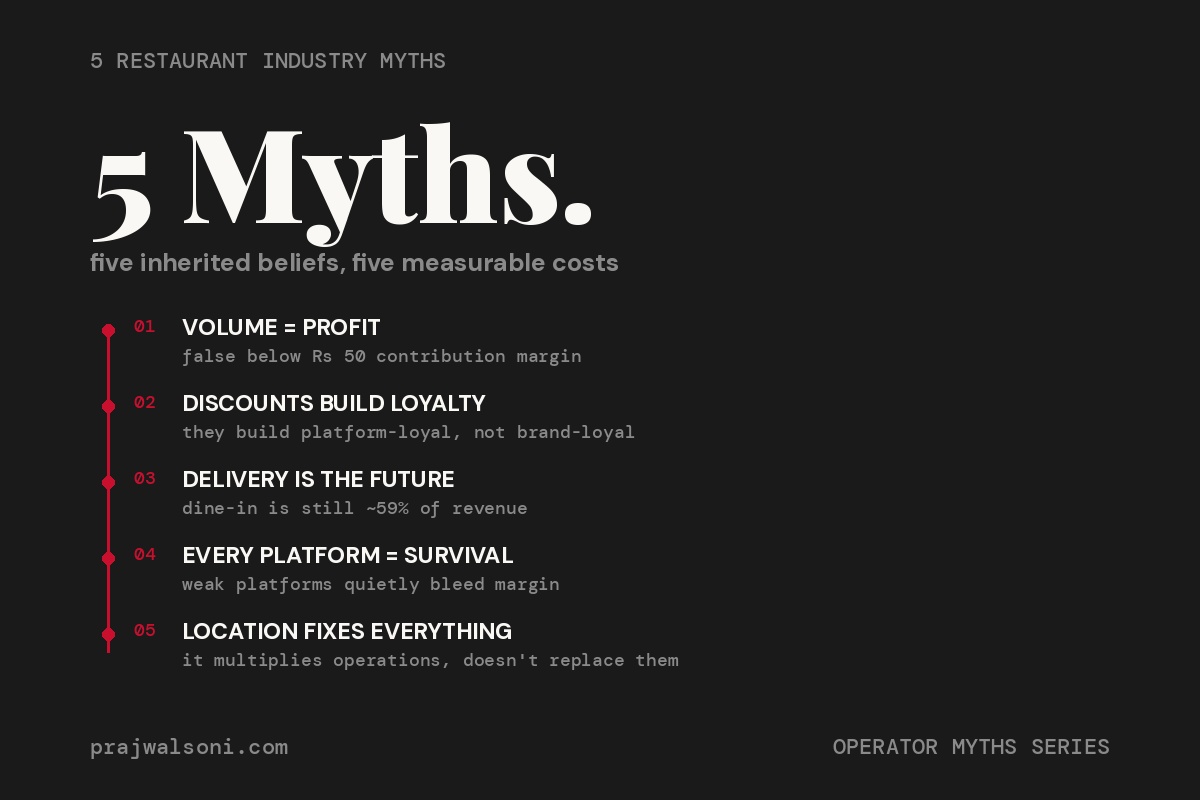
Picture this: you are running a restaurant in Ahmedabad when a friend who runs a similar setup in Surat tells you that volume will fix everything. Sell more plates, and the profits will follow. You have heard this before. You believed it the first time. So you ran discounts, pushed combos, stretched your kitchen, and watched your bank balance stay flat. The restaurant industry myths that operators pass around like trusted recipes are not harmless. They cost real money. Every month. And in a market where net margins sit between 5% and 15%, believing the wrong thing is expensive.
Why Do Restaurant Industry Myths Persist?
Restaurant industry myths survive because they contain a grain of truth wrapped in bad logic. Volume does matter. Discounts can drive footfall. Aggregators do bring orders. But operators take these partial truths and build entire business strategies on them. That is where the damage starts.
Most of these myths come from a time when the market worked differently. Before Swiggy and Zomato reshaped consumer behaviour, before cloud kitchens redefined cost structures, before the NRAI’s India Food Services Report 2024 pegged the industry at Rs 5.69 lakh crore. The market has changed. The beliefs have not.
Each myth below is something I have heard from real operators. Not once. Dozens of times. Across Pune, Nagpur, Bengaluru, and Hyderabad. And each one has a measurable cost that shows up in your P&L if you know where to look.
Myth 1: More Volume Always Means More Profit
This is the most dangerous restaurant industry myth because it feels mathematically obvious. Sell 200 plates instead of 100, and you double your profit. Except you do not. Because variable costs scale with volume, and if your per-plate contribution margin is thin, more volume just means more work for the same disappointing result.
If your biryani sells at Rs 300 and your food cost per plate is Rs 120, your packaging is Rs 15, and Swiggy takes roughly 25% (Rs 75), you are left with Rs 90 per plate before rent, labour, and electricity. Now sell 500 plates instead of 300. You need more staff. Your gas bill goes up. Your kitchen slows down. Complaints increase. Ratings drop.
Volume only helps when your unit economics are already healthy. If each additional plate earns you Rs 90 before fixed costs, then yes, volume is your friend. But if each plate earns Rs 20, you are scaling a loss. I have seen restaurants in Surat do 600 delivery orders a day and still lose Rs 1.5 lakh a month. The menu pricing was wrong from the start. Volume just amplified the mistake.
The counter-truth: Fix your per-plate margins first. Then chase volume. The order matters.
Myth 2: Deep Discounts on Aggregators Build a Customer Base
Discounting on Swiggy and Zomato does not build loyal customers. It builds discount-seekers who will switch to the next restaurant running a better offer tomorrow. This is not speculation. Ask any operator who ran a 60% off campaign and then watched their order count collapse the week the promotion ended.
Aggregator discounts attract what I call “platform-loyal” customers, not “brand-loyal” ones. These customers search by price filter, not by restaurant name. They have no idea what your brand stands for. They will not remember your restaurant’s name in two weeks. Meanwhile, you have sold 400 dal makhani combos at a loss and called it marketing.
The aggregator commission structure makes discounting even more painful. You are paying 15-30% commission on the discounted price while absorbing the discount yourself. So on a Rs 250 meal discounted to Rs 150, you might pay Rs 37 in commission plus absorb Rs 100 in discount. Your actual revenue per order drops below Rs 115. Your food cost alone might be Rs 90.
The counter-truth: Build repeat behaviour through food quality and loyalty programs that actually work. Discounts are a tool for specific, time-bound goals. They are not a customer acquisition strategy.
Myth 3: Dine-In Is Dying and Delivery Is the Only Future
Dine-in is not dying. According to the NRAI India Food Services Report 2024, dine-in still accounts for roughly 59% of total foodservice revenue in India. The delivery boom is real, but it has not replaced the dining table. It has added a channel alongside it.
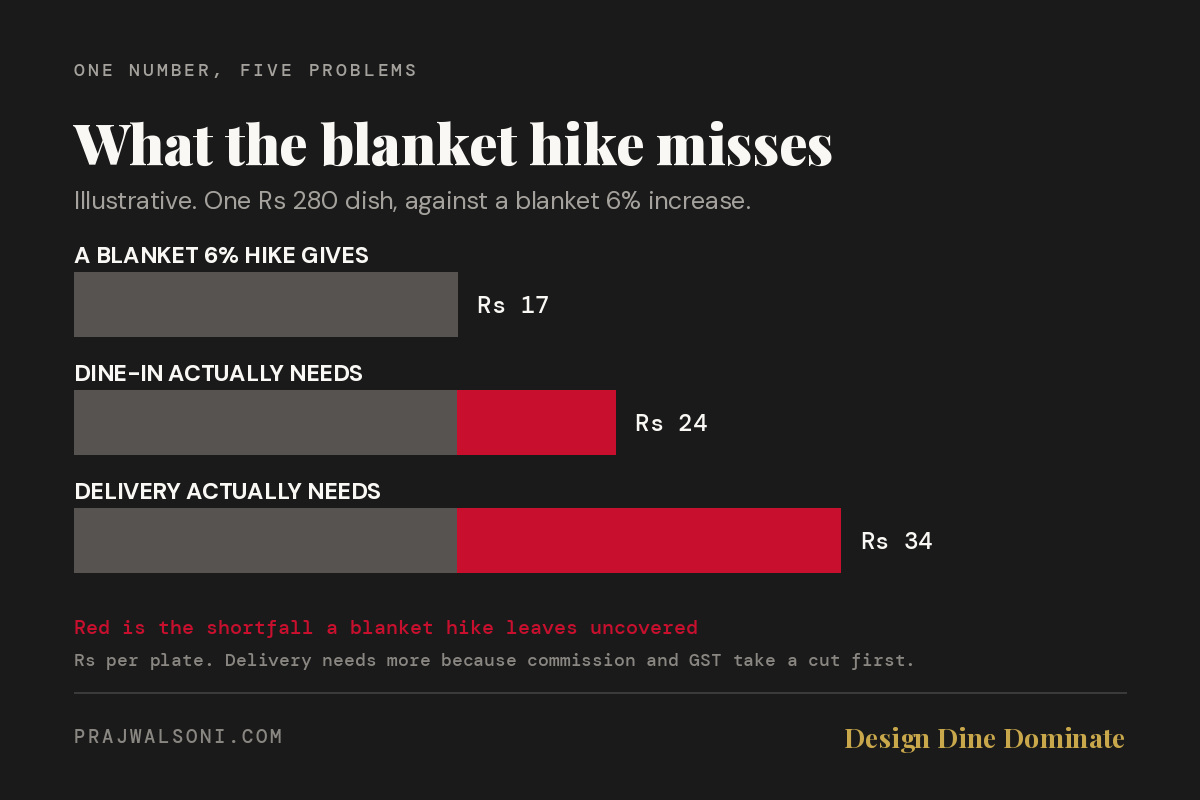
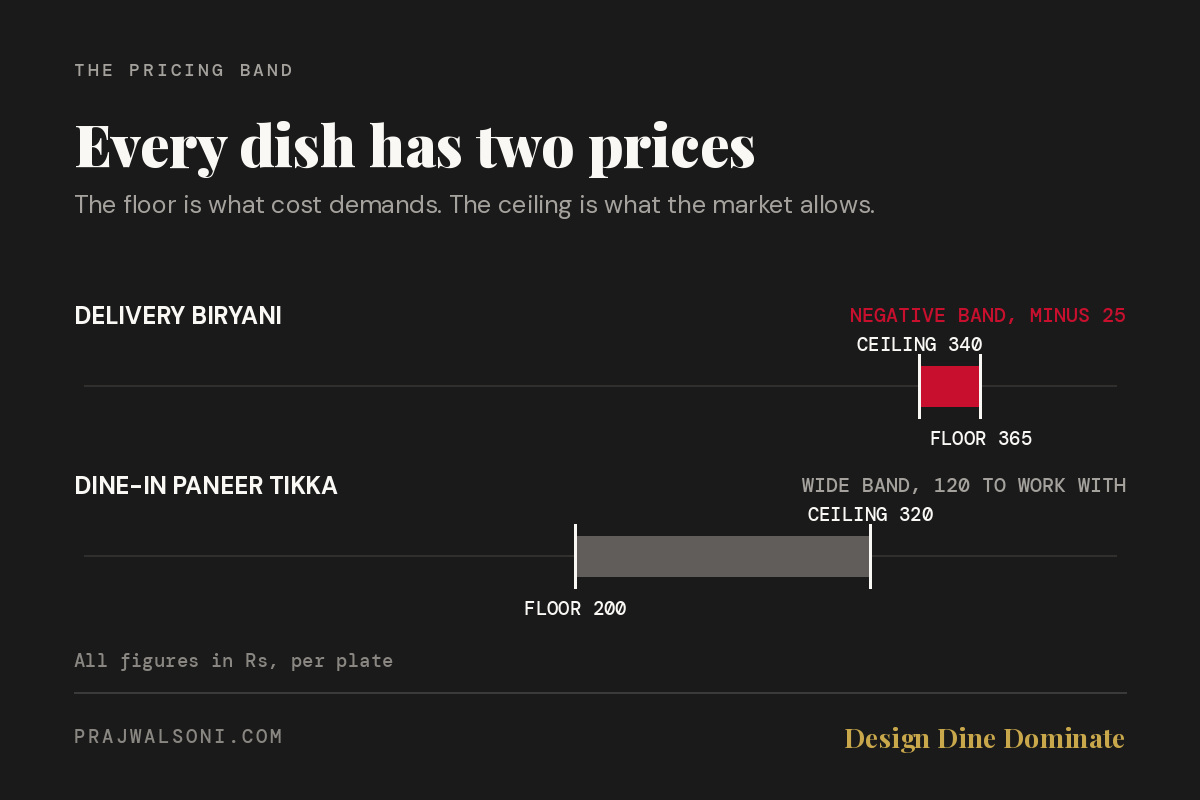
Operators who went all-in on delivery and ignored their dine-in experience have made a costly mistake. Delivery margins are typically thinner because of aggregator commissions, packaging costs, and the inability to sell high-margin beverages. A paneer tikka that earns you Rs 140 in contribution margin on a dine-in table earns you Rs 60-80 on delivery after platform fees and packaging.
The real shift is not from dine-in to delivery. It is from single-channel to multi-channel. The operators winning in 2026 are those who protect their dine-in profitability while also running a tight delivery operation. Cloud kitchens have their place, but they solve a different problem for a different operator profile.
The counter-truth: Dine-in delivers higher margins per ticket than delivery in most formats. Invest in both channels, but do not gut one to feed the other.
Myth 4: You Need to Be on Every Aggregator Platform to Survive
Being on Swiggy, Zomato, and every other platform does not guarantee survival. In fact, spreading yourself across platforms without tracking per-platform profitability often means you are subsidising unprofitable channels with revenue from profitable ones.
I have worked with operators in Bengaluru and Pune who discovered that one platform generated 70% of their delivery orders while the other contributed mostly low-value orders with higher return rates. Once they pulled detailed reports from their POS (Petpooja tracks this well), they realised they were losing Rs 15-20 per order on the weaker platform after accounting for commissions, packaging, and customer complaints.
The smarter approach is to build direct ordering capabilities alongside your aggregator presence. Your own website, your own WhatsApp ordering, your own repeat customer base. Every order you shift from a 25% commission channel to a direct channel adds that 25% straight to your margin. On a Rs 500 order, that is Rs 125 saved.
The counter-truth: Be strategic about which platforms you invest in. Track per-platform unit economics. Build your direct channel in parallel.
Myth 5: A Good Location Fixes Everything
A prime location helps. But it does not fix a broken menu, a weak kitchen, or a team that cannot execute during peak hours. I have seen restaurants on the busiest streets in Ahmedabad close within 18 months because they confused footfall with profitability.
A high-traffic location typically comes with rent in the range of 12-15% of revenue in major Indian cities. If your food cost is already at 35% and your labour sits at 25%, you are at 75% cost before marketing, utilities, or maintenance. One slow month wipes out your reserves. The location brought customers to your door, but the operations could not convert them into profit.
The operators who make prime locations work are the ones who already have tight systems and disciplined operations. They know their break-even cover count. They know their peak-hour capacity. They have trained their team to handle 200 covers on a Saturday without falling apart. The location amplifies what is already working. It does not create something from nothing.
The counter-truth: Location is a multiplier, not a foundation. Fix your operations first, then choose a location that matches your capacity and unit economics.
What Happens When You Stop Believing These Restaurant Industry Myths
When you drop these myths, your decision-making changes immediately. You stop chasing volume for its own sake. You stop bleeding money on discounts that buy you nothing. You invest in your dine-in experience instead of abandoning it. You get selective about platforms. You choose locations based on math, not emotion.
The Indian food services market is growing at 8.1% CAGR according to the NRAI IFSR 2024, projected to reach Rs 7.76 lakh crore by 2028. There is real opportunity here. But that opportunity goes to operators who make decisions based on data and unit economics. Not to those who run their business on inherited assumptions.
The middle class expansion across tier-2 cities means new markets are opening up every quarter. Operators who enter those markets with clear thinking and clean financials will build lasting businesses. Those who enter carrying these five myths will repeat the same expensive mistakes.
Key Takeaway
- Volume only generates profit when your per-unit contribution margin is already healthy. Fix margins before scaling orders.
- Aggregator discounts attract platform-loyal customers, not brand-loyal ones. They leave when the discount ends.
- Dine-in still generates roughly 59% of India’s foodservice revenue and delivers higher per-ticket margins than delivery.
- Being on every platform is not a strategy. Track per-platform profitability and invest in direct ordering channels.
- A great location multiplies good operations. It cannot fix broken ones.
Your Move This Week
Pull your last 30 days of delivery data from Petpooja or whichever POS you use. Calculate your actual contribution margin per order on each platform, after commissions, packaging, and food cost. If any platform shows a contribution margin below Rs 50 per order, you have a problem that volume will never fix. That number tells you which myths you are still operating under.
Then look at your dine-in numbers. Compare your average ticket and contribution margin per cover against delivery. If dine-in is significantly more profitable, ask yourself how much you invested in improving your dine-in experience last quarter versus how much you spent on aggregator promotions. The ratio will tell you everything.
Stop guessing. Start building. Get Design Dine Dominate, the complete restaurant business playbook from someone who has actually done it.

Leave a comment