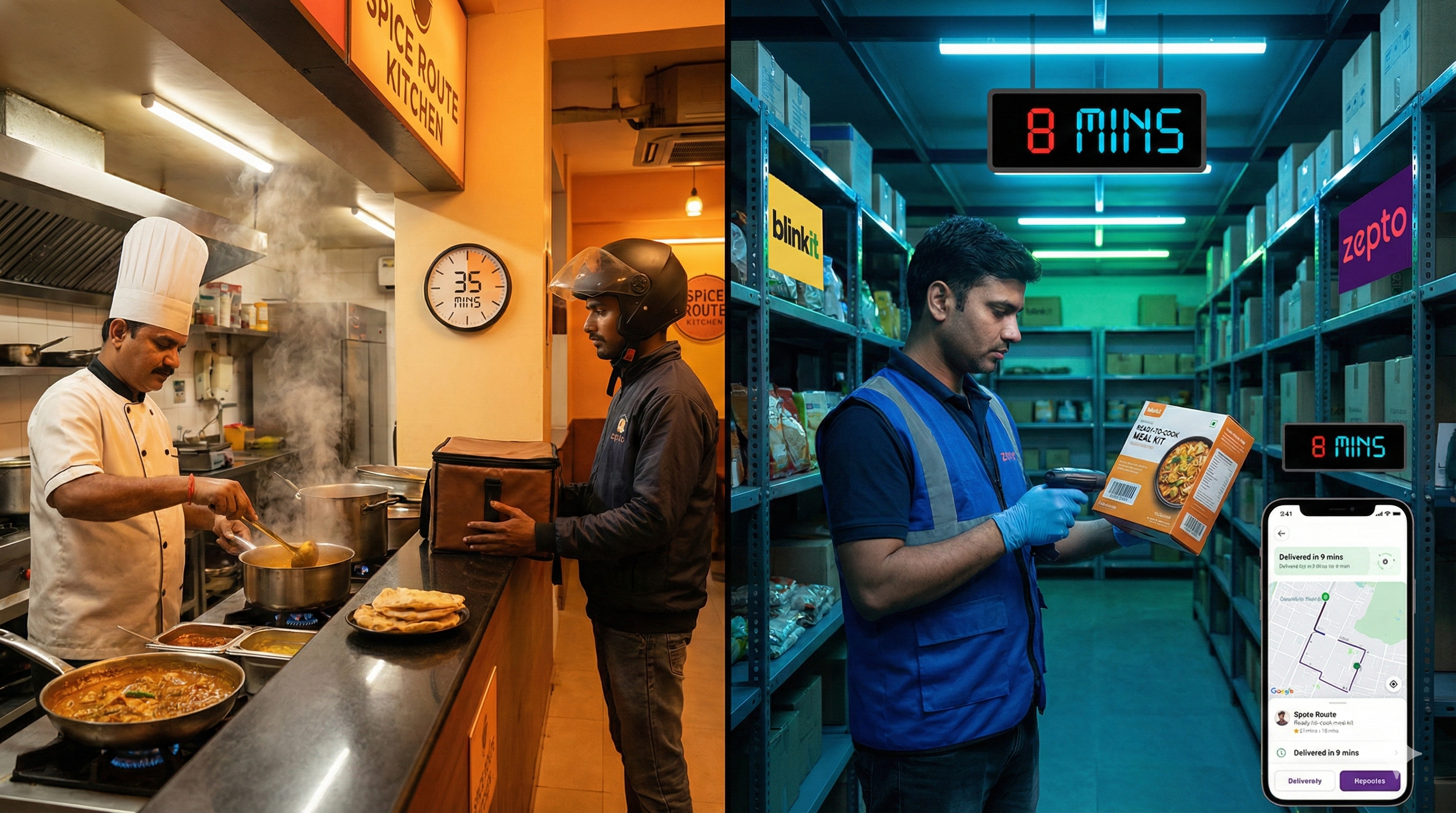
Quick commerce restaurant impact is reshaping India’s food economy. Blinkit, Zepto, and Swiggy Instamart deliver groceries in 10 minutes. Meanwhile, restaurants take 30-45 minutes. Consequently, customer behavior is shifting dramatically. The quick commerce restaurant impact isn’t theoretical. It’s happening now. Therefore, understanding this shift determines which restaurant formats survive the next five years.
Here’s the context: India’s quick commerce market hit $5.5 billion in 2024. Moreover, it’s growing 75% year-over-year. Blinkit alone completes 700,000+ daily orders. Zepto raised $1 billion in funding. Swiggy Instamart operates in 43 cities. In contrast, restaurant delivery growth has slowed to 12% annually.
The gap is widening. Quick commerce is winning the convenience race. As a result, restaurants must adapt or die.
The Quick Commerce Restaurant Impact: What’s Actually Changing
The quick commerce restaurant impact manifests in three specific ways. First, customer expectations are resetting. Second, convenience thresholds are shifting. Third, competition definitions are expanding.
Let me explain each.
Customer Expectations Are Resetting
Previously, 30-minute food delivery felt fast. Now, it feels slow compared to 10-minute grocery delivery. Therefore, restaurants face a perception problem.
However, this isn’t about actual speed needs. Most customers don’t urgently need biryani in 10 minutes. Instead, it’s about the psychological anchoring effect. When Blinkit delivers milk, eggs, and vegetables in 8 minutes, suddenly your 35-minute biryani delivery feels inefficient.
For example, at Straina Foods, we tracked order cancellations. In 2022, 3% of orders were cancelled due to delivery time. By 2024, cancellations hit 7%. The food quality hadn’t changed. Nevertheless, patience had decreased.
The Convenience Threshold is Shifting
Here’s the critical insight: Quick commerce isn’t just faster grocery delivery. It’s redefining what “convenient” means. Consequently, the entire value proposition of restaurant delivery is under pressure.
Consider this scenario: You’re hungry at 8 PM. You have two options.
Option A (Restaurant): Order chicken curry from your favorite restaurant. ₹350 for food. Wait 35-40 minutes. Pay ₹40-60 delivery fee. Total: ₹390-410, 40 minutes.
Option B (Quick Commerce + Home Cooking): Order boneless chicken, curry paste, and rice from Blinkit. ₹250 total. Arrives in 10 minutes. Cook in 15 minutes. Total: ₹250, 25 minutes including cooking.
Moreover, Option B gives you leftover ingredients for tomorrow. Therefore, it’s cheaper and not significantly slower. As a result, some customer segments are shifting away from restaurant delivery entirely.
This isn’t affecting all customers equally. However, for budget-conscious customers who can cook basic meals, quick commerce restaurant impact is directly reducing restaurant orders.
Competition Definition is Expanding
Traditionally, restaurants competed with other restaurants. Your biryani competed with the biryani place next door. Now, your biryani competes with Blinkit’s ready-to-cook biryani kit.
Furthermore, restaurants now compete with cooking. Previously, restaurant delivery competed with home cooking for convenience. Cooking took planning and time. Therefore, restaurants won on spontaneity. Now, quick commerce delivers ingredients instantly. Consequently, the convenience advantage has shrunk.
The quick commerce restaurant impact extends beyond direct competition. In fact, it’s changing how customers think about meal solutions entirely.
Which Restaurant Formats Are Dying (The Vulnerable Four)
The quick commerce restaurant impact isn’t uniform. Some formats are getting killed. Let me identify them.
1. Basic Home-Style Food Restaurants
Dal, roti, simple vegetables, basic curries. These restaurants are most vulnerable to quick commerce restaurant impact. Why? Their food is easily replicable at home. Moreover, customers already know how to cook these dishes.
Previously, the value proposition was convenience. Now, quick commerce enables home cooking with equal convenience. Therefore, these restaurants are losing the only advantage they had.
For example, I consulted for a home-food delivery brand in Pune. Their orders dropped 22% in 2024. Meanwhile, their customer surveys revealed: “Blinkit delivers ingredients so fast, I just cook myself now.”
However, there’s a survival strategy here. I’ll address it later.
2. Mid-Tier, Non-Differentiated Casual Dining
These restaurants lack unique cuisine or strong branding. They serve “everything”, Chinese, North Indian, South Indian, continental. Nothing exceptional. Just acceptable food at ₹300-500 per person.
The quick commerce restaurant impact hits them through price comparison. Consider this: Family of four spending ₹1,600 at a non-differentiated restaurant versus ₹800 on quick commerce ingredients making the same meal at home.
Previously, this segment survived on location convenience and ambiance. Now, ambiance matters less post-pandemic. Moreover, quick commerce has removed the ingredient-sourcing friction. Therefore, these restaurants are hemorrhaging customers.
In fact, I’ve seen three such restaurants close in Bangalore in the last 18 months. Their common refrain? “Customer visits dropped, but we don’t know where they went.”
3. Low-Quality Cloud Kitchens
Cloud kitchens banking purely on aggregator discounts and low prices. No brand. No quality consistency. Just cheap food delivered via Swiggy/Zomato.
The quick commerce restaurant impact here is brutal. Why? These kitchens competed on price. Now, cooking at home with quick commerce ingredients is cheaper. Therefore, the price advantage is gone.
Furthermore, these kitchens have no loyal customers. They attracted deal-seekers. When quick commerce offers better deals on ingredients, these customers vanish. As a result, order volumes collapse.
4. Breakfast and Simple Snack Places
Poha, upma, idli, dosa places that served convenience breakfast. Previously, customers ordered because making fresh breakfast took time. Now, Blinkit delivers instant mixes and ready-to-cook options in 10 minutes.
For instance, instant dosa batter, ready idli batter, MTR breakfast mixes. All available in minutes via quick commerce. Consequently, breakfast delivery orders have declined 15-20% in many markets.
However, this doesn’t apply to specialty breakfast places with unique recipes or strong brand loyalty. Instead, it kills generic, convenient-but-unremarkable breakfast spots.
Which Restaurant Formats Are Thriving (The Survivor Five)
Interestingly, the quick commerce restaurant impact isn’t entirely negative. Some formats are thriving. Let me explain why.
1. Impossible-to-Replicate-at-Home Cuisine
Sushi, dim sum, authentic Thai, Hyderabadi dum biryani, wood-fired pizza. These formats are immune to quick commerce restaurant impact. Why? Customers can’t replicate them even with instant ingredients.
For example, making sushi requires skill, tools, and practice. Similarly, authentic Hyderabadi biryani needs technique that quick commerce ingredients can’t solve. Therefore, these restaurants maintain their moat.
In fact, specialized cuisine restaurants have seen stable or growing demand. The quick commerce restaurant impact doesn’t affect them because they never competed on convenience alone. Instead, they compete on expertise.
2. Experience-Led Dining
Restaurants where ambiance, service, and experience matter as much as food. Rooftop dining. Live music. Themed interiors. Chef interactions.
These restaurants aren’t competing with home cooking. Therefore, quick commerce isn’t their threat. Moreover, post-pandemic, experience dining is rebounding. Customers want socializing and environment. Consequently, these formats are growing.
However, they must execute the experience well. Mediocre ambiance with decent food no longer cuts it. Instead, the experience must justify leaving home.
3. Hyper-Local, Community-Embedded Restaurants
Neighborhood restaurants with loyal, repeat customers. These places know their customers by name. They customize orders. They’re part of the community fabric.
Interestingly, the quick commerce restaurant impact barely touches them. Why? Their customers aren’t ordering for convenience alone. Instead, they’re ordering from relationships and trust. Quick commerce can’t replicate that.
For instance, I know a family restaurant in Rajkot. Same customers for 15 years. Orders haven’t declined despite Blinkit and Zepto entering the market. The reason? Customers view them as “our restaurant,” not just a food provider.
4. Premium, Convenience-Plus Restaurants
High-quality food delivered in 20-25 minutes with exceptional packaging and presentation. These restaurants position convenience as one benefit among many. Not the only benefit.
They compete on food quality that quick commerce ingredients can’t match. Moreover, they offer convenience to customers who value time over money. Busy professionals. Working parents. These customers aren’t cooking even if ingredients arrive in 10 minutes.
Therefore, the quick commerce restaurant impact is minimal on this segment. They operate in a different value tier altogether.
5. Delivery-Optimized Cloud Kitchen Brands
Smart cloud kitchens that understood speed matters. They’ve optimized for sub-20-minute delivery. They operate near demand clusters. They’ve designed menus for speed. Consequently, they’re competitive with quick commerce on delivery time.
Furthermore, these brands invested in strong branding. Customers order from them specifically. Not randomly from aggregator listings. Therefore, they’re sticky despite quick commerce competition.
For example, brands like Faasos, Behrouz Biryani, Oven Story. They deliver fast AND build brand recall. The quick commerce restaurant impact doesn’t kill them because they’ve already optimized for the same customer expectation: speed.
The Strategic Response: What Restaurants Must Do Now
The quick commerce restaurant impact isn’t going away. Therefore, restaurants need strategic adaptation. Here’s how.
Strategy 1: Embrace the 20-Minute Delivery Standard
Accept this reality: 30-40 minute delivery is too slow. Therefore, optimize everything for 20-25 minutes maximum.
This means:
- Location strategy: Be closer to demand (not cheaper rent far away)
- Menu design: Eliminate dishes that take 20+ minutes to prepare
- Kitchen workflow: Optimize for speed without quality compromise
- Order batching: Smart tech to group orders by delivery zone
At Straina Foods, we reduced the average delivery time from 38 minutes to 24 minutes. We achieved this by removing five slow-cooking items and reorganizing kitchen stations. As a result, order volumes stabilized despite quick commerce growth.
Strategy 2: Differentiate on What Quick Commerce Can’t Provide
Ask yourself: Why should customers order from you instead of cooking with quick commerce ingredients?
Your answer must be:
- Recipe complexity customers can’t replicate
- Taste consistency they can’t achieve at home
- Unique cooking techniques (tandoor, wood fire, specialized equipment)
- Secret recipes and marinades
- Brand trust and quality assurance
For instance, if you’re serving basic dal-chawal, you’re vulnerable. However, if you’re serving slow-cooked dal makhani with a specific recipe, you’re defensible. Therefore, menu curation matters more than ever.
Strategy 3: Build Direct Customer Relationships
Stop depending entirely on aggregators. Start building direct customer channels. Why? When quick commerce and restaurants both exist on aggregators, you lose differentiation.
Build direct relationships through:
- WhatsApp ordering with exclusive deals
- Loyalty programs that reward frequency
- Personalization (remembering preferences, customization)
- Community building (local events, regular customer recognition)
Remember: Quick commerce is transactional. Restaurants can be relational. That’s your moat. Use it.
Strategy 4: Partner With Quick Commerce (Surprising But Smart)
Here’s a contrarian strategy: Don’t fight quick commerce. Partner with it.
Several restaurants now supply ready-to-cook meal kits via Blinkit and Zepto. Your biryani masala. Your signature curry base. Your marinated chicken. Packaged for customers to cook at home.
This works because:
- You reach customers who want your taste but prefer cooking
- You monetize your recipes even when they don’t order delivery
- You build brand presence in quick commerce environment
- You create a new revenue stream
For example, I’m consulting with a Bangalore restaurant launching their signature curry kits on Blinkit. Early results show 15% additional revenue with minimal cannibalization of delivery orders.
Strategy 5: Focus on Occasions, Not Convenience
Stop competing on convenience. You’ll lose to quick commerce. Instead, position your restaurant for occasions.
- Weekend family lunch
- Celebration dinners
- Date nights
- Friend gatherings
- Comfort food cravings
These occasions aren’t about speed. Therefore, quick commerce isn’t competition. Consequently, your 30-minute delivery becomes acceptable because it’s not about urgency.
Market accordingly: Stop saying “order now.” Start saying “make your Sunday special” or “celebrate with our biryanis.”
The Bigger Picture: What Quick Commerce Growth Means for Indian Food Economy
The quick commerce restaurant impact is one symptom of a larger shift. India is formalizing and digitizing food consumption rapidly.
Consider these trends:
- Organized retail share in food is growing from 12% to projected 20% by 2027
- D2C food brands are proliferating (sauces, ready-to-cook, instant meals)
- Consumer packaged food is growing 15% annually
- Home cooking equipment sales (air fryers, instant pots) are booming
What does this mean? Eating at home is becoming more convenient and diverse. Not because people love cooking more. But because technology (quick commerce, kitchen appliances, ready-to-cook options) has removed friction from home cooking.
Restaurants that survive will be those offering what home-cooking-plus-technology can’t replicate. Which is:
- Exceptional skill and technique
- Unique experiences and ambiance
- Social and community value
- Time savings for high-value customers
- Taste complexity impossible at home
Everything else becomes vulnerable to the quick commerce restaurant impact.
The 2026 Prediction: Which Formats Will Dominate
Based on current trends, here’s my prediction for restaurant formats in 2026-2027:
Winning Formats:
- Specialty ethnic cuisine (Japanese, Lebanese, regional Indian specialties)
- Premium fast-casual with sub-20-minute delivery
- Experience dining (rooftops, themed, entertainment-integrated)
- Hyperlocal community brands with loyal followings
- Restaurant brands that also sell via quick commerce (hybrid model)
Struggling Formats:
- Generic multi-cuisine casual dining
- Basic home-food delivery without differentiation
- Budget cloud kitchens competing purely on price
- Slow-delivery formats that haven’t optimized speed
- Convenience-only positioning without quality distinction
The reality: Quick commerce isn’t going to replace restaurants. However, it’s raising the bar dramatically. Therefore, mediocrity dies. Excellence survives.
What to Do This Month
If you’re vulnerable to quick commerce restaurant impact, act now. Don’t wait for orders to drop 30% before responding.
Take these actions:
- Audit your menu: Which dishes can customers easily replicate with quick commerce ingredients? Remove or improve them.
- Measure delivery speed: Are you consistently under 25 minutes? If not, identify bottlenecks.
- Survey lost customers: Contact customers who stopped ordering. Ask why. You’ll hear “I cook more now” often.
- Test direct channels: Launch WhatsApp ordering with a small loyalty offer. Build your customer base.
- Explore quick commerce partnership: Can you package and sell meal kits via Blinkit/Zepto?
The quick commerce restaurant impact is permanent. It’s not a temporary trend. Therefore, adaptation is mandatory. Not optional.
The good news? Restaurants that adapt have a massive advantage. You have brand, recipes, kitchen infrastructure, and customer relationships. Quick commerce has speed. Combine them strategically, and you win.
The quick commerce restaurant impact is simultaneously a threat and an opportunity. Which one it becomes depends entirely on how you respond.
Stop guessing. Start building. Get Design Dine Dominate, the complete restaurant business playbook from someone who’s actually done it.


Leave a comment