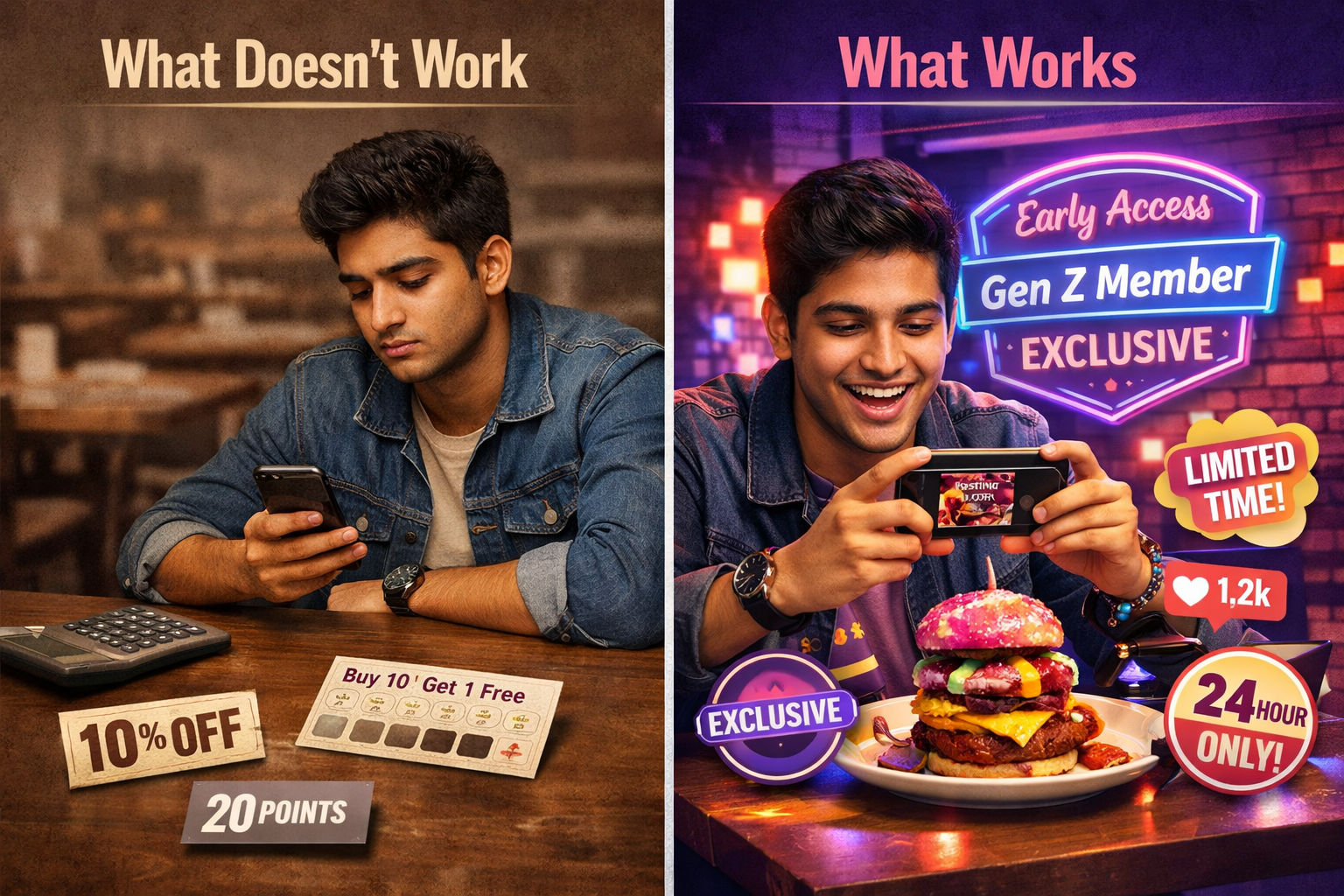
Gen Z loyalty programs restaurants need a complete redesign. Traditional loyalty programs don’t work for India’s 250 million Gen Z consumers. Therefore, restaurants using “collect points, get discount” models are wasting money. In fact, Gen Z actively avoids these programs. Moreover, they want something entirely different. Understanding Gen Z loyalty programs restaurants strategies determines which brands dominate 2026-2030.
Here’s the context: Gen Z (born 1997-2012) became India’s largest consumer demographic in 2024. Furthermore, they control ₹3.2 lakh crore in spending power. However, their behavior fundamentally differs from millennials and Gen X. Consequently, restaurants using old loyalty playbooks are losing this massive market.
The gap is widening. Therefore, adaptation isn’t optional anymore.
Why Traditional Loyalty Programs Die With Gen Z
Gen Z loyalty programs restaurants fail because of three fundamental mismatches. Let me explain each.
Points Feel Like Math Homework
Traditional model: Spend ₹100, earn 10 points. Collect 500 points, get ₹50 off. Simple, right?
Wrong. Gen Z finds this tedious. Why? They’ve grown up with instant gratification. Netflix plays next episode automatically. Instagram refreshes endlessly. Swiggy delivers in 30 minutes. Therefore, waiting to collect 500 points over 10 visits feels archaic.
Moreover, the value proposition is weak. ₹50 off after spending ₹5,000? That’s 1% cashback. Meanwhile, UPI apps give 2-3% cashback instantly. Consequently, Gen Z sees restaurant points programs as worse deals than payment apps.
For example, I consulted for a Bangalore cafe targeting Gen Z. They had a classic “buy 10 coffees, get 1 free” card. However, only 12% of Gen Z customers even picked up the loyalty card. When surveyed, the response was consistent: “Too much effort for basic discount.”
Discounts Signal Low Value
Here’s the uncomfortable truth: Gen Z equates heavy discounting with low quality. Unlike millennials who hunt for deals, Gen Z is willing to pay full price for things they value. However, they define value differently.
They value:
- Unique experiences
- Social shareability
- Brand authenticity
- Exclusive access
- Community belonging
They don’t value:
- Generic discounts
- Accumulated points
- Plastic loyalty cards
- Complex tier systems
Therefore, when your loyalty program’s main benefit is “save 10%,” Gen Z interprets it as “our food isn’t worth full price.” This is brand damage, not loyalty building.
Digital-First Means App-Free
Paradoxically, Gen Z is digital-first but app-resistant. They don’t want to download your restaurant’s loyalty app. Why? Their phones already have 40+ apps. Moreover, they’re protective of phone storage and notification sanity.
Instead, they prefer:
- WhatsApp integration
- Instagram-based engagement
- QR code instant access
- Phone number-based loyalty (no app, no card)
For example, a Mumbai restaurant launched an elaborate loyalty app. Cost them ₹3 lakhs to develop. However, Gen Z download rate was 4%. Meanwhile, their Instagram follower engagement was 12x higher. The lesson? Meet Gen Z where they already are. Don’t force them to come to you.
What Gen Z Actually Wants From Restaurant Loyalty Programs
Gen Z loyalty programs restaurants need four core elements. Each one differs fundamentally from traditional approaches. Let me break them down.
1. Experiences Over Transactions
Gen Z will choose a memorable experience over a 20% discount. Every time. Therefore, design loyalty programs around experiences, not savings.
What works:
- Early access to new menu items: “Gen Z members taste our new burger 48 hours before public launch”
- Behind-the-scenes experiences: Kitchen tours, meet-the-chef sessions, recipe reveals
- Exclusive events: Members-only tasting nights, cooking workshops, themed parties
- Limited-edition items: Menu items available only to loyalty members, for limited time
Real example: A Bangalore cafe I worked with created “Secret Menu Saturday.” Only loyalty members got access via Instagram DM. Items changed weekly. Result? 340% increase in Gen Z loyalty signups in 3 months. Moreover, members spent 60% more than non-members because exclusive items were premium priced.
The psychology: Gen Z values the story they can tell friends. “I tried the secret burger only 100 people know about” beats “I saved ₹50 with my loyalty points.”
2. Social Currency Over Financial Savings
Gen Z measures value in Instagram stories and social proof. Therefore, make your loyalty program Instagram-worthy.
What works:
- Shareable moments: Unique plating, Instagram walls, exclusive loyalty member badges
- Status signaling: Visible membership benefits (special seating area, unique menu holder, member-only merchandise)
- User-generated content rewards: Post about us with #MemberMonday, get exclusive perks
- Challenge-based engagement: “Complete our spice challenge, get featured on our wall of fame”
3. Immediacy and Simplicity
Gen Z loyalty programs restaurants must deliver value immediately. Not after 10 visits. Immediately.
What works:
- Instant welcome reward: Sign up, get free dessert TODAY (not after next visit)
- Simple earn mechanism: Order once = 1 unlock. No points calculation needed
- Fast redemption: Use rewards same day you earn them
- Clear progress: “2 more orders to unlock exclusive item” (visual progress bar)
Real implementation: A Pune cloud kitchen switched from points (complex) to “levels” (simple). Every order unlocks benefits. Order 1: Free drink upgrade. Order 3: Early access to Friday specials. Order 5: Exclusive menu item. Order 10: Personalized dish creation with chef.
Result? Gen Z redemption rate jumped from 8% to 47%. Why? Clear, immediate, no math required.
4. Community and Belonging
Gen Z craves authentic communities. Therefore, loyalty programs that build community outperform transactional ones.
What works:
- WhatsApp member groups: Exclusive community where members interact, share experiences, get insider info
- Co-creation opportunities: Members vote on new menu items, suggest recipes, name dishes
- Member recognition: Spotlight “member of the month” on social media
- Values alignment: Sustainability initiatives, local sourcing—show what you stand for
For instance, a Bangalore restaurant created a WhatsApp group for their Gen Z loyalty members. Initially, it was just for exclusive offers. However, members started discussing food trends, sharing restaurant recommendations (including competitors!), organizing meetups. The restaurant let it happen organically. Result? 80% retention rate among Gen Z members versus 25% for older demographics. Moreover, these members became brand advocates, bringing friends.
The Gen Z Loyalty Program Blueprint (What Actually Works in India)
Based on managing restaurants across India, here’s what Gen Z loyalty programs restaurants should implement. This framework balances experience and economics.
Tier 1: Instant Gratification (No Barrier Entry)
First order = instant reward. Gen Z won’t join loyalty programs “eventually.” Either you hook them immediately, or you lose them.
Implementation:
- Sign up via QR code scan (no app download, no forms, just phone number)
- Instant reward: Free drink upgrade, exclusive menu preview, or 10% off today
- Welcome via WhatsApp with personalized message
- Set expectations: “As a member, you get first access to our weekly secret menu drops”
Cost: Minimal (₹30-50 per signup reward). Lifetime value: Gen Z customers retained through loyalty programs spend 3x more annually.
Tier 2: Experience Unlocks (Gamified Progress)
Replace points with achievement-based unlocks. Make it feel like leveling up in a game.
Implementation:
- Level 1 (1 order): Exclusive Discord/WhatsApp access
- Level 2 (3 orders): Early access to new launches (48 hours before public)
- Level 3 (5 orders): Secret menu unlocked (items not on public menu)
- Level 4 (10 orders): Create-your-own dish session with chef
- Level 5 (20 orders): VIP status—permanent perks, special seating, member merchandise
Visibility: Show progress via Instagram story updates (“Congrats! You’re Level 3 now!”) that members can reshare.
Tier 3: Social Integration (Shareable by Design)
Every loyalty benefit should have shareability built in. Not as an afterthought. As the core feature.
Implementation:
- Unique member dishes with Instagram-worthy presentation
- Member-only events worth posting about
- Physical loyalty items that signal status (cool cards, merchandise, member badges)
- Encourage tagging with rewards (post your meal with #MemberExclusive, unlock bonus)
For example, create a “Member Wall” in your restaurant. Members who complete challenges get their photo on the wall. Gen Z loves this. It’s both achievement validation and social proof.
Tier 4: Community Activation (Belonging Over Benefits)
The ultimate goal: Gen Z members identify with your brand. They say “I’m a [Your Brand] member” with pride.
Implementation:
- Member-only WhatsApp community (but don’t over-message; let organic discussion happen)
- Quarterly member meetups (food tastings, chef sessions, social gatherings)
- Co-creation: Let members vote on limited-edition items, name new dishes, suggest improvements
- Values-driven initiatives: Sustainability programs, local partnerships—involve members
Real case: A Chennai restaurant involved Gen Z members in their zero-waste initiative. Members helped design eco-friendly packaging. They voted on local farmers to partner with. Result? These members became unpaid brand ambassadors. Moreover, they brought friends organically because they felt ownership.
What Not to Do (Common Gen Z Loyalty Mistakes)
Gen Z loyalty programs restaurants often make these fatal errors. Avoid them.
Mistake 1: Copying Starbucks Blindly
Starbucks works in the US. However, Indian Gen Z behaves differently. Don’t assume global playbooks translate directly. Instead, test and adapt locally.
Mistake 2: Over-Gamification
Some restaurants add so many tiers, badges, challenges that it becomes complex. Gen Z wants simple. Therefore, 3-5 levels maximum. Clear benefits. Easy understanding.
Mistake 3: Discount Dependency
If your loyalty program is just accumulated discounts, you’re training Gen Z to wait for deals. Instead, offer value they can’t get elsewhere, experiences, access, exclusivity.
Mistake 4: Ignoring Mobile-First
Your loyalty program must work flawlessly on mobile. No downloads required. QR code scan, WhatsApp integration, Instagram-based access. If it requires an app download, 70% of Gen Z won’t join.
Mistake 5: Broadcasting, Not Engaging
Don’t just send promotional messages. Instead, create two-way engagement. Ask opinions. Run polls. Let Gen Z contribute. They want to be heard, not marketed at.
The Economics: Does This Actually Drive Profit?
Gen Z loyalty programs restaurants must be financially viable. Here’s the math.
Traditional program costs:
- Discount expense: 10% off on loyal customers who’d pay full price = margin loss
- Points liability: Accounting for unredeemed points
- Tech cost: App development, maintenance (₹2-5 lakhs annually)
Experience-based program costs:
- Exclusive items: Higher food cost but premium pricing (net positive)
- Events: ₹10,000-30,000 per quarterly event
- WhatsApp community management: Staff time (2-3 hours weekly)
Revenue impact:
- Frequency: Gen Z members visit 2-3x more frequently (experience unlocks drive visits)
- Spend: 40-60% higher average order value (exclusive premium items)
- Retention: 60-80% annual retention versus 20-30% without loyalty
- Acquisition: Organic referrals reduce customer acquisition cost by 30-40%
Real numbers from Bangalore cafe case:
- Traditional discount program: ₹3 lakh annual cost, 15% redemption rate, 25% retention
- Experience-based program: ₹2.2 lakh annual cost, 45% redemption rate, 68% retention
Therefore, experience programs cost less and perform better. The reason? You’re not subsidizing purchases. You’re creating value.
By 2027, Gen Z will control 40% of India’s dining-out spending. That’s ₹2+ lakh crore in annual restaurant revenue. Therefore, restaurants that crack Gen Z loyalty now will dominate the next decade.
However, this isn’t just about Gen Z. Their preferences are reshaping expectations across demographics. Millennials are adopting Gen Z behaviors. Even Gen X is influenced by their kids’ preferences. Consequently, experience-based, community-driven loyalty is becoming universal.
The restaurants winning in 2026 aren’t those with the best points systems. Instead, they’re the ones building communities, creating shareable experiences, and making customers feel special, not just saving them money.
Gen Z killed traditional loyalty programs. Good riddance. What they demand instead (authenticity, experiences, belonging) is what restaurants should have been offering all along.


Leave a comment